
Avatar Kling AI´s video Sample
Kling AI is a cutting-edge text-to-video and image-to-video generation platform developed by Kuaishou Technology, one of China’s leading interactive media and short video companies.
Kling AI Review 2026: Introduction
It was first launched in June 2024 and has rapidly evolved through several enhanced models — including Kling 2.0, Kling 2.6, and the latest unified Kling 3.0 series that integrates multiple creative workflows.
Unlike many early video AI tools that only produce short, silent loops or basic animations, Kling AI is built to generate cinematic-style clips with synchronized audio, multi-shot sequencing, and advanced motion reasoning. It supports text prompts, static image inputs, and even multi-reference generation, offering creators a versatile tool for fast visual storytelling and social content.
In this review, we’ll explore what Kling AI offers, how it works in 2026, who should use it, real use case scenarios, limitations to consider, workflow tips, pricing breakdowns, and how it stacks up against some of the leading competitors.
What Kling AI Video Tool Does Best
Kling AI’s standout strength is its native integration of video, sound, and cinematic motion from a few lines of text or a static reference image. Its latest Kling 3.0 model family delivers up to 15-second videos with multi-shot camera sequencing, lip-synchronized dialogue in multiple languages, and automatic audio effects all generated in a single pass.
This unified workflow eliminates the traditional separation between video generation and post-production sound editing, which is a major advantage for creators who need quick yet engaging clips ready for social sharing or ad placements.
Kling AI also supports multiple aspect ratios like 9:16 for TikTok/Reels, 16:9 for YouTube, and 1:1 for Instagram, making it adaptable to today’s platform diversity without extra resizing steps.

Kling AI Key Features Explained
Text-to-Video Generation
At its core, Kling AI transforms natural language prompts into moving images. You describe the scene, action, mood, and even camera behavior, and the AI constructs a video that aligns with that narrative. Latest versions support 15-second continuous clips with dynamic pacing and scene sequencing generated directly from text.
Image-to-Video and Multi-Reference Inputs
Beyond text, creators can upload images as starting points. Kling 3.0’s multi-reference mode can handle multiple reference visuals — maintaining subject consistency across shots while applying motion, camera angles, and environmental transformation.
Native Audio and Lip-Sync
A real differentiator is Kling AI’s integrated audio pipeline. Dialogue, ambient sound, sound effects, and music are automatically embedded in the video generation process — including lip synchronization for characters and avatars in multiple languages.
Intelligent Camera and Storyboard Control
Kling 3.0 includes an “AI Director”-style capability for smart camera scheduling — where the model chooses effective cuts, angles, and shot orders to build a structured, storyboard-like output without manual editing.
Multi-Language Support
Many versions of Kling now support English, Chinese, Japanese, Korean, and Spanish dialogue output, enabling broader use for global creators rather than being limited to the Chinese market.
Kling AI Pros and Cons
Pros
• High-quality video with native audio generation – Integrated sound and visuals save hours of editing.
• Cinematic motion and multi-shot sequencing – Outputs feel more polished than many early AI models.
• Flexible input options – Supports text, image, and multi-reference workflows.
• Multiple aspect ratios for modern platforms – Adaptable outputs for Reels, Shorts, and feeds.
• Multi-language dialogue and voice support – Useful for localized content and global campaigns.
Cons
• Limited video duration – Even the powerful Kling 3.0 family currently maxes out around 15 seconds, which may be too short for some narratives or storytelling styles.
• Inconsistent output quality reported by users – Some creators experience off-model faces, artifacts, or motion glitches in complex scenes.
• Server reliability and load issues – Heavy usage or free quota attempts can fail or queue for extended time.
• Censorship and prompt filtering – Strict content moderation can block certain realistic or sensitive prompts, frustrating creators seeking broader creative freedom.
• Support and ecosystem gaps – Users report mixed experiences with customer support response and issue resolution.
Who Should Use This Tool
Kling AI is designed for speed, visual impact, and short-form efficiency. It performs best in environments where quick turnaround and engaging visuals matter more than deep cinematic control.
Kling AI is best suited for:
• Social media content creators aiming to produce eye-catching short clips that capture attention quickly on platforms like TikTok, Instagram Reels, and YouTube Shorts.
• Marketers and advertisers who need fast ad creatives with integrated audio, allowing them to test multiple angles, hooks, and messages without lengthy production cycles.
• Prototype storytellers and concept demonstrators who want to bring ideas to life in motion without hiring a production crew or managing complex editing software.
• Localization teams creating short multilingual content for different markets, where rapid adaptation and variation are essential.
It is not ideal for:
• Long-form storytelling or documentary production, where narrative structure, continuity, and in-depth development are critical.
• Detailed cinematic editing workflows that require precise control over pacing, transitions, layered sound design, and advanced post-production techniques.
• Creators who need high-resolution, extended clips beyond 15 seconds, especially for broadcast-level or large-scale commercial use.
In short, Kling AI excels at fast, short, and visually compelling content. It is a strong tool for rapid creation and testing, but it is best used within the limits of its short-form design.
Kling AI Pricing, Plans and Limitations
Pricing for Kling AI varies depending on the platform offering it — from free beta access with limited daily credits to paid subscription tiers providing higher quotas and advanced features. Some third-party hosts list plans roughly around:
• Free plan: Limited usage and credits for basic testing.
• Standard plan (~$79.20/yr): Moderate credit limits, watermark removal, faster generation.
• Pro plan (~$293/yr): More generous credit allocation, priority access.
• Premier (~$728.64/yr): Highest credit limits and premium content tools.
Limitations often include usage caps, credit burn per generation, and limited export length. Creators with high-volume needs may find plans pricey compared with Western offerings, yet competitive in markets focused on short-form content.
Kling AI Real Use Case Examples
Social Hooks & Short Reels
Creators can generate captivating 10–15 second videos with synchronized sound, ideal for hooks on platforms like TikTok, Reels, and Douyin. These clips can showcase brand highlights or quick storytelling moments.
Example prompt: “A bustling neon city street at dusk with a narrative caption, cinematic camera dolly shot, ambient sound and soft background score.” This results in a polished, engaging social reel.
Product Quick Ads
Kling AI’s native audio and motion understanding make it suitable for rapid product ads that feel more dynamic than static slides or voiceovers. Simply describe the object, action, and mood to see a promotional clip.
Example workflow: Craft 3 variations of the same product prompt to test which theme performs best across audiences.
Concept Visual Drafting
Storytellers or advertisers who need early stage visual drafts can use Kling AI to generate concept sequences without hiring cinematographers or editors, enabling creative experimentation with motion and style early in production cycles.
Workflow Tips for Consistency
Consistency with Kling AI is less about luck and more about structure. Because the platform is optimized for short-form generation, your workflow needs to match that rhythm. The more intentional your preparation, the more reliable your outputs become.
Break scripts into short actionable prompts:
Since Kling performs best within a 15-second window, avoid feeding it long narrative blocks. Instead, break your script into compact, visually clear segments.
Focus each prompt on:
- One main action
- One emotional tone
- One camera movement
- One core message
If your concept is 45 seconds long, divide it into three distinct 15-second scenes. This not only improves generation quality but also gives you modular clips you can rearrange later.
Think in scenes, not scripts.
Reference images before text prompts:
Uploading a reference image significantly improves visual stability. It helps anchor:
- Character appearance
- Brand colors
- Product details
- Scene composition
- Lighting style
When you rely on text alone, visual interpretation may vary more between generations. An image acts like a visual compass — it narrows ambiguity and increases coherence.
If consistency matters, anchor first, describe second.
Test multiple variations:
Small wording adjustments can dramatically change camera behavior, pacing, and motion intensity.
Try:
- Swapping adjectives (cinematic vs. energetic)
- Adjusting movement instructions (slow pan vs. dynamic tracking shot)
- Modifying emotional tone (inspiring vs. urgent)
- Changing time-of-day or lighting descriptions
Generate at least three versions of the same idea before choosing one. Selection is part of the creative process. The best results often come from comparison, not first attempts.
Iteration is not inefficiency — it is refinement.
Use platform aspect ratio presets:
Choose the correct format before generating: vertical (9:16), square (1:1), or horizontal (16:9).
This prevents:
- Cropping important visual elements
- Manual resizing after export
- Composition imbalance
- Wasted regeneration time
Matching the final platform format from the start (TikTok, Reels, YouTube Shorts, or standard horizontal ads) keeps your workflow cleaner and more professional.
Format discipline saves editing time later.
Audit generation results before publishing:
Never publish the first output blindly. Review each clip for:
- Visual artifacts
- Motion inconsistencies
- Audio glitches
- Text alignment issues
- Brand mismatches
Minor imperfections can often be fixed with a quick regeneration or light external editing. A simple review pass dramatically increases perceived production quality.
The difference between amateur and professional use of AI tools is not the tool itself — it is the review process.
When structured correctly, Kling AI becomes predictable and efficient. Clear segmentation, visual anchoring, variation testing, correct formatting, and quality control turn short-form generation into a repeatable system rather than a guessing game.
Contribution to the Broader AI Ecosystem
Kling AI exemplifies China’s rapidly accelerating presence in the generative video arena, rivaling Western systems like Sora and Google Veo while highlighting distinct regional moderation policies and platform strategies.
Its emergence signals several broader shifts within the global AI landscape.
First, it reinforces that generative video innovation is no longer concentrated in one geographic region. For years, much of the attention in AI media tools focused on U.S.-based labs and companies. Kling AI demonstrates that high-level research, model scaling, and commercial deployment are now truly multipolar. Competition is no longer local — it is global.
Second, Kling AI reflects a different approach to platform integration and distribution. Chinese AI platforms often move quickly from research release to consumer-facing deployment, embedding tools directly into social ecosystems and mobile-first environments. This tight integration accelerates user adoption and real-world testing, allowing rapid iteration at scale.
Third, Kling AI highlights how regional moderation frameworks shape AI capabilities. Content policies, data governance rules, and compliance standards differ significantly between regions. As a result, generative outputs, accessibility, and feature sets may evolve differently across markets. This creates a fragmented but dynamic ecosystem where innovation pathways are influenced not only by technical ambition, but also by regulatory structure.
Fourth, its development contributes to competitive pressure that drives overall quality improvements across the industry. When multiple major players — from China, the United States, and beyond — push model performance in realism, motion consistency, and audio integration, the entire field advances faster. Each breakthrough forces others to refine their architectures, training data, and user experience.
Finally, Kling AI represents the broader democratization of video production. As generative tools mature across regions, barriers to visual storytelling continue to decline. Independent creators, small businesses, and marketing teams gain access to capabilities that previously required large production budgets and specialized crews.
In this sense, Kling AI is more than a single platform. It is part of a larger competitive wave redefining who can create video, how quickly they can create it, and how global the innovation race has become.
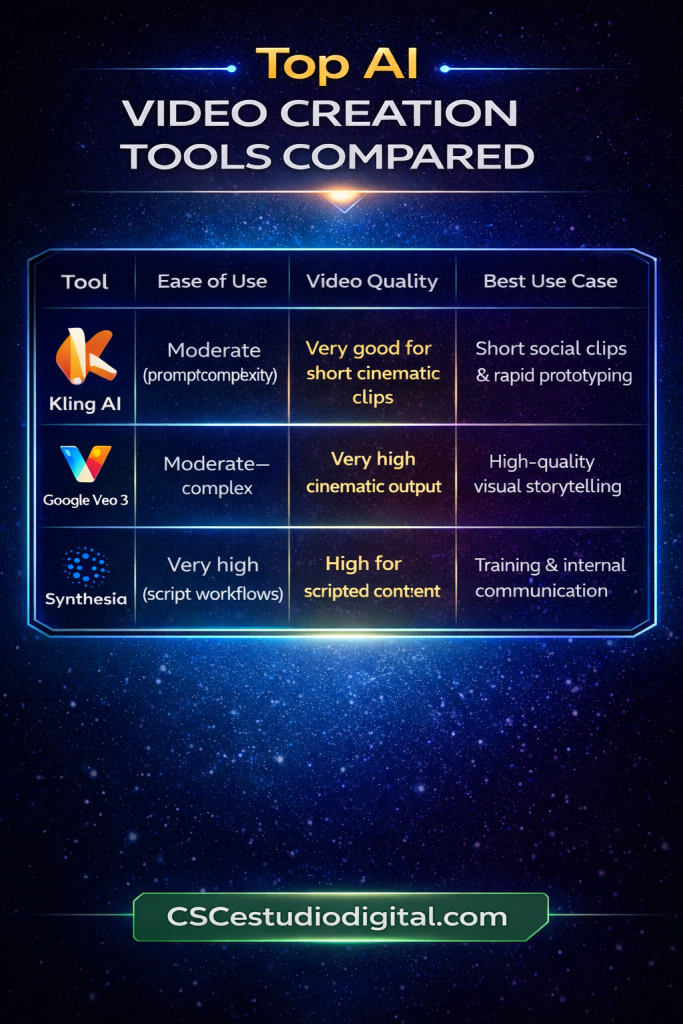
Comparison: Top 3 AI Video Creation Tools
| Tool | Ease of Use | Video Quality | Best Use Case |
|---|---|---|---|
| Kling AI | Moderate (prompt complexity) | Very good for short cinematic clips | Short social clips & rapid prototyping |
| Google Veo 3 | Moderate–complex | Very high cinematic output | High-quality visual storytelling |
| Synthesia | Very high (script workflows) | High for corporate scripted content | Training & internal communication |
Final Verdict
Kling AI has evolved far beyond being a novelty text-to-video generator. In its current state, it feels like a product built for speed-first creators who care about visual impact more than granular control. The platform’s ability to generate cinematic-style clips with synchronized motion, atmosphere, and native audio inside a single workflow dramatically reduces production friction. For social creators and performance marketers, that reduction in friction is not a small benefit — it’s the difference between publishing daily and publishing occasionally.
One of Kling AI’s strongest advantages is its unified multimodal generation. Instead of stitching together visuals in one tool, voice in another, and sound design in a third, Kling allows creators to conceptualize and render cohesive short-form videos within one environment. This streamlining is especially valuable in vertical formats where speed, volume, and trend responsiveness matter more than frame-perfect precision. When you’re producing high-frequency content for Shorts, Reels, or TikTok, execution speed often beats perfection.
However, Kling AI is not without limitations. Consistency across multiple outputs can still be unpredictable, particularly when trying to maintain character continuity or replicate exact stylistic tones over a series of videos. For creators building narrative-driven channels or branded series content, this inconsistency may require additional testing and prompt refinement. In other words, Kling performs best when each clip stands on its own rather than when it must fit into a tightly controlled visual universe.
Moderation constraints also remain a practical consideration. As with many generative platforms in 2026, content filters can restrict certain themes, visual directions, or stylistic elements. While this may not affect mainstream marketing content, creators operating in more experimental or edgy niches may encounter friction.
The credit-based pricing model is another factor that influences long-term scalability. For hobbyists or occasional creators, the cost structure may feel manageable. But for high-volume publishing systems, credit consumption can scale quickly. This makes workflow optimization essential. Teams that pre-plan scripts and test lower-resolution drafts before final renders will extract significantly more value from the platform than those generating content impulsively.
Despite these challenges, Kling AI stands out in the 2026 generative video landscape because it solves a real bottleneck: time. It allows creators to move from concept to publish-ready clip faster than most traditional editing pipelines. For marketers testing ad creatives, social media managers responding to trends, or entrepreneurs building faceless content brands, that speed translates directly into competitive advantage.
In short, Kling AI is not a perfect cinematic production studio replacement. It is something more practical: a high-velocity content engine. For social creatives and digital marketers who prioritize agility, built-in audio cohesion, and visually compelling short-form output, Kling AI remains a serious contender — and in many cases, a strategic asset rather than just another AI tool.
The Future of AI Video Creation
Learn How to Create AI Video Fast an Easy,
If you want a step-by-step guide to create AI videos fast — without learning 50 complicated tools — download the free PDF below and simplify your entire workflow.
Download the free guide:
How to Create AI Videos FAST Without Learning 50 Complicated Tools