AI for Video Creation: How Businesses Are Automating Visual Content in 2026
Video has become the most powerful form of digital communication, but for many businesses, producing consistent, high-quality video content has always been expensive, time-consuming, and technically demanding. That reality is changing fast. Artificial intelligence is reshaping how companies create, scale, and automate visual content, allowing even small teams to produce professional videos at a level that once required full production crews.
AI for video creation is no longer an experimental trend. It is now a core operational advantage for brands that want to move faster, reduce costs, and stay visible in an attention-driven economy.
This article explores how businesses are using AI to automate video creation, the real use cases driving adoption, the benefits and limitations, and what this shift means for the future of digital marketing and content operations.
Why Video Automation Has Become a Business Priority
Businesses today are expected to publish video across multiple platforms at once: websites, YouTube, social media feeds, ads, landing pages, and internal communications. Traditional video production cannot keep up with that demand.
AI solves three critical problems at scale.
First, it removes production bottlenecks. Instead of scripting, filming, editing, revising, and exporting manually, AI systems can generate videos directly from text, data, or templates. This dramatically shortens production cycles.
Second, it lowers costs. AI replaces or reduces the need for cameras, actors, voice talent, editors, and production software licenses. Businesses can reallocate budgets toward strategy and distribution instead of execution.
Third, it enables consistency. AI tools allow companies to maintain a uniform visual identity, tone, and pacing across hundreds or thousands of videos without variation caused by human error or creative fatigue.
Automation is not replacing creativity. It is removing friction.

How AI for Video Creation Actually Works in Business Environments
AI video creation platforms typically combine several technologies into one workflow.
Text-to-video systems convert scripts, articles, or prompts into visual sequences using stock footage, animations, or generated visuals. Natural language processing interprets meaning and structure to align scenes with context.
AI voice synthesis produces narration in multiple languages and tones without recording sessions. Many businesses use this for training, onboarding, and explainer videos.
Avatar-based systems generate realistic or stylized presenters that can deliver scripted messages on camera without filming. These are widely used in corporate communications, product demos, and educational content.
Automated editing engines handle pacing, transitions, subtitles, formatting, and aspect ratios for different platforms. One input can become dozens of outputs.
The result is an end-to-end system where video production becomes repeatable, predictable, and scalable.
Core Business Use Cases Driving AI Video Adoption
AI video creation is not limited to marketing departments. Its impact spans multiple areas of business operations.
Marketing and Advertising
Marketing teams use AI to generate promotional videos, social media ads, product highlights, and retargeting creatives at scale. Campaigns that once required weeks can now be launched in days or hours.
AI enables rapid A/B testing by producing multiple versions of the same message with different hooks, visuals, or lengths. This allows data, not guesswork, to drive creative decisions.
Sales and Product Communication
Sales teams use AI videos for personalized outreach, product explainers, and follow-up messages. Instead of generic emails, prospects receive visual explanations tailored to their stage in the funnel.
Product teams create feature updates, walkthroughs, and release announcements without waiting for production resources. This keeps customers informed and engaged continuously.
Training, Onboarding, and Internal Communication
HR and operations teams rely heavily on AI video creation for training materials. Policies, procedures, and onboarding modules can be updated quickly without re-filming.
AI avatars and voiceovers ensure consistent delivery of sensitive or regulated information while reducing dependency on specific individuals.
Customer Support and Education
Businesses use AI to produce tutorial videos, FAQs, and troubleshooting guides. These videos reduce support tickets by answering common questions visually and clearly.
Because AI videos are easy to update, support content stays current even as products evolve.
The Business Advantages of Automating AI for Video Creation
The appeal of AI video creation is not just speed. It is strategic leverage.
Automation allows businesses to publish more content without increasing headcount. It enables experimentation without risk. It reduces dependency on external agencies and freelancers.
Most importantly, it aligns video production with business systems rather than creative bottlenecks. Video becomes an operational asset, not a creative luxury.
Companies that adopt AI video tools early gain an advantage in reach, responsiveness, and adaptability. Those that delay often struggle to keep up with competitors producing content at ten times the volume.
Common Misconceptions About AI for Video Creation in Business
One of the biggest misconceptions is that AI video content feels robotic or low quality. In reality, poorly executed AI video feels robotic. Well-designed systems produce clean, professional output that audiences accept as normal.
Another misconception is that automation eliminates authenticity. Businesses that rely on AI as a tool rather than a shortcut still define messaging, values, and strategy at a human level. AI simply executes faster.
There is also a belief that AI video is only for large enterprises. In practice, small businesses benefit the most because AI removes barriers that previously favored companies with large budgets.
AI for Video Creation: Limitations and Risks Businesses Must Manage
AI video creation is powerful, but it is not a set-and-forget solution.
Over-automation without strategy leads to generic content. Businesses must still define audience, purpose, and outcomes.
Legal and ethical considerations matter. Usage rights, disclosure requirements, and brand safety must be addressed, especially when using avatars or synthetic voices.
Quality control is essential. Automation increases output, but without review processes, errors can scale just as quickly.
The companies that succeed with AI video treat it as an operational system, not a content gimmick.
The Future of Business Video Is Modular and Automated
As AI video creation tools continue to evolve, businesses will move toward modular content systems. A single idea will generate dozens of assets across platforms, languages, and formats automatically.
Video will no longer be produced project by project. It will be generated continuously based on data, performance feedback, and business objectives.
This shift changes how brands compete. Visibility becomes less about production capacity and more about clarity of message and distribution strategy.
Businesses that build AI-driven video systems today are not just saving time. They are building long-term digital infrastructure.
AI for Video Creation: Why a Structured Guide Makes the Difference
For businesses exploring AI video creation, the biggest challenge is not technology. It is decision overload.
There are dozens of tools, platforms, and workflows available. Without a clear framework, companies waste time testing randomly and never fully implement a system that produces results.
A focused guide helps businesses understand which tools matter, how to combine them, and how to avoid common mistakes that slow adoption. It turns experimentation into execution.
That clarity is often what separates businesses that automate successfully from those that abandon AI after initial frustration.
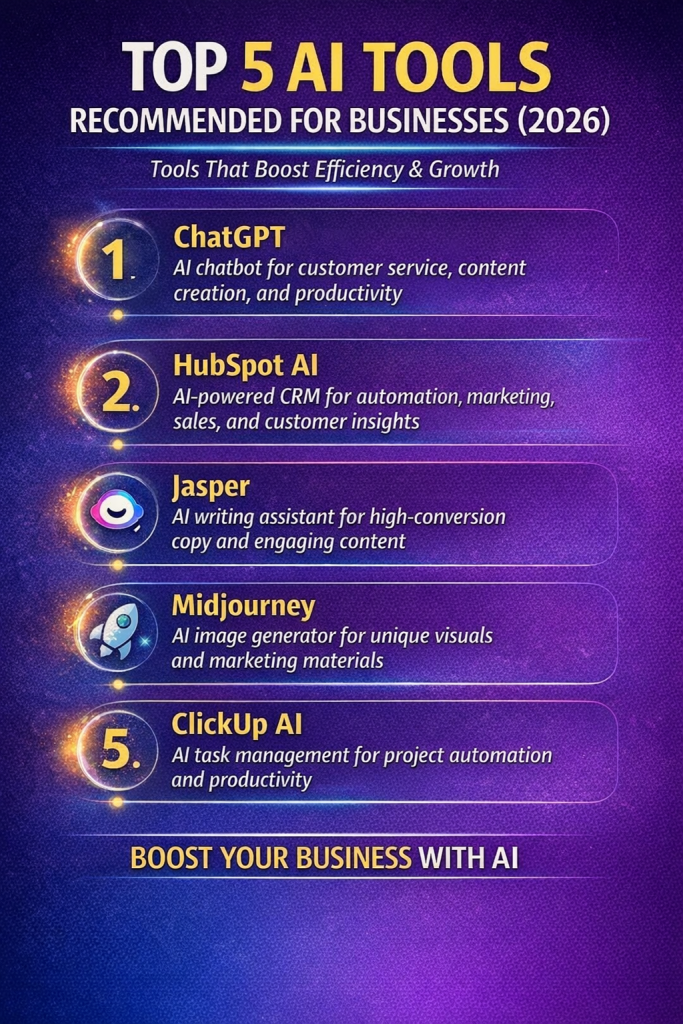
AI for Video Creation: Top AI Tools Recommended for Businesses (2026)
1. ChatGPT (OpenAI)
Category: AI Text & Conversational
Use Cases: Customer support automation, content generation, email drafting, idea brainstorming, chatbots, knowledge bases
Why It’s Recommended: Extremely versatile, integrates with many platforms, scales from small business to enterprise
2. Jasper AI
Category: AI Copywriting
Use Cases: Blog posts, ad copy, landing pages, SEO content, social captions
Why It’s Recommended: Customer-focused content generation with templates, tone control, and brand voice customization
3. Canva AI
Category: AI Design & Video
Use Cases: Social graphics, branded videos, presentations, short ads
Why It’s Recommended: Easy for non-designers, tons of templates, excellent cross-platform output
4. Pictory
Category: AI Video Creation
Use Cases: Turn scripts or blogs into videos, automated captioning, repurposing content
Why It’s Recommended: Fast video creation without editing skills; ideal for small teams
5. Synthesia
Category: AI Video with Avatars
Use Cases: Corporate training, explainer videos, multilingual voiceovers
Why It’s Recommended: Realistic AI presenters without filming; great for internal comms & education
6. Descript
Category: Audio & Video Editing AI
Use Cases: Pod editing, transcriptions, overdubs, video cuts
Why It’s Recommended: Text-based video/audio editing makes production fast and accessible
7. Runway
Category: AI Video Tools
Use Cases: Background removal, motion graphics, creative AI effects
Why It’s Recommended: Blends professional visuals with generative AI power
8. Lumen5
Category: AI Video Marketing
Use Cases: Social promo videos from articles, summaries
Why It’s Recommended: Converts written content to videos easily with templates
9. Midjourney
Category: AI Image Generation
Use Cases: Visual branding, concept art, product graphics
Why It’s Recommended: High-quality artistic visuals for marketing and ads
10. Adobe Firefly
Category: AI Creative Suite
Use Cases: Images, video effects, text-to-image, pattern creation
Why It’s Recommended: Enterprise-level creative support from a trusted brand
11. HubSpot AI
Category: CRM + Marketing Automation
Use Cases: Lead scoring, email automation, chat flows
Why It’s Recommended: Built for business workflows and sales expansion
12. MarketMuse
Category: SEO AI
Use Cases: Keyword strategy, content briefs, topic modeling
Why It’s Recommended: Helps content rank faster with strategic insight
13. Zapier AI
Category: Workflow Automation
Use Cases: Automate actions across apps, triggers with AI input
Why It’s Recommended: Scales business operations without custom code
14. Google Veo 3
Category: Advanced AI Video Creation
Use Cases: Cinematic video, character scenes, AI storytelling
Why It’s Recommended: Professional-grade visuals without traditional production
15. Synthesys
Category: AI Voice & Avatar Generation
Use Cases: Voiceovers, training videos, narrated ads
Why It’s Recommended: Realistic voices and avatars for professional outreach
16. Chatbot Builders (ManyChat, Chatfuel)
Category: AI Chat & Messaging
Use Cases: Facebook Messenger, WhatsApp automation, customer funnels
Why It’s Recommended: Boosts retention and lead capture automation
17. SurferSEO / Frase
Category: AI SEO + Content Optimization
Use Cases: On-page optimization, briefs, SERP analysis
Why It’s Recommended: Aligns AI content with search intent and rankings
18. VidIQ / TubeBuddy
Category: YouTube AI Tools
Use Cases: Tags, titles, analytics, rank optimization
Why It’s Recommended: Essential for growing video channels strategically
19. Otter.ai
Category: Transcription & Meeting AI
Use Cases: Meeting transcripts, searchable docs, captions
Why It’s Recommended: Speeds up documentation and accessibility
20. Notion AI
Category: Productivity + Knowledge
Use Cases: Notes, SOPs, knowledge base summaries
Why It’s Recommended: Combines workspace and AI insights for teams
AI for Video Creation: Business AI Tools by Category
Video & Visual Creation
- Pictory
- Synthesia
- Runway
- Lumen5
- Google Veo 3
- Descript
Content & Copy
- Jasper AI
- ChatGPT
- Notion AI
- MarketMuse
- SurferSEO
Automation & Workflow
- HubSpot AI
- Zapier AI
- ManyChat / Chatfuel
Marketing & SEO
- Canva AI
- VidIQ / TubeBuddy
- Frase
- Otter.ai
AI for Video Creation: How Businesses Use These Tools
AI video creation has become an operational asset across multiple industries. Companies are no longer using these tools as experimental add-ons. They are embedding them directly into their marketing, sales, education, and growth systems. The value is not just lower production cost, but increased speed, testing capacity, and scalability.
Below are the most common and impactful ways businesses are leveraging AI video tools today.
Marketing Teams: Automating Social Production and Campaign Assets
Modern marketing departments operate under constant pressure to produce more content across more platforms. AI video tools allow them to generate social media clips, paid ad creatives, retargeting variations, and promotional content at scale without overwhelming internal teams.
Instead of producing a single campaign video, marketers can quickly create multiple variations tailored to different audiences, hooks, and offers. This increases testing capacity and improves performance optimization. AI becomes a force multiplier, not a replacement for strategy.
Small Businesses: Producing Content Without Agencies
For small businesses, traditional video production has often been financially out of reach. Hiring agencies, renting equipment, and coordinating shoots requires resources that many entrepreneurs simply do not have. AI removes that barrier.
With structured prompts and simple workflows, business owners can create brand videos, service explainers, social posts, and promotional materials internally. This reduces dependency on external providers while maintaining consistent output. The result is greater control and faster execution.
E-Commerce Brands: Generating Product Videos and Ads
E-commerce companies depend heavily on visual content to drive conversions. AI video tools allow brands to generate product demonstrations, feature highlights, user-style testimonials, and short-form ad creatives without organizing physical shoots.
This is particularly powerful when launching new products or testing offers. Instead of waiting for full production cycles, brands can deploy video variations quickly, analyze performance data, and iterate based on real results. Speed becomes a competitive advantage.
Educational Platforms: Scaling Tutorials and Onboarding
Online education platforms and course creators use AI video tools to transform written material into structured video lessons efficiently. Updating modules no longer requires re-recording entire sessions. Content can be revised and regenerated with far less friction.
This flexibility allows educational businesses to maintain relevance, improve clarity, and scale their content libraries faster. AI helps convert static information into engaging visual instruction without expanding production teams.
Sales Teams: Personalized Outreach and Explainer Content
Sales departments are increasingly integrating AI-generated video into outreach and client communication. Instead of sending static emails or generic presentations, teams can create personalized video messages, product walkthroughs, and tailored explainers.
This approach increases engagement and improves clarity during the sales process. AI makes personalization scalable, allowing teams to maintain a human touch without manually producing each asset from scratch.
Across these use cases, the pattern is clear. AI video creation is not just about saving time. It is about enabling businesses to operate with greater agility, test more ideas, and communicate more effectively in competitive markets.
Strategic Tip
Don’t choose tools based on “cool factor.”
Choose tools based on output quality, workflow integration, and repeatable results tied to your business goals.
AI for Video Creation: Final Thoughts
AI for video creation has moved from being a competitive advantage to becoming an operational necessity. Any business that depends on digital visibility, audience attention, or online conversions can no longer treat video as an occasional asset. It is now a core communication layer, and AI is rapidly becoming the infrastructure behind it.
The shift is not about replacing teams or removing creative direction. It is about removing friction. Automation handles repetition, formatting, variation testing, and production speed. Human input remains essential for positioning, messaging, storytelling, and strategic alignment. When both elements work together, output increases without sacrificing quality.
What truly changes is scalability.
Businesses that integrate AI video into their workflows can respond faster to trends, launch campaigns more frequently, test creative angles in real time, and maintain consistent brand presence across multiple platforms. Instead of slowing down due to production bottlenecks, they operate with flexibility and momentum.
In a content-driven economy, visibility compounds. The companies that publish consistently, iterate intelligently, and optimize continuously build stronger brand authority over time. AI makes that level of consistency sustainable.
Organizations that learn to integrate these systems today are not simply adopting a tool. They are redesigning how communication, marketing, and growth operate inside their business. And in an environment where speed and adaptability determine relevance, that structural advantage makes all the difference.
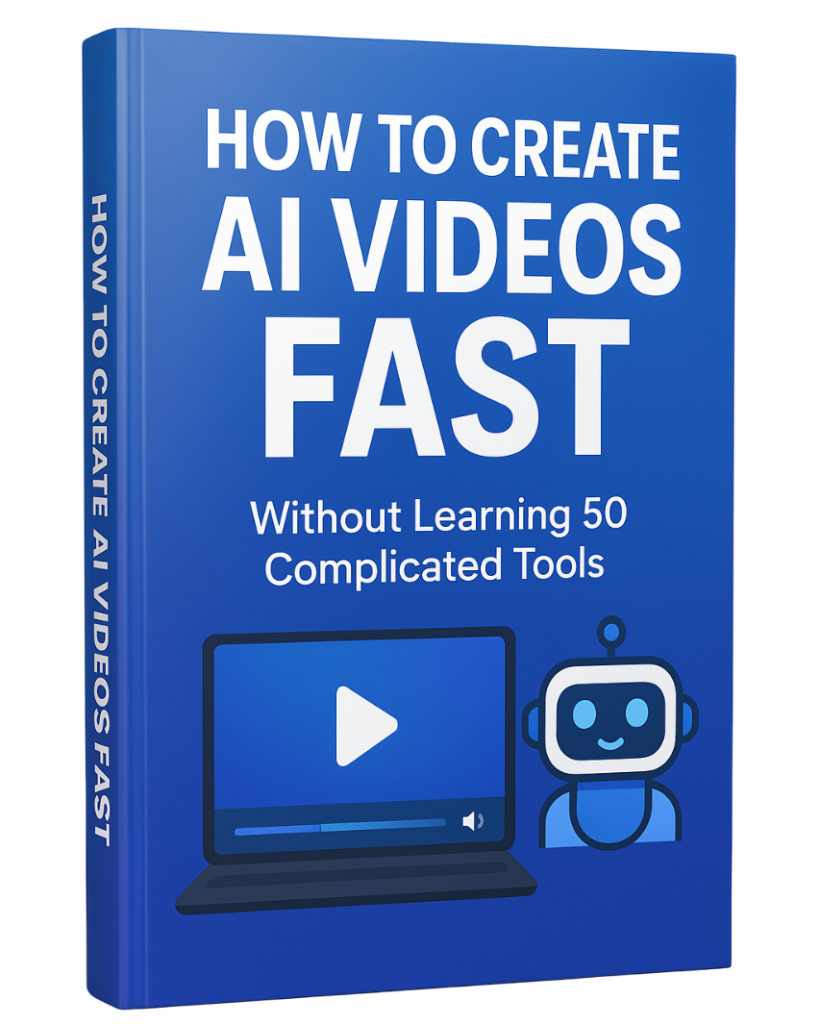
Learn How to Create AI Video Fast an Easy,
If you want a step-by-step guide to create AI videos fast — without learning 50 complicated tools — download the free PDF below and simplify your entire workflow.
Download the free guide:
How to Create AI Videos FAST Without Learning 50 Complicated Tools