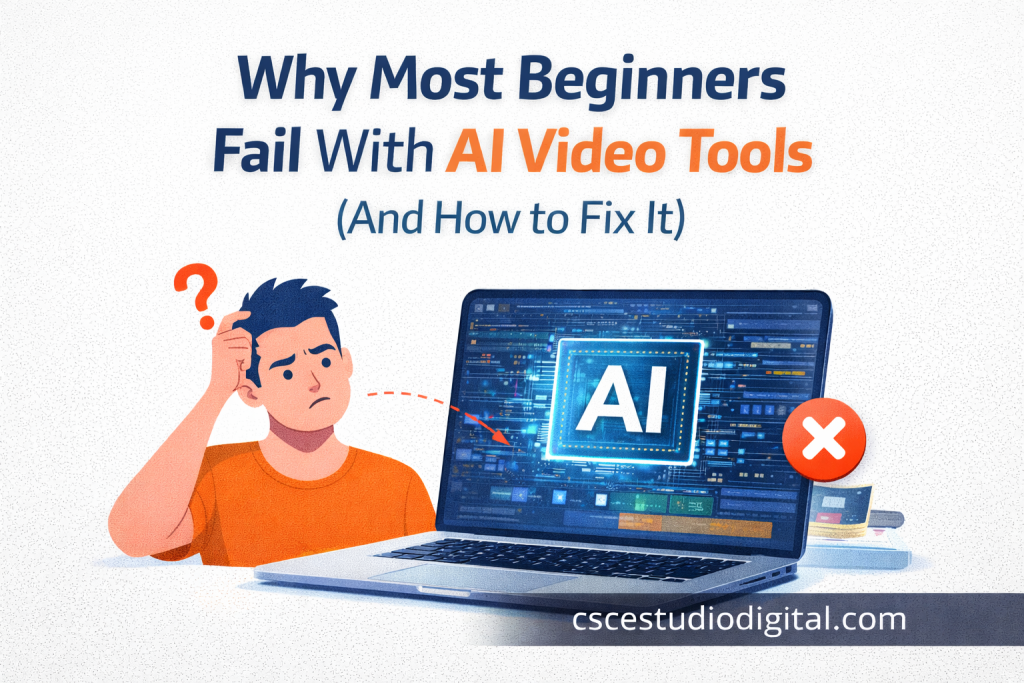
Why Most Beginners Fail With AI Video Tools (And How to Fix It)
AI video tools promise speed, automation, and professional results. Yet many beginners try them once, feel disappointed, and abandon them. The problem is rarely the technology. It’s the approach.
The most common mistake beginners make is expecting AI to do all the thinking. AI video tools are assistants, not strategists. When users input vague prompts, unclear scripts, or unfocused ideas, the output reflects that confusion.
Clarity is the foundation of effective AI video creation. Before opening any tool, beginners should answer three questions: Who is this video for? What problem does it solve? What action should the viewer take next? Without these answers, even the best AI tools will produce generic content.
Another frequent issue is overloading videos with features. Beginners often use too many animations, transitions, avatars, and effects. This creates visual noise and reduces credibility. Simpler videos tend to perform better, especially in marketing contexts.
AI tools work best when they enhance a clean structure. A strong hook, a clear message, and a focused call to action matter more than visual complexity. AI should support the message, not compete with it.

Many beginners also underestimate the importance of audio. Poor voiceovers, robotic pacing, or mismatched tone can instantly reduce trust. Choosing natural-sounding AI voices and adjusting speed and emphasis makes a significant difference.
Another hidden issue is inconsistency. Beginners jump from one AI platform to another, never mastering any of them. This leads to fragmented workflows and frustration. Sticking to one tool long enough to understand its strengths creates better results than constantly switching.
Testing is another overlooked element. Beginners often publish one video and judge the tool based on that single result. Successful creators test variations: different hooks, formats, lengths, and styles. AI makes testing easier, but only if it’s used intentionally.
The solution is not more tools, but better process. Start small. Create short videos. Focus on one platform. Measure performance. Improve gradually.
AI video tools reward clarity, patience, and strategy. Those who fail often expect shortcuts. Those who succeed treat AI as a multiplier, not a replacement for thinking.
AI video tools promise something incredible: fast, cheap, and easy content creation. Yet most beginners who try them end up frustrated, confused, and disappointed. They expect instant success but instead get low-quality videos, poor engagement, and almost no real results.
The truth is simple. AI video tools are powerful, but they are not magic. Like any professional tool, they require the right approach. Understanding why most beginners fail is the first step to fixing the problem.
Unrealistic Expectations Are the First Problem
The biggest reason beginners fail with AI video tools is unrealistic expectations. Many new users believe that AI will automatically create perfect videos with no effort at all. They imagine clicking one button and watching money roll in.
This mindset is dangerous.
The Expectation Gap
The first major issue beginners face is unrealistic expectations. Many assume AI video tools function like magic machines. Type a few words, press generate, and instantly receive viral-ready content.
In reality, AI tools amplify clarity. They do not replace it. If a beginner has no clear niche, no defined audience, and no structured message, the output will reflect that confusion. The video may look polished on the surface, but it lacks direction and purpose.
AI does not fix weak ideas. It scales strong ones.
Beginners often skip foundational steps like audience research or positioning. They rely on the tool to create the strategy. When views do not come immediately, frustration builds quickly.
The expectation that AI removes the need for thinking is the first trap
AI can generate content quickly, but it still needs direction, structure, and human judgment. Beginners often expect professional results without learning the basics of storytelling, marketing, or video production. When the results are not amazing immediately, they assume the tool is broken.
The real issue is not the AI. The issue is the expectation.
Mistaking Tools for Strategy
AI video platforms are production tools. They are not business models.
Many beginners believe that simply using AI automatically creates opportunity. They generate random motivational videos, trending topic summaries, or generic list-style clips without understanding how monetization connects to the content.
The result is scattered output. There is no funnel. No consistent theme. No clear value proposition.
A successful content operation requires alignment between content and outcome. That means asking deeper questions before generating anything:
Who is this video for?
What problem does it solve?
What action should the viewer take?
How does this connect to monetization?
Without those answers, AI becomes noise generation at scale. The tool works. The strategy fails.
Treating AI Like a Magic Button
Another common mistake is treating AI video platforms like automatic money machines. Beginners type a few random sentences, generate a video, and hope it goes viral.
That rarely works.
AI tools follow instructions. If the instructions are weak, unclear, or poorly structured, the output will also be weak. Many beginners do not spend enough time learning how to write good prompts, plan content, or define clear goals.
AI amplifies effort. It does not replace it.
Lack of a Real Strategy
Most beginners jump into AI video creation without any strategy at all. They create random videos on random topics with no clear audience in mind.
This approach almost always fails.
Successful AI video creation requires:
- A defined niche
- A target audience
- Clear goals
- Consistent themes
- A long-term plan
Without these elements, even the best AI tools will produce content that goes nowhere.
Weak Content Foundations
Even with AI assistance, strong content requires structure.
Storytelling fundamentals still matter. A clear hook, tension, progression, and resolution are essential. Viewers decide within seconds whether to stay or scroll.
Many beginners generate videos that lack narrative clarity. The message feels flat. The pacing feels rushed or repetitive. There is no emotional arc.
AI can assist with scripting, but it cannot automatically infuse emotional intelligence or deep audience understanding. That still depends on human direction.
When beginners skip learning storytelling principles, AI becomes a shortcut that leads nowhere.
Poor Prompting Skills
AI video platforms rely heavily on prompts. The quality of your input directly controls the quality of the output. Beginners often write vague, confusing, or overly simple prompts such as:
“Make a video about business”
“Create a motivational video”
“Generate something cool”
These instructions are far too broad.
Good prompts include:
Specific topics, Clear tone, Target audience, Video length, Style preferences.
Learning how to prompt AI correctly is one of the most important skills beginners must develop.
A Smarter Approach to AI Video
If you are starting with AI video tools, consider a structured path. Begin with audience clarity. Define a niche problem you understand well. Develop a repeatable format. Consistency builds recognition.
Use AI for efficiency, but inject human perspective. Add insights, examples, or framing that reflect your understanding of the topic.
Test variations strategically, not randomly. Compare hooks, lengths, and calls to action within a defined theme. Connect every video to a monetization pathway, even if revenue comes later. This transforms AI video from experimentation into infrastructure.
Overreliance on Automation
Automation feels empowering, especially to beginners who are excited by efficiency. However, overreliance on automation often leads to generic content that blends into the background.
AI-generated scripts, stock visuals, and synthetic voiceovers can produce acceptable results quickly. But acceptable is not memorable.
When every creator uses similar prompts, similar templates, and similar workflows, the output becomes predictable. Audiences sense repetition. Engagement drops.
This does not mean automation is bad. It means automation without differentiation is weak.
Beginners rarely invest time refining tone, adding unique perspectives, or building a distinct voice. They assume speed equals advantage. In reality, speed without originality creates saturation.
Ignoring the Human Element
Many beginners assume AI can replace creativity and human judgment. That is a serious mistake.
AI can generate visuals and scripts, but it cannot fully understand what your audience truly needs. Beginners who rely 100 percent on automation often produce robotic, boring, or generic content.
The best results come from combining AI efficiency with human creativity.
Choosing the Wrong Tools
Not all AI video tools are the same. Beginners often choose platforms randomly without understanding what each tool is designed for.
- Some tools are great for short social clips.
- Others are better for long-form content.
- Some focus on animation.
- Others specialize in realistic visuals.
Using the wrong tool for the wrong job leads to frustration and poor results. Learning which AI platform fits your specific goal is essential.
Skipping the Learning Phase
Many beginners refuse to invest time in learning how AI video systems actually work. They want results immediately without studying tutorials, guides, or best practices.
This impatience almost guarantees failure.
Ignoring the Learning Curve
AI video tools are marketed as beginner-friendly. That is partially true. Interfaces are often simple, and basic videos can be produced quickly. However, mastery still requires experimentation. Prompt engineering, pacing adjustments, voice modulation, scene sequencing, and storytelling flow all influence output quality.
Beginners often quit too early. They generate a few average videos, see limited traction, and conclude the platform does not work. In most cases, the issue is shallow usage.
AI tools reward iteration. Strong outputs rarely come from first drafts. They come from refining prompts, testing variations, and adjusting creative direction. Those who treat AI as a skill to develop succeed. Those who treat it as instant automation struggle.
Like any new technology, AI video tools have a learning curve. Beginners who take time to experiment, practice, and improve their workflow always outperform those looking for shortcuts.
Inconsistent Effort
Another major reason beginners fail is lack of consistency. They create a few AI videos, see little traction, and quit too soon. Success with AI video creation rarely happens overnight.
It requires:
Regular publishing
Testing different formats
Improving over time
Building an audience gradually
Beginners who treat AI video as a quick experiment instead of a long-term process usually give up before results appear.
Emotional Burnout
Ironically, automation can create burnout. When beginners believe AI should produce fast results, every underperforming video feels like failure. The speed of production increases expectations. When growth does not match effort, motivation declines.
Content creation still requires patience. Algorithms reward consistency over time. Audience trust builds gradually. AI reduces workload, but it does not eliminate the psychological component of entrepreneurship. Resilience remains essential.
Poor Content Quality Control
AI can generate scripts, images, and voices, but it can also make mistakes. Beginners often publish AI-generated videos without reviewing or editing them.
The Volume Without Direction Problem
One of AI’s biggest advantages is the ability to produce content at scale. But scale without structure creates chaos. Beginners sometimes generate dozens of videos across unrelated topics. They chase trends, jump between niches, and experiment randomly without tracking performance.
Volume feels productive. But productivity without metrics is illusion.
Successful creators use volume strategically. They test specific hooks within a defined niche. They track click-through rates, retention curves, and conversion behavior. They refine based on data.
Beginners often upload and move on. They rarely analyze deeply. AI increases output capacity. It does not replace analytical thinking. Quality control is essential. AI should be a starting point, not the final product.
No Understanding of Platforms
Different platforms require different types of videos. Beginners often upload the same AI-generated content everywhere without adapting it.
A video that works on TikTok may fail on YouTube.
A long educational video may not work on Instagram Reels.
Understanding platform requirements and audience behavior is critical for success.
What Successful Beginners Do Differently
The difference between those who quit and those who build momentum is rarely talent. It is mindset and structure. Successful beginners treat AI video tools as part of a broader system. They focus on one niche. They define a target audience clearly. They refine prompts continuously. They track analytics and adjust accordingly.
They understand that AI amplifies consistency. Instead of asking, “Why is this not viral?” they ask, “What can I improve in the next iteration?” This shift changes everything.
Expecting Immediate Monetization
Many beginners start using AI video tools with only one goal: making money fast. When income does not appear instantly, they assume AI does not work.
Realistically, building profitable channels or businesses with AI video creation takes time, testing, and patience. Beginners who focus only on quick profits usually lose motivation quickly.
Monetization Confusion
Another common failure point is misunderstanding how revenue connects to content. Beginners often assume that uploading AI-generated videos to platforms will automatically produce ad income. They underestimate the thresholds required for monetization and overestimate how quickly audience growth happens.
Effective monetization requires intentional design. That may include:
- Affiliate links integrated naturally into scripts
- Lead magnets connected to video topics
- Email funnels for follow-up engagement
- Digital products aligned with niche problems
Without a monetization framework, AI content becomes passive exposure rather than active income generation. AI accelerates production. It does not automatically generate revenue.

How to Fix These Problems step by step:
Now that we understand why beginners fail, the solution becomes clear.
1. Start With Clear Goals
Before creating any AI video, ask yourself:
- Who is this video for?
- What problem does it solve?
- What platform is it for?
- What action should viewers take?
Defining these answers prevents random, unfocused content.
Learn to Write Better Prompts
Spend time mastering prompt writing.
A strong AI video prompt includes:
- Topic
- Audience
- Tone
- Style
- Length
- Format
The more detailed your instructions, the better the result.
Use AI as a Tool, Not a Boss
Let AI handle repetitive tasks, but keep control over:
- Ideas
- Story structure
- Final edits
- Brand voice
The human element should always guide the process.
Build a Repeatable Workflow
Create a system instead of working randomly.
For example:
- Research topic
- Write script with AI
- Edit script
- Generate visuals
- Add voiceover
- Review and improve
- Publish
Having a structured workflow dramatically improves results.
Choose the Right Platform
Research different AI video tools and pick the one that matches your goals.
Beginners should focus on tools that are:
- Easy to use
- Reliable
- Well supported
- Designed for their content type
Using the correct platform eliminates many frustrations.
Focus on One Niche First
Instead of creating random videos, beginners should choose one clear niche and stick to it.
This makes it easier to:
- Build an audience
- Improve quality
- Understand what works
- Grow consistently
Be Patient and Consistent
The most successful AI video creators are not the smartest or luckiest. They are simply the most consistent. Commit to publishing regularly and improving step by step.
Final Thoughts
Most beginners fail with AI video tools not because the technology is bad, but because their approach is wrong.
- They expect magic instead of learning.
- They rush instead of planning.
- They automate instead of thinking.
AI video tools are incredibly powerful when used correctly. With realistic expectations, good strategy, and steady effort, anyone can achieve impressive results.
Most beginners fail with AI video tools because they misunderstand what the technology actually provides. AI offers leverage, not guarantees. It accelerates output, not success. It amplifies clarity, not confusion.
Those who approach AI video with strategic intent, patience, and a willingness to iterate will build advantages quickly. Those who expect automation to replace thinking will likely become discouraged.
The future of content belongs to creators who combine technology with structured business thinking.
AI is not the shortcut. It is the multiplier.
The key is to treat AI as a professional assistant, not as a shortcut to success. Follow the right process, and AI video creation becomes one of the most valuable skills you can learn today.

How to Make Video with AI.
Learn How to Create AI Video Fast an Easy,
If you want a step-by-step guide to create AI videos fast — without learning 50 complicated tools — download the free PDF below and simplify your entire workflow.
Download the free guide:
How to Create AI Videos FAST Without Learning 50 Complicated Tools