
How AI Video Creation Is Changing Content Monetization
Content monetization has always favored those who can produce consistently and adapt quickly. AI video creation is accelerating this trend by reducing production costs and increasing output potential.
Traditionally, monetized video content required cameras, lighting, editing skills, and time. This limited scalability. AI removes many of these constraints. Creators can now generate videos from scripts, articles, or product descriptions without filming anything.
This shift is especially important for affiliate marketing. AI video tools allow affiliates to create product demos, reviews, and educational content faster than ever. Video increases trust, and trust increases conversions.
AI also enables niche domination. Instead of producing one polished video per month, creators can produce multiple targeted videos per week. This increases surface area across search engines and social platforms.
Another major advantage is localization. AI video tools can generate videos in multiple languages using the same script. This opens global markets without hiring translators or voice actors.

Content Monetization is evolving
Short-form content benefits greatly from AI workflows. Vertical videos for TikTok, Reels, and Shorts can be created quickly and tested in volume. This allows creators to identify winning formats and double down on what works.
However, monetization still depends on strategy. AI does not guarantee income. Poor offers, weak messaging, and unclear funnels will fail regardless of production speed.
Successful monetization combines AI efficiency with human insight. Understanding audience pain points, crafting compelling offers, and guiding viewers toward action remain essential.
AI video creation shifts the bottleneck from production to strategy. Those who invest time in learning markets, psychology, and storytelling will outperform those who only chase tools.
The Future of Content Monetization
The future of content monetization belongs to creators who use AI not to work less — but to think bigger, move faster, and build systems instead of just videos.
For more than a decade, making money online followed a relatively predictable path. A creator would manually record videos, edit them, upload to platforms like YouTube, and slowly grow an audience. Monetization depended on scale: more subscribers, more views, more brand deals. It was linear. Time-intensive. Often exhausting.
That model is being rewritten in real time.
AI video creation is not simply improving production speed. It is transforming the economics behind how content generates income. When you can produce 10 videos in the time it once took to produce one, the strategy changes. When you can test multiple hooks, formats, and audience angles instantly, optimization becomes a science rather than guesswork.
The bottleneck is no longer production.
The bottleneck becomes strategy.
From Creator to Content Operator
In the past, creators were limited by personal bandwidth. Your output was constrained by how much you could film and edit yourself.
Now, AI enables creators to operate like micro-media companies:
- Multiple channels.
- Multiple formats.
- Multiple audience segments.
- Multiple revenue streams.
Instead of relying on one viral video, you can build structured content pipelines designed to test, validate, and scale what works.
This shifts monetization from luck-based to system-based.
More Volume = More Data = More Revenue Opportunities
When production scales, experimentation scales.
AI allows creators to:
- Test different niches rapidly.
- Launch faceless channels.
- Repurpose long-form content into dozens of short clips.
- Adapt messaging for different demographics.
- Translate and localize content for global audiences.
Every variation generates data.
Every data point informs optimization.
Every optimization increases monetization efficiency.
The creator who publishes once per week competes differently than the creator who publishes strategically every day.
Lower Costs, Higher Margins
Traditional video production required:
- Equipment investment.
- Editing software.
- Freelancers or agencies.
- Time-intensive workflows.
AI reduces those costs dramatically. That means:
- Lower startup barriers.
- Higher profit margins.
- Faster break-even points.
- Greater reinvestment capacity into ads or distribution.
When production becomes cheaper and faster, monetization becomes more accessible — not just to influencers, but to educators, affiliate marketers, ecommerce sellers, consultants, and small brands.
Diversified Revenue Models
AI-driven content opens doors beyond ad revenue.
Creators can now monetize through:
- Affiliate marketing.
- Digital products.
- Courses.
- Lead generation funnels.
- Subscription communities.
- Automated content channels.
- Performance-based ad testing.
Because video can be produced at scale, it becomes a growth engine — not just an entertainment outlet.
Instead of hoping platforms pay you, you can design monetization into the content from day one.
The Competitive Shift
The entire economics of digital content is shifting from:
Manual effort → audience growth → monetization
to:
AI-assisted production → rapid testing → optimized systems → scalable monetization
In this new model, creativity still matters — but leverage matters more.
Creators who resist AI may still succeed, but they will compete against individuals and teams operating at 5–10x production speed. The gap will widen.
The Real Advantage
The future doesn’t belong to those who simply use AI tools.
It belongs to those who integrate AI into strategy.
AI won’t replace creativity.
It will amplify the creators who understand distribution, psychology, positioning, and monetization mechanics.
The opportunity is not just to make more content.
It’s to build smarter content ecosystems.
And those who do won’t just earn views — they’ll build scalable digital assets that compound over tim
The Old Content Monetization Model Is Breaking
Traditional video Content Monetization relied on a few basic pillars: manual production, slow growth, and platform dependence.
Creators had to spend hours filming, editing, and optimizing a single video. Growth was gradual. Income usually depended on ad revenue or brand deals, which required large audiences.
This system worked, but it was slow, expensive, and risky. AI video creation has disrupted every part of that structure. It has reduced production time, lowered costs, and introduced new ways to earn money that were not practical before.
What used to take days can now take minutes.
Lower Production Costs Change Everything
One of the biggest ways AI video creation is changing monetization is by dramatically lowering the cost of making content.
In the past, producing professional videos required:
- Cameras and equipment
- Editing software
- Skilled editors
- Voiceover artists
- Graphic designers
Each video represented a real financial investment.
AI tools replace many of those expenses. Scripts can be generated instantly. Voiceovers can be created automatically. Visuals can be produced without cameras or studios.
When the cost of production drops, the barrier to profit also drops.
Creators no longer need millions of views to break even. Smaller audiences can now generate meaningful income because expenses are so low.
More Content Means More Opportunities
One of the most transformative advantages of AI video creation is output capacity. What once required a small production team — scriptwriter, editor, designer, voice talent — can now be handled by one person with the right workflow. That shift does not just save time; it multiplies opportunity.
When a creator moves from publishing one video per week to publishing daily — or even multiple times per day — the entire monetization dynamic changes. Visibility increases. Algorithm exposure expands. Search indexing accelerates. Each piece of content becomes another entry point into the ecosystem.
And digital ecosystems thrive on entry points.
Every additional video increases the probability of discovery. More impressions create more clicks. More clicks generate more watch time. More watch time fuels ad revenue. More content also means more placements for affiliate links, more chances to introduce products, and more opportunities to capture leads.
Beyond direct monetization, higher volume generates something equally valuable: data. With more uploads comes more performance feedback. Creators can identify which hooks retain attention, which topics convert, and which formats underperform. Optimization becomes informed rather than speculative.
At that point, monetization stops being purely creative and starts becoming mathematical. AI does not guarantee success, but it dramatically improves the input variables in the numbers game.
More content, when strategic, means more surface area for revenue.
New Revenue Models Become Possible
Before AI-powered production, most creators were constrained by time and energy. Their monetization strategies revolved around a limited set of income streams: ad revenue, occasional sponsorships, or selling a single flagship product. Scaling beyond that required either hiring a team or burning out.
AI removes that ceiling.
Because production can now be systemized and partially automated, entirely new business models become realistic. A single operator can manage multiple niche channels simultaneously, each targeting a different audience segment. Instead of betting everything on one brand identity, creators can diversify across categories.
Automated affiliate review channels are another emerging model. Structured product breakdowns, comparison content, and educational explainers can be produced consistently without manual filming. Educational content at scale — once time-intensive — becomes sustainable through batch production systems.
Businesses can also hire creators to produce lead-generation video libraries powered by AI, opening service-based revenue streams that were previously too labor-intensive to justify. Faceless channels, once niche experiments, are now legitimate business properties with structured workflows behind them.
What makes these models viable is not just the technology — it is the reduction of operational friction. Tasks that were once bottlenecks become manageable processes.
Monetization is no longer limited by how many hours someone can personally appear on camera. It becomes limited only by strategy and execution discipline.
Affiliate Marketing Is Being Supercharged
Affiliate marketing has always rewarded scale, consistency, and search visibility. AI video creation amplifies all three.
Creators can now produce comprehensive product review videos, in-depth comparisons, tutorials, explainer breakdowns, and ranked “Top 10” lists without traditional filming setups. Instead of spending days producing one review, they can build structured libraries that cover entire categories of products or tools.
This volume creates compounding effects. Each video targets different search queries or audience intents. Over time, a channel can dominate a niche segment simply by covering it thoroughly and consistently.
What makes this especially powerful is the longevity of affiliate-focused content. A well-structured tutorial or comparison video can continue generating commissions for months or even years. As new products emerge, additional videos can be added to expand the library further.
AI does not replace strategic research in affiliate marketing — but it accelerates execution. The result is a content engine capable of generating passive and semi-passive income streams that were once reserved for large review websites or media teams.
For creators who understand audience intent and purchasing psychology, AI becomes a force multiplier in affiliate monetization.
Businesses Are Monetizing Content Internally
The monetization shift is not limited to individual creators. Businesses are increasingly using AI-generated video as a direct revenue driver rather than a simple marketing accessory.
Instead of outsourcing production to agencies or investing heavily in studio setups, companies can now create structured video assets in-house. Sales funnels incorporate short educational videos that warm up leads before a call. Email campaigns embed AI-generated explainers that increase engagement and click-through rates. Product demonstrations can be produced quickly for new launches without weeks of production planning.
Online courses, once expensive to film and edit, can now integrate AI-enhanced visual modules that reduce production time while maintaining clarity. Customer education videos decrease support costs while simultaneously improving user satisfaction.
In this environment, marketing departments shift from cost centers to revenue engines. Content is no longer just brand awareness — it is conversion infrastructure.
AI video creation enables businesses to produce assets that directly influence sales performance, shorten buying cycles, and scale customer acquisition more efficiently.
Faster Testing Leads to Faster Profits
In traditional content production, testing new ideas carried risk. Each experiment required time, equipment, editing, and often financial investment. Failure was expensive, so creators hesitated to experiment widely.
AI changes that equation.
When production becomes faster and more affordable, experimentation becomes practical. Creators can test different niches, video structures, hooks, thumbnails, offers, and audience angles without committing weeks of effort to a single hypothesis.
This accelerates learning.
Instead of guessing which topic might perform well, creators can launch multiple variations and analyze retention rates, click-through performance, and conversion data. Patterns emerge quickly. Profitable directions become clear.
The ability to iterate rapidly transforms monetization from intuition-driven to data-informed. Testing headlines, adjusting calls-to-action, refining messaging — all become manageable within short production cycles.
Speed in testing creates speed in optimization.
Speed in optimization creates speed in revenue growth.
AI video tools do not eliminate risk, but they dramatically reduce the cost of experimentation. And when experimentation becomes affordable, innovation becomes consistent.
That is where real profitability begins.
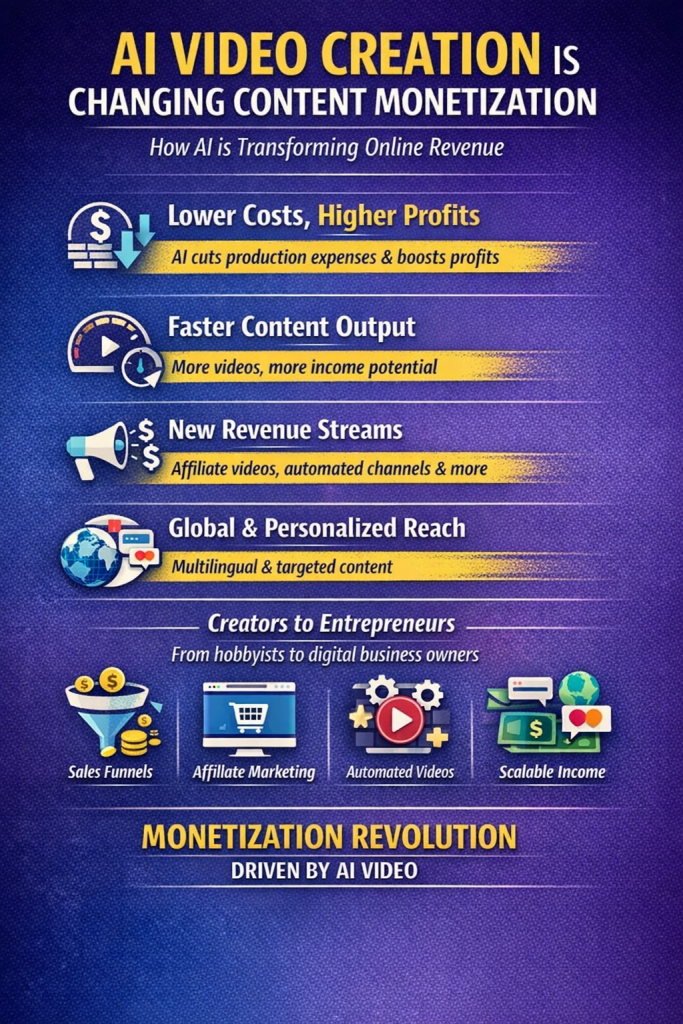
How AI Video Creation Is Changing Content Monetization:
Automated Channels as Digital Assets
AI video creation has introduced the concept of fully or partially automated channels as business assets.
Creators can now build channels that:
- Run on scheduled workflows
- Use AI-generated scripts
- Automatically produce visuals
- Publish consistently
These channels generate ad revenue, affiliate commissions, and leads with minimal ongoing effort.
Some creators even build and sell AI-powered channels as digital properties, creating an entirely new monetization market.
Content Monetization: Personalized Content at Scale
Another major change is personalization.
AI allows creators and brands to produce customized videos for specific audiences, languages, or regions.
Personalized content converts better.
Better conversion leads to higher revenue.
This level of targeted monetization was almost impossible before AI video creation became accessible.
Subscription and Membership Growth
Creators are also using AI videos to support subscription-based businesses.
AI makes it easier to produce:
- Training libraries
- Exclusive courses
- Member-only content
- Educational series
With faster production, creators can maintain active communities and paid memberships without burning out.
AI video creation supports recurring revenue models that were once too time-consuming for small teams.
The Rise of Micro-Niche Monetization
Before AI, creators needed large audiences to earn meaningful income.
Now micro-niches are becoming profitable.
AI video creation makes it practical to target very specific audiences with tailored content. Even small groups of highly interested viewers can generate good revenue through affiliate offers, digital products, or specialized ads.
This shift allows thousands of new creators to monetize topics that were once considered too small.
Global Content Monetization Opportunities
Language used to be a major limitation.
AI video tools now offer:
- Automatic translations
- AI voiceovers in many languages
- Localized versions of videos
Creators can monetize the same content in multiple countries without recreating everything from scratch.
Global income streams are becoming normal instead of exceptional.
Advertising Is Becoming More Accessible
Running paid ads with video used to require large budgets and professional production.
AI changes that.
Small businesses and creators can now generate high-quality ad creatives in minutes and test them across platforms like Facebook, Instagram, TikTok, and YouTube.
This allows faster scaling of profitable campaigns and direct monetization through paid traffic.
Challenges Creators Must Understand
While AI video creation creates huge opportunities, it also introduces new challenges.
Monetization still requires:
- Good strategy
- Audience understanding
- Quality control
- Ethical use of AI
- Original ideas
AI makes production easier, but it does not replace the need for smart business thinking.
Creators who combine AI efficiency with real value creation will win. Those who rely only on automation without strategy will struggle.

The Shift From Creator to Entrepreneur
Perhaps the most profound transformation AI video creation brings is not technical — it’s psychological. It changes how creators see themselves.
For years, the identity was simple: content creator. Film. Edit. Upload. Repeat. Success was measured in views, likes, and subscribers. Growth felt unpredictable, tied to algorithms and virality.
Now, that identity is evolving.
Content creators are becoming content entrepreneurs.
The difference is subtle — but powerful. Entrepreneurs don’t just publish content. They build systems. They don’t chase views alone; they engineer outcomes.
Instead of thinking only about visibility, modern creators are thinking about structure:
- Funnels — Where does the viewer go after watching?
- Conversion rates — What percentage turns into leads, subscribers, or buyers?
- Multiple income streams — Ads, affiliates, digital products, consulting, memberships.
- Automated systems — Email sequences, lead magnets, retargeting campaigns.
- Scalable business models — Processes that grow without requiring equal increases in time.
That shift changes everything.
From Content Output to Business Architecture
Under the old model, a creator’s workflow looked like this:
Idea → Record → Edit → Upload → Hope
Under the entrepreneurial model, it looks more like this:
Market Research → Content Strategy → AI-Assisted Production → Distribution → Data Analysis → Optimization → Monetization
The content becomes an asset within a larger machine.
AI video tools accelerate this transition. When production no longer consumes 80% of your time, you can reinvest that energy into strategy, audience psychology, offer development, and distribution mechanics.
The creative process becomes part of a business infrastructure.
The Metrics That Start to Matter
As creators evolve into entrepreneurs, their focus expands beyond vanity metrics.
They start asking:
- How much revenue does this channel generate per 1,000 views?
- Which content topic produces the highest lead conversion?
- What is my customer acquisition cost?
- How can I repurpose this video into five additional formats?
- Which audience segment converts best?
Views are still important — but they’re no longer the finish line. They’re the entry point into a monetization ecosystem.
Automation as Leverage
AI video tools introduce operational leverage. Instead of manually creating every asset, creators can:
- Batch-produce content.
- Repurpose long-form into short-form automatically.
- Generate multilingual versions.
- Test multiple hooks in paid campaigns.
- Maintain consistent publishing schedules without burnout.
Automation doesn’t remove creativity — it multiplies output.
And when output multiplies, opportunities multiply.
Building Assets, Not Just Content
A hobbyist uploads videos.
An entrepreneur builds digital assets.
Assets include:
- Evergreen video libraries.
- SEO-optimized content funnels.
- Email lists.
- Automated affiliate campaigns.
- Replicable content frameworks.
- Repeatable production workflows.
AI makes asset-building realistic even for solo operators. You don’t need a team of editors to create a content engine. You need systems, clarity, and consistency.
The Mindset Shift That Changes the Game
The biggest change isn’t technical — it’s strategic.
When creators begin to see their channel as a business:
- They prioritize sustainability over short-term virality.
- They design monetization intentionally.
- They diversify income sources.
- They optimize instead of guessing.
- They think in quarters and years, not just in uploads.
AI video tools are simply the catalyst. They remove friction from production so that creators can operate at a higher level of thinking.
The future belongs to those who stop asking, “How do I get more views?”
And start asking, “How do I build a scalable content business?”
That’s the shift. And once it happens, you don’t go back.
Content Monetization: What the Future Looks Like
Content monetization is entering a new phase — one where production speed, personalization, and automation converge into scalable digital ecosystems.
The future of content monetization will not be defined by who uploads the most videos — it will be defined by who builds the smartest systems behind those videos.
As AI technology continues to evolve, monetization will expand beyond traditional ad revenue and sponsorships. We are entering a phase where content is no longer just media — it is infrastructure. Video becomes the entry point into ecosystems powered by automation, personalization, and data-driven optimization.
As AI technology matures, we won’t just see better video quality. We’ll see entirely new monetization architectures emerge. The gap between idea and revenue will shrink. The distance between audience insight and content adaptation will narrow.
The future is not about replacing creators. It’s about amplifying strategic creators.
Here’s what that future is likely to include:
1. More Automated Video Channels
In practical terms, this means creators will no longer depend solely on platform payouts. Instead, they will design content strategically to feed larger revenue mechanisms. AI will make it easier to launch automated video channels that run on structured workflows: idea validation, scripted generation, multi-format publishing, and performance feedback loops. What once required a team can now be managed by a single operator who understands systems thinking.
Creators will build systems where:
- Scripts are generated from trending data.
- Videos are produced automatically.
- Thumbnails are optimized using AI testing.
- Upload schedules are pre-programmed.
- Analytics inform the next wave of content.
Instead of manually managing every upload, entrepreneurs will oversee content engines.
One person will operate multiple niche channels simultaneously — each with its own audience, funnel, and revenue model.
2. Smarter Personalization
At the same time, personalization will move from optional to essential. As AI improves, content will adapt dynamically to audience behavior. Viewers may encounter slightly different versions of the same core video depending on location, interests, or engagement history. This shift will increase conversion rates not through louder messaging, but through relevance. Monetization will reward precision over volume.
AI will allow:
- Dynamic video messaging tailored to specific audience segments.
- Location-based variations.
- Behavior-based offers.
- Personalized calls to action embedded into video content.
Imagine viewers seeing slightly different versions of the same video depending on their interests or past interactions. Conversion rates will rise not because of louder messaging — but because of smarter targeting.
3. AI-Generated Virtual Influencers
Virtual creators are already emerging. In the coming years, AI-generated influencers will become more realistic, more consistent, and more commercially viable.
We will also see the rise of AI-generated virtual influencers and brand avatars. These digital personalities won’t get tired, won’t drift off-brand, and can operate across multiple languages and platforms simultaneously. For businesses, this creates consistent, scalable brand representation. For entrepreneurs, it opens the possibility of building media brands detached from personal identity — an entirely new layer of leverage.
These digital personalities will:
- Post content daily without burnout.
- Speak multiple languages fluently.
- Maintain consistent branding.
- Operate across platforms simultaneously.
Brands may deploy AI spokespersons for campaigns. Entrepreneurs may build entire faceless media brands powered by virtual personas.
Influence will no longer require physical presence — only strategic positioning.
4. Fully AI-Driven Marketing Funnels
Today, funnels still require manual coordination. Tomorrow, they will be increasingly automated. Behind the scenes, marketing funnels will become increasingly AI-driven. Content creation, lead capture, email sequences, retargeting, and offer optimization will connect more seamlessly. Instead of manually managing each step, creators will oversee automated frameworks where video acts as the top-of-funnel magnet and AI handles much of the nurturing process. Monetization becomes less reactive and more engineered.
AI will connect:
- Content creation
- Lead capture
- Email sequences
- Retargeting ads
- Offer optimization
- Conversion analysis
Video content won’t just attract views — it will plug directly into automated revenue systems.
From first click to final purchase, AI will optimize every touchpoint.
5. New Platform Monetization Models
Even platform economics are likely to evolve. As AI-generated content becomes mainstream, we can expect new monetization models to emerge — interactive commerce integrations, smarter revenue-sharing mechanisms, performance-based creator incentives, and more sophisticated analytics tools designed for high-output creators.
We can expect:
- Enhanced creator revenue-sharing systems.
- AI-assisted performance bonuses.
- Interactive video commerce integrations.
- Micro-subscription ecosystems.
- Tokenized or community-based monetization layers.
The platforms themselves will evolve to support AI-driven creators, not just traditional influencers.
The Competitive Advantage
The creators who learn to integrate AI video tools today are not simply increasing efficiency. They are positioning themselves ahead of structural change. Early adopters will build data advantages, refine workflows, and establish authority before competition intensifies.
They will:
- Build systems before the market becomes saturated.
- Accumulate data before competition intensifies.
- Establish authority in emerging niches.
- Experiment faster than slower-moving competitors.
When technology shifts, advantage goes to those who adapt early.
The future of content monetization will reward those who think beyond uploads and views. It will reward those who design systems, analyze performance, and treat content as a scalable digital asset rather than a creative experiment.
And strategy, combined with AI leverage, creates scale.
In the coming years, the question will no longer be whether AI belongs in content strategy. It will be whether your monetization model is intelligent enough to compete in an AI-accelerated landscape.
Content Monetization: Final Thoughts
AI video creation is not simply a creative upgrade. It represents a structural shift in how digital income is generated. What used to require expensive production equipment, specialized talent, and long turnaround times can now be executed with streamlined workflows and intelligent tools. That shift does more than improve efficiency — it changes the financial equation entirely.
By lowering production costs, increasing execution speed, and enabling scalable output, AI has fundamentally transformed the economics of online video. Barriers that once protected established creators and media companies have weakened. Independent operators can now compete in niches that were previously out of reach. Monetization is no longer reserved for those with studios and large teams. It is increasingly accessible to individuals who understand systems and strategy.
This does not mean success is automatic. It means opportunity is wider.
AI expands creative capacity. It allows creators to test more ideas, enter more niches, and build larger content libraries in less time. It enables diversification across revenue streams — from ads and affiliate marketing to lead generation and digital products. When used strategically, it turns content into infrastructure rather than isolated uploads.
Creators no longer need massive budgets to experiment with new formats. They do not need weeks to validate a topic. They can iterate quickly, optimize based on data, and refine messaging continuously. This agility accelerates profitability because feedback loops become shorter and smarter.
The rules of monetization have changed from scarcity-driven to system-driven. In the past, limited output restricted earning potential. Today, strategic volume combined with quality control creates leverage.
AI video creation is not about replacing effort. It is about amplifying intelligent effort.
Those who treat it as a disciplined system — aligning audience research, consistent production, and monetization architecture — will build sustainable digital income streams. Those who treat it casually may produce content, but not assets.
The revolution is not in the tool itself. It is in how the tool reshapes what is possible for ordinary creators willing to think long-term.
AI video is not just changing how content is made.
It is redefining how content earns.
Author’s Note: I have been building and monetizing digital content projects across different niches for several years, working independently as a web designer, content creator, and digital entrepreneur. My perspective on AI-driven business strategies comes from applying these systems directly in my own projects, not from theory. What I share here reflects what actually works in practice when your goal is building scalable, semi-passive income online.

How to Make Video with AI.
Learn How to Create AI Video Fast an Easy,
If you want a step-by-step guide to create AI videos fast — without learning 50 complicated tools — download the free PDF below and simplify your entire workflow.
Download the free guide:
How to Create AI Videos FAST Without Learning 50 Complicated Tools