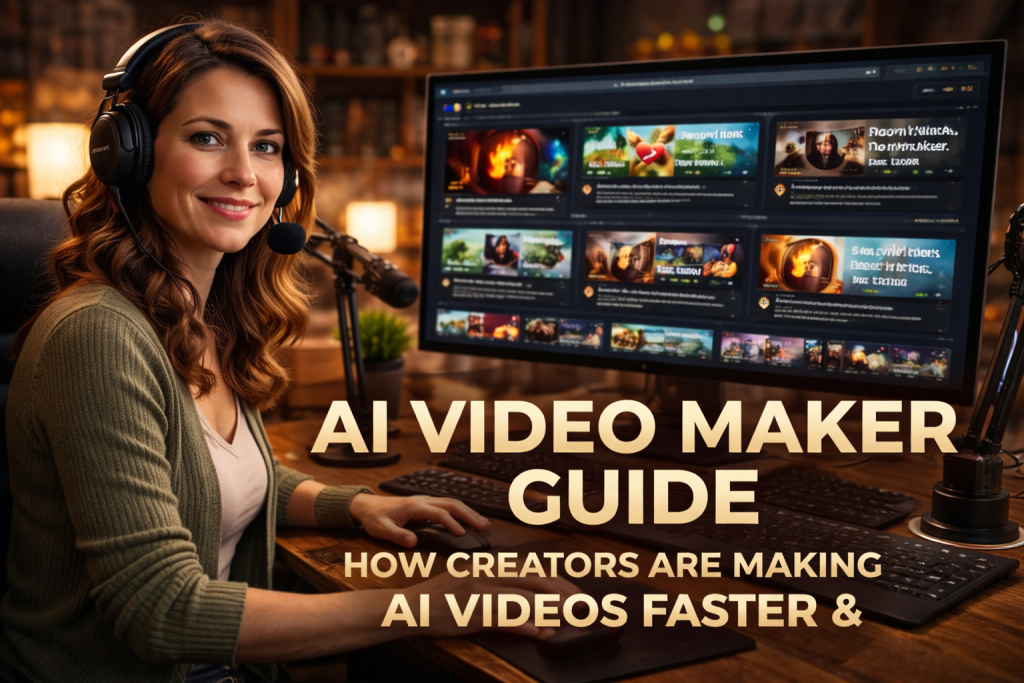
AI Video Maker Guide: How Creators Are Making AI Videos Faster, Smarter, and at Scale
AI video creation is no longer experimental. In 2026, it has become one of the most practical ways to produce content consistently—whether for YouTube, social media, education, or digital businesses. What once required cameras, editing software, and long production hours can now be handled by an AI video maker in a fraction of the time.
But not all AI video tools deliver the same results. Some help creators build real systems. Others create generic content that struggles to perform. This guide explores how modern AI video creation works, what makes a video maker AI platform effective, and how creators are using these tools to scale content and income.
What Is an AI Video Maker and Why It Matters in 2026
An AI video maker is a platform that uses artificial intelligence to generate videos from text, images, templates, or structured prompts. Instead of manually filming and editing, creators can make AI videos by guiding the system with scripts, scenes, or concepts.
In 2026, the demand for video content continues to grow across every major platform. At the same time, attention spans are shorter and competition is higher. AI video creation tools allow creators to keep up with this demand without burning out.
The real value of a video maker AI system isn’t speed alone—it’s consistency. AI helps creators produce repeatable formats, maintain visual identity, and publish at a pace that would be impossible with traditional workflows.
How AI Video Creation Actually Works
Most AI video creation platforms follow a similar core process, even if the interface looks different.
First, the creator provides an input. This can be a script, bullet points, or even a short prompt describing the video’s goal. The AI then interprets this input and generates visuals, animations, or scenes that match the narrative.
Next comes narration and audio. Many platforms include built-in AI voice options, allowing creators to choose tone, pacing, and language. This is especially useful for faceless content, educational videos, or multilingual channels.
Finally, the system assembles the video—combining visuals, text, transitions, and audio into a finished piece. The creator can then refine timing, adjust scenes, or export the video for publishing.
This workflow is why AI video creation has become a practical solution rather than a novelty.
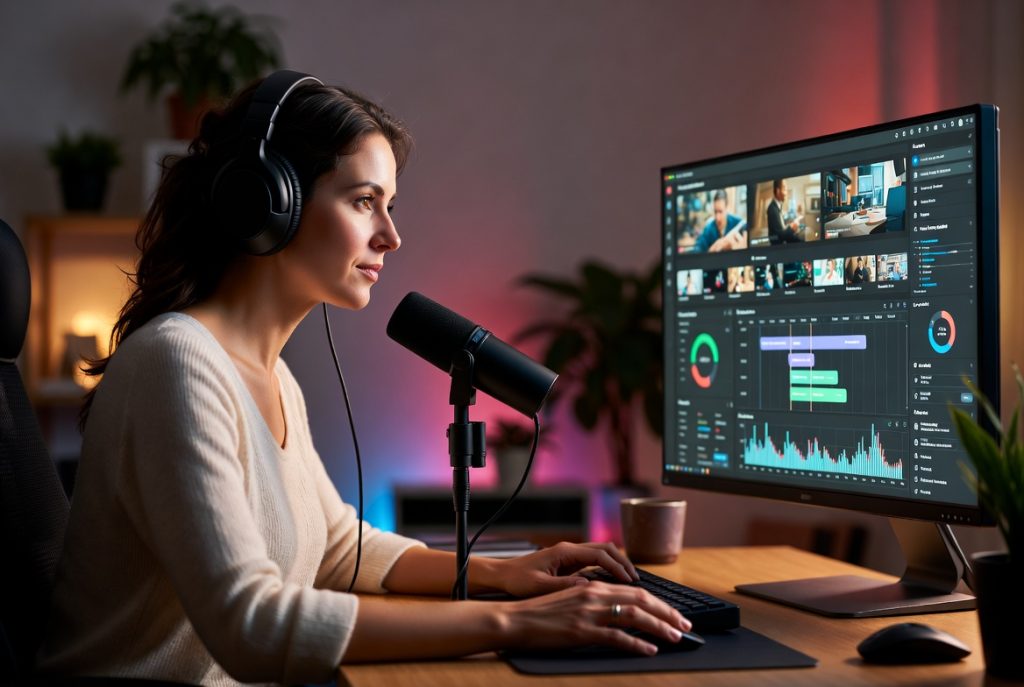
The Rise of AI Video Maker Free Tools: Lowering the Entry Barrier
One of the primary catalysts for the democratization of high-end content is the surge in accessibility. AI video creation has officially transitioned from a niche technical skill to a mainstream creative outlet. This shift is largely driven by the “freemium” model; many leading platforms now provide an AI video maker free tier, allowing creators to test the waters and validate their ideas before committing to a monthly subscription.
The Strategic Value of Free Tiers
While these free versions typically come with specific constraints—such as visible watermarks, capped export resolutions, or a limited number of “generation credits”—they serve a vital educational purpose. They act as a sandbox for innovation, giving beginners the space to understand the complex mechanics of making AI videos without any upfront financial risk. In a rapidly evolving market, this “try-before-you-buy” approach has become the standard for user onboarding.
A Roadmap for Emerging Creators
For those just beginning their journey, free tools are more than just a cost-saving measure; they are a laboratory for growth. Creators often utilize these entry-level tools to:
- A/B Test Content Ideas: Rapidly prototype different visual styles to see what resonates with an audience.
- Experiment with New Formats: Transition from static images to motion graphics or talking-head avatars without a production budget.
- Master Prompt Engineering: Learn the specific “language” of AI to understand how the system interprets scripts into visual data.
As a project scales and the need for professional branding grows, most creators eventually transition to paid plans. These upgrades unlock essential features like 4K exports, custom branding removal, and priority rendering speeds, transforming a hobbyist tool into a professional workstation.
Defining Excellence: What Makes the Best AI Video Maker Stand Out?
With a new tool launching almost every week, the market has become saturated. However, choosing the best AI video maker isn’t about chasing the flashiest features or the most viral effects; it is fundamentally about control, consistency, and reliability. A tool that produces a masterpiece once but fails the next ten times is a toy, not a professional asset.
The Pillars of High-Quality AI Production
The industry leaders—the platforms that truly stand out—share a core set of DNA traits that prioritize the user’s workflow:
- Logical Narrative Structure: The ability to organize scripts into distinct scenes, allowing for granular control over the story arc.
- Visual Continuity: Ensuring that characters, lighting, and art styles remain consistent from the first second to the last.
- Nuanced Audio Integration: Moving beyond robotic voices to offer natural-sounding narration with emotional range and proper cadence.
- Iterative Flexibility: The power to “in-paint” or edit specific sections of a video without having to regenerate the entire clip from scratch.
The Human-AI Partnership
The most successful platforms today don’t aim to replace the creator. Instead, they position themselves as intelligent assistants. They excel at handling the “grunt work”—the repetitive tasks like syncing lips to audio, basic color grading, or background removal—while leaving the high-level creative direction in human hands.
Data shows that creators who rely solely on “one-click” auto-generated outputs often struggle with audience engagement because the content lacks a human soul. In contrast, those who use AI as a collaborative partner—guiding the system, refining the prompts, and injecting personal style—are the ones seeing the highest ROI and viewer retention in 2026.
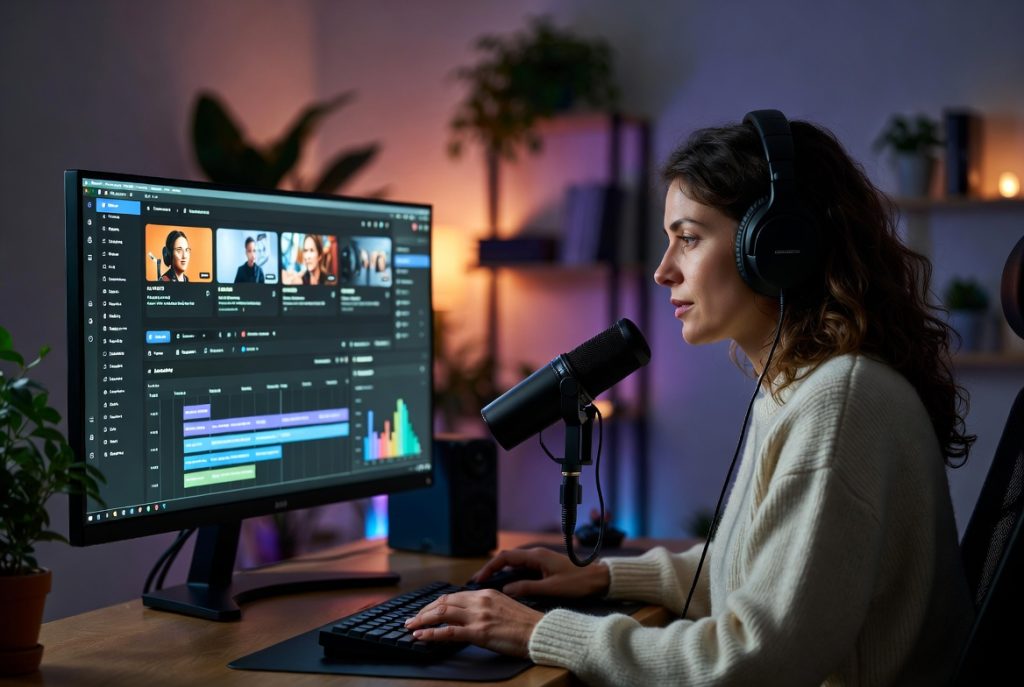
How Creators Use AI Video Creation Tools for Different Goals
AI video creation isn’t limited to one type of content. In 2026, it’s not a niche trick — it’s infrastructure. Creators across industries are using these tools as production engines, not gimmicks.
Educational creators use AI video makers to explain concepts visually without filming themselves. Instead of relying on slides or static graphics, they generate dynamic scenes, visual metaphors, and animated breakdowns that increase retention. Complex topics become easier to understand when paired with motion and storytelling.
Business channels rely on AI video creation platforms to produce explainers, tutorials, product updates, and industry commentary quickly. Speed matters in competitive niches. When trends move fast, the ability to generate polished visuals without organizing shoots or hiring editors creates a serious advantage.
Storytelling channels use AI visuals to bring ideas to life that would otherwise be expensive—or impossible—to film. Fantasy worlds, futuristic cities, abstract emotional sequences, historical recreations… AI eliminates physical production limits. Imagination stops being constrained by budget.
Even personal brands use AI video tools strategically. They repurpose long-form videos into short clips, create visual summaries, generate animated highlights, or test new content directions before committing to full production. Instead of recording more, they extract more value from what they already create.
The real power lies in flexibility. AI video creation tools adapt to different tones, industries, and formats. Whether the goal is education, authority building, entertainment, or conversion, the same underlying system can support multiple content strategies.
From Content Creation to Monetization
Creating AI videos is only step one. The creators who actually win treat AI video creation as a structured system — not a magic shortcut.
Once a repeatable format is established, monetization becomes predictable rather than random.
Videos can generate:
- Ad revenue from platforms like YouTube
- Affiliate commissions tied to relevant products or tools
- Traffic to email lists, courses, or downloadable guides
- Brand sponsorships within focused niches
The difference-maker isn’t the tool. It’s the system around the tool.
AI video makers reduce production friction. They remove the bottleneck of filming, editing logistics, and heavy manual work. That freed-up time should be reinvested into strategy: understanding audience pain points, optimizing hooks, refining messaging, and building distribution channels.
This is the real shift: moving from labor-based content creation to scalable content systems.
When videos can be produced consistently without burning out, growth compounds. And when growth compounds, monetization stops feeling unpredictable.
Why Structure Beats Automation Alone
Here’s where many beginners sabotage themselves: they assume automation equals success.
It doesn’t. Automation without structure just produces more average content, faster.
High-performing AI-generated videos typically follow clear patterns:
- A strong hook that captures attention immediately
- A logical progression of ideas
- Visual reinforcement of key points
- A defined ending with direction (CTA, summary, or next step)
These elements are strategic, not technical.
AI video makers are excellent at executing a defined format. They struggle when the creator has no format at all. Without structure, the output may look impressive visually but feel empty narratively.
Creators who design their content architecture first — defining their hook style, pacing rhythm, visual identity, and closing framework — scale much faster. Once the structure is clear, automation becomes a multiplier instead of noise.
In short:
- Structure creates consistency.
- Consistency builds trust.
- Trust builds monetization.
Automation is powerful — but only when it’s supporting a system that already makes sense.
The Future of AI Video Creation Platforms: From Tools to Ecosystems
The trajectory of AI video technology is moving at breakneck speed, but the most profound shifts in 2026 aren’t just technical—they are fundamentally strategic. We are moving past the era of “novelty generation” and entering the era of integrated production.
The Shift Toward Content Pipelines
In the coming years, the best AI video creation tools will cease to be standalone apps. They are evolving into comprehensive ecosystems that are more personalized and focused on holistic workflows rather than single, isolated outputs. Instead of a simple “make a video” button, platforms will empower creators to manage entire content pipelines—from automated script variations for A/B testing to multi-platform formatting in a single click.
Compounding Skills in a Rapid Market
This evolution means that creators who master AI video creation today are building compounding professional value. While the specific buttons and interfaces of 2026 will inevitably change, the underlying logic—understanding AI systems, narrative formats, and audience psychology—remains a permanent asset. Those who start now aren’t just learning a tool; they are developing a new mental framework for digital storytelling.
Final Thoughts: AI Video Makers as Strategic Creative Leverage
It is a common misconception that AI is here to replace the artist. In reality, AI video makers are amplifying human creativity, not erasing it. As we navigate the landscape of 2026, the creators who thrive aren’t those who automate everything to the point of being soulless; they are the ones who use AI to remove technical friction, allowing them to focus on the high-level vision that truly matters.
The Power of Intentional Design
Whether you are just starting with an AI video maker free plan to test a concept or building full-scale commercial systems with advanced pro-tier tools, the secret to success lies in intentionality.
- Purpose over Automation: Don’t just generate; curate.
- Thoughtful Guidance: Treat the AI as a highly skilled intern that needs clear, artistic direction.
- Strategic Integration: Every clip should serve a larger goal, whether it’s brand awareness, education, or conversion.
The Bottom Line
Real results in the AI era don’t come from the software itself—they come from the human-in-the-loop. By treating AI video creation as a partnership, you transform a set of algorithms into a powerful lever for growth. In a world of infinite content, the “human touch” guided by AI efficiency is what creates a lasting impact.
YouTube Automation with AI
Learn How to Create AI Videos Fast an Easy,
If you want a step-by-step guide to create AI videos fast — without learning 50 complicated tools — download the free PDF below and simplify your entire workflow.