
Chinese AI Video creators Review: Introduction
By 2026, China has emerged as a major contender in AI video generation — not just in language models, but in tools that turn text and images into dynamic video content with growing sophistication. Generative AI is quickly becoming mainstream on platforms like Douyin (China’s TikTok equivalent), KuaiYing, and other ecosystems, driven by local giants and agile startups. Here we examine three of the most impactful Chinese AI video generators: Hailuo AI, Kling AI, and Seedance — breaking down what they offer, who they are for, and how they compare in real use.
These tools are especially relevant for creators and digital businesses looking to leverage AI for social video content, ads, and storytelling, often with lower cost and faster iterations than Western alternatives.
What These Chinese AI Video Tools Do Best
All three models focus on text-to-video and image-to-video generation — letting users input text prompts or static images and receive AI-generated video content. Most outputs support multiple aspect ratios like 9:16 for Shorts and Reels, 16:9 for YouTube, and 1:1 for Instagram feeds. They emphasize speed and simplicity, allowing creators to produce clips without traditional editing workflows.

Hailuo AI: Fast & Creator-Friendly
Hailuo AI positions itself as a streamlined solution for creators who value speed and simplicity over complex production layers. From the first interaction, the platform emphasizes accessibility. The interface is clean, minimal, and structured in a way that reduces friction between idea and execution. Whether accessed on desktop or mobile browsers, the experience remains consistent, making it practical for creators who manage content on the go.
What makes Hailuo AI particularly appealing is its focus on rapid output. Instead of overwhelming users with granular controls, it simplifies the process into a guided workflow. Templates help structure content, while automatic prompt optimization assists users in refining their inputs. This is especially helpful for beginners who may not yet understand how to craft highly detailed AI prompts. By improving prompt interpretation internally, the platform reduces guesswork and shortens the learning curve.
For social media creators operating in fast-paced environments, this speed can be a major advantage. When trends emerge, being able to generate and publish quickly often matters more than achieving cinematic perfection. Hailuo AI supports that reality by prioritizing efficiency and usability.
Hailuo AI Key Features
• Text & Image Input:
Hailuo AI allows users to generate videos from written prompts or static images, offering flexibility in how ideas are translated into motion. Text-based inputs enable creators to describe scenes, concepts, or messages directly, while image inputs provide a visual anchor that the AI can build upon. This dual approach makes it easier to experiment with different creative starting points, whether you are scripting from scratch or transforming existing visuals into animated content.
• Prompt Refinement:
One of the platform’s most practical features is its built-in prompt refinement logic. Rather than relying entirely on the user’s wording, Hailuo AI helps interpret and enhance prompts to produce more coherent outputs. This reduces the trial-and-error cycle that many generative tools require. For beginners especially, this layer of assistance can significantly improve results without demanding deep technical understanding of AI prompting techniques.
• Cinematic Motion Tools:
Although the tool is optimized for speed, it still offers basic cinematic motion controls. Users can incorporate camera cues such as pan and zoom effects to make scenes feel more dynamic and intentional. These additions help avoid static outputs and give videos a more structured visual flow. While not equivalent to professional timeline editing, these motion tools add a level of polish that elevates short-form content beyond simple animated slides.
Overall, Hailuo AI succeeds by lowering barriers. It empowers creators to move quickly from idea to publishable clip, making it particularly valuable for social-first strategies where consistency and responsiveness outweigh deep post-production control.
Hailuo AI Pros & Cons
Pros:
• Beginner-friendly interface, low learning curve.
Hailuo AI is clearly designed with accessibility in mind. New users can navigate the interface without feeling overwhelmed by advanced settings or complex editing panels. The layout is intuitive, and the workflow from prompt to output feels straightforward. This makes it especially appealing for creators who are just entering the AI video space and want to experiment without investing weeks into mastering technical controls. Instead of focusing on granular adjustments, users can concentrate on ideas and messaging.
• Quick content production for social media.
Speed is one of Hailuo AI’s strongest advantages. The platform enables users to generate short-form video drafts rapidly, which aligns well with the fast-paced nature of social media platforms. When trends shift quickly and creators need to publish consistently, this quick turnaround becomes valuable. Rather than spending hours editing, users can test multiple variations of a concept and refine based on engagement data. For marketers running short campaigns or creators experimenting with hooks, this agility supports efficient iteration.
• Flexible input formats.
Hailuo AI supports multiple types of inputs, allowing creators to work from text prompts, scripts, or concept outlines. This flexibility lowers the barrier for different working styles. Some users prefer writing detailed prompts, while others may want to input structured scripts. The ability to adapt to varied input approaches makes the tool versatile across use cases, from simple social clips to more structured explanatory content.
Cons:
• Free or entry plans may restrict output length.
Like many AI video platforms, Hailuo AI places limitations on lower-tier plans. Output length restrictions can become a constraint for users who need longer-form content or higher rendering volumes. While the free tier is useful for testing and experimentation, scaling production may require upgrading to paid plans. For creators aiming to publish consistently at higher volume, this pricing structure needs to be factored into workflow planning.
• Still dependent on prompt quality for polished results.
Hailuo AI, like most generative video tools, performs best when guided by well-structured prompts. Vague or poorly constructed inputs often result in inconsistent visuals or uneven pacing. This means that while the interface is beginner-friendly, achieving polished outputs still requires a level of prompt experimentation and refinement. Users who expect perfect results from minimal input may feel limited, whereas those willing to iterate can extract stronger performance.
Best For
Hailuo AI is best suited for social creators, digital marketers, and teams needing rapid video drafts rather than cinematic precision. It performs particularly well in fast-moving environments where idea testing, trend participation, and consistent posting matter more than advanced post-production control. When used with realistic expectations and clear prompts, it can serve as a practical tool for scalable short-form content workflows.
Kling AI: High-Quality Text-to-Video Output
Kling AI, developed by Chinese technology company Kuaishou, has positioned itself as one of the most advanced text-to-video systems emerging from China’s rapidly evolving AI ecosystem. Unlike many lightweight generators designed purely for short social clips, Kling AI leans toward cinematic ambition. Its outputs are known for smoother motion rendering, stronger scene coherence, and higher-resolution generation compared to many competing tools in the same category.
What distinguishes Kling AI is its focus on synchronized audio-visual storytelling. Instead of treating sound as an afterthought, the system is engineered to generate motion, ambient sound, and effects in a unified process. This integrated approach allows creators to produce more immersive clips without exporting assets between multiple platforms. With support for extended video durations — up to two minutes in 1080p resolution — Kling AI opens the door to more developed narratives rather than limiting creators to ultra-short loops.
For creators who want cinematic-style output but prefer to avoid complex timeline editing, Kling AI offers a compelling middle ground. It bridges the gap between automated generation and structured storytelling, making it suitable for social campaigns, branded content drafts, and experimental narrative pieces.
Kling AI Key Features
• Simultaneous Audio-Visual Generation:
Kling AI’s ability to generate video alongside ambient sound and audio effects in a single rendering process is one of its standout strengths. This unified workflow reduces the need for separate sound design tools and helps maintain synchronization between visuals and audio elements. For creators aiming to produce cohesive clips quickly, this integration simplifies production significantly.
• Longer Clips:
While many text-to-video tools limit outputs to a few seconds, Kling AI supports videos up to two minutes at 1080p resolution. This expanded duration allows for more structured storytelling, extended scenes, and deeper narrative development. It provides flexibility for creators who need more than quick visual snippets and want to explore more detailed concepts.
• Stable Motion Architecture:
Built on a 3D variational autoencoder (VAE) combined with advanced diffusion techniques, Kling AI is optimized for smoother motion and improved scene continuity. This technical foundation helps reduce jittery transitions and unnatural frame shifts, which are common weaknesses in generative video systems. The result is more stable camera movement and visually coherent sequences that feel intentional rather than randomly assembled.
Kling AI Pros & Cons
Pros:
• High visual quality and smooth motion.
Kling AI consistently delivers strong visual fidelity with fluid motion, making it suitable for projects that demand a more polished aesthetic. Its cinematic leaning sets it apart from tools focused purely on fast social content.
• Supports longer narrative clips.
The extended duration capability gives creators room to experiment with storytelling formats beyond micro-content. This makes it viable for mini-documentary styles, branded narratives, or in-depth concept explorations.
• Multi-input support for text and images.
Users can guide generation through both written prompts and visual references, increasing creative flexibility and control over final outputs.
Cons:
• Learning curve for complex prompt crafting.
To unlock its full potential, Kling AI often requires detailed and well-structured prompts. Beginners may need time to refine their input strategy in order to achieve consistent cinematic results.
• Availability may vary by region and platform.
Access to Kling AI can depend on geographic location or specific platform integrations, which may limit usability for some international creators.
Best For
Kling AI is best suited for mid-level creators and marketers who want cinematic-style social content or longer narrative clips without diving into full professional editing software. It strikes a balance between automation and visual ambition, making it a strong option for those seeking elevated generative video output with structured storytelling potential.
Seedance AI: Cinematic Photo-to-Video
Seedance AI — frequently linked to ByteDance’s broader research and creative ecosystem — takes a slightly different approach from traditional text-to-video generators. Instead of focusing primarily on generating scenes from written prompts, it specializes in transforming still images into cinematic motion sequences. The platform enhances static visuals with depth simulation, controlled camera movement, and lighting dynamics that create the illusion of a professionally filmed scene.
This focus on photo-to-video conversion makes Seedance AI particularly interesting for creators who already work with strong visual assets. Rather than building every scene from scratch, users can upload product photos, portraits, or conceptual artwork and animate them with structured motion. The result often feels more grounded and visually coherent than fully synthetic text-driven outputs, especially when the source imagery is high quality.
By emphasizing cinematic camera behavior and spatial depth, Seedance AI produces clips that resemble controlled studio footage rather than experimental AI loops. For brands and marketers who want elevated visuals without organizing a physical shoot, this can offer a practical middle ground.
Seedance AI Key Features
• Photo-to-Video Transformation:
At its core, Seedance AI converts still images into dynamic video sequences. It analyzes composition, lighting, and subject placement to introduce motion that feels intentional rather than random. This is particularly useful for ecommerce brands, photographers, and designers who want to repurpose static assets into engaging social video content without reshooting material.
• Cinematic Feel:
The platform places strong emphasis on polished transitions, lighting adjustments, and realistic motion flow. Rather than simply animating elements, it aims to simulate cinematic camera movement and environmental depth. This gives outputs a more refined appearance, especially when compared to entry-level AI video tools focused purely on speed.
• Camera Effects:
Integrated tools allow users to apply zoom, pan, and depth cues that mimic real-world camera techniques. These effects help guide viewer attention and add visual storytelling structure to otherwise static compositions. When used thoughtfully, these movements can dramatically elevate product showcases, portrait animations, and mood-driven content.
Seedance AI Pros & Cons
Pros:
• Generates engaging, cinematic output from photos.
Seedance AI excels at turning static images into visually dynamic scenes. For creators who already invest in high-quality photography, the tool adds motion and storytelling potential without requiring full video production.
• Useful for product visuals and storytelling.
Ecommerce brands and marketers can transform product images into scroll-stopping clips suitable for social ads or promotional campaigns. The cinematic style also supports mood-based storytelling, making it effective for lifestyle branding and visual narratives.
Cons:
• Quality depends heavily on source material and prompt clarity.
Because the system builds motion around existing images, weak or poorly lit photos can limit final output quality. Clear prompts and strong visual assets are essential to achieve convincing results.
• Limited video length on free/basic tiers.
Entry-level plans may restrict output duration, which can constrain more elaborate storytelling attempts. Users aiming to scale production may need to upgrade to unlock longer or higher-resolution renders.
Best For
Seedance AI is best suited for creators, brands, and marketers who start with strong photography and want to elevate it into cinematic motion without hiring a film crew. It performs particularly well for product showcases, social campaigns, and visually driven storytelling where depth and movement enhance engagement without requiring complex editing workflows.
Who Should Use These Tools
Let’s keep it simple: these tools are built for momentum. If your goal is to publish consistently, test ideas fast, and scale content without building a full production team — you’re in the right arena.
These Chinese AI video platforms are worth exploring if you want:
• Fast, affordable AI video creation without getting trapped in complex timelines, keyframes, and multi-layer editing software. You describe it. It renders it. You iterate. Done.
• Social-first output. Short reels, vertical storytelling, scroll-stopping hooks — they’re optimized for the rhythm of platforms, not Hollywood pipelines.
• Multi-input flexibility. Start from text. Start from a photo. Remix existing visuals. The workflow adapts to your idea, not the other way around.
• Rapid content testing. Ideal for marketers running creative experiments, affiliate campaigns, faceless channels, or trend-based content where speed beats perfection.
• Lean creator setups. If you’re solo, small team, or bootstrapping, these tools give you leverage without payroll.
In other words: if your bottleneck is time, budget, or production complexity — these platforms remove friction.
Now, let’s talk about when they’re not the best fit.
They are not ideal if you need:
• Frame-accurate editing. If you obsess over micro-cuts, color grading precision, or cinematic continuity control, traditional editing suites still win.
• Deep post-production workflows. Advanced compositing, VFX layering, or intricate audio mastering require more manual environments.
• Enterprise-grade SLAs and strict consistency guarantees. Large-scale corporate deployments with compliance-heavy requirements may prefer more established enterprise ecosystems.
• Absolute creative predictability. Generative AI still involves interpretation. If you need the same shot reproduced identically across 50 versions, expect variation.
The Real Question Isn’t “Are They Perfect?”
It’s: Do they move your production forward faster than what you’re using now?
If you’re building faceless YouTube channels, testing ad creatives, creating product showcases, launching short-form storytelling accounts, or producing educational snippets — these tools are not just useful. They’re strategic.
But if you’re producing a feature-length film or managing broadcast-level brand standards, they’re better used as accelerators — not replacements.
Bottom line:
Use them for speed, scale, and experimentation.
Avoid them when precision and contractual reliability are the top priority.
Different tools. Different battles. Choose accordingly.
Pricing, Plans & Limitations
Let’s talk about the part nobody reads until they hit a paywall.
All three tools follow a familiar pattern: attract with a free tier, hook with usable quality, and scale with paid plans. But the details matter — especially if you’re producing content daily.
Hailuo AI
• Free tier: Daily credits that reset, usually enough for short-form experimentation.
• Paid plans: Unlock higher resolution, faster rendering, and more generation volume.
• Best pricing advantage: Budget-friendly entry for creators testing ideas at scale.
If you’re running multiple short videos per day, you’ll likely outgrow the free credits quickly. But for concept validation? More than enough.
Kling AI
• Free tier: Limited daily video generations.
• Paid options: Longer clip duration, higher resolution, and priority queue access.
• Best pricing advantage: Strong value for creators wanting cinematic output without studio costs.
Because Kling supports longer narrative clips, paid plans make more sense for storytellers and YouTube-style creators. If you’re producing multi-minute sequences, the upgrade feels justified.
Seedance AI
• Basic generation: Often free for short, lower-complexity outputs.
• Premium plans: Unlock advanced camera movements, enhanced depth, and improved cinematic control.
• Best pricing advantage: Great for product visuals and photo-based storytelling upgrades.
Since Seedance relies heavily on source material quality, your cost isn’t just subscription-based — it’s also about the quality of your input assets.
General Limitations (The Fine Print That Actually Matters)
No AI video platform — Chinese or Western — is unlimited magic. Expect:
• Generation caps. Daily limits are common in free tiers. Scaling means upgrading.
• Queue delays. During peak demand, free users often wait longer.
• Resolution restrictions. HD or 1080p output may be locked behind paid plans.
• Regional access variations. Some features may roll out gradually or differ by location.
• Prompt dependency. Weak prompts = weak output. These tools reward clarity and specificity.
Here’s the truth: the cost isn’t just money — it’s iteration time. The better your prompts and workflow, the less you waste credits.
Strategic Perspective
If you’re casually experimenting, free tiers are generous enough to explore.
If you’re building a content engine — affiliate marketing, faceless channels, brand storytelling — you should treat paid plans as operational expenses, not luxuries. Speed + consistency = revenue leverage.
The real limitation isn’t the platform.
It’s whether you approach it like a toy… or like a production syste
Real Use Case Examples
Social Media Reels and Shorts
These AI tools are ideal for creating fast, high-impact vertical videos designed specifically for platforms like TikTok, Douyin, Instagram Reels, and YouTube Shorts. Instead of spending hours editing footage manually, creators can generate engaging clips from simple text prompts or static images. This is perfect for influencers, small brands, and marketers who need to publish content daily without a full production team. From motivational videos to travel montages and trending-style content, Chinese AI video generators can deliver polished results in minutes.
Product Promotion Without a Studio
One of the strongest real-world applications is product marketing. Businesses can transform basic product photos into dynamic promotional videos with camera movement, lighting effects, and cinematic transitions. This eliminates the need for expensive filming equipment, professional videographers, or physical sets. E-commerce sellers, dropshippers, and digital marketers can create professional-looking ads for Amazon, Shopify, or social media campaigns using nothing more than images and short descriptions.
Rapid Prototyping and Storyboarding
For filmmakers, advertisers, and creative agencies, these AI platforms serve as powerful pre-production tools. Instead of sketching static storyboards or explaining ideas verbally, teams can generate rough video drafts that visually represent their concepts. This makes pitching ideas to clients faster and more effective. Directors can experiment with different scenes, camera angles, and visual styles before committing to full-scale production, saving both time and budget.
Content Localization at Scale
Another practical use is adapting the same core content for multiple languages and regions. AI video tools can quickly generate different versions of a video by modifying text prompts, visuals, or voiceovers. This is especially useful for global brands that need localized marketing materials without producing entirely new videos for each market.
Educational and Training Material
Teachers, coaches, and online course creators can turn written lessons or slide presentations into animated explainer videos. Instead of recording themselves on camera, they can generate visual narratives that keep viewers engaged. This makes complex topics easier to understand and allows creators to produce professional training content with minimal technical skills.
Personal Branding and Faceless Channels
Entrepreneurs building YouTube automation channels or faceless social media brands can use these AI tools to generate entire libraries of content. Motivational quotes, history explainers, top-10 lists, and niche tutorials can all be produced without ever recording real footage. This opens the door to scalable content businesses powered almost entirely by AI.
How Chinese AI Video Tools Compare With Western Alternatives
To give readers deeper context and help them make informed decisions, it’s valuable to compare these Chinese platforms not just against each other but also against leading Western video generation tools. This comparative analysis emphasizes strengths and limitations driven by regional development focus.
For example, tools like Hailuo AI and Kling AI excel at prompt-based video generation with competitive speed and social-ready output — often at a significantly lower cost than some Western counterparts. Hailuo focuses on fast turnaround and accessibility for creators, while Kling is pushing longer narrative capabilities and synchronized audio-visual synthesis . In contrast, many Western tools such as Google’s Veo 3 or OpenAI’s Sora prioritize photorealism, built-in audio fidelity, and ecosystem integration with broader cloud services — features that are attractive for enterprise workflows but often come with higher subscription tiers and steeper learning curves .
This type of section helps readers understand when a Chinese AI video generator might actually be the better choice — for example, if cost and social clip performance matter more than cinematic realism — and when a Western alternative might be preferable, such as for high-end narrative content or advanced editorial control.
Top 3 Chinese AI Video Generators infographic
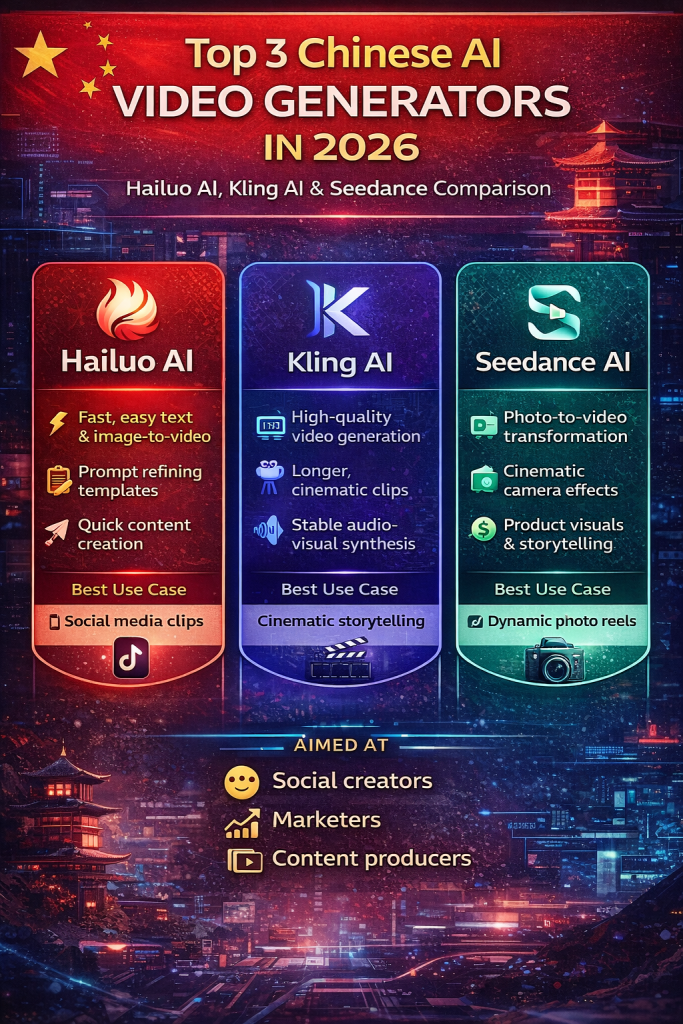
Comparison: Top 3 Chinese AI Video Tools
| Tool | Ease of Use | Video Quality | Best Use Case | Accessibility |
|---|---|---|---|---|
| Hailuo AI | High (easy learning) | Good to very good | Social clips and quick content | High (browser and mobile friendly) |
| Kling AI | Moderate (requires prompt practice) | Very high (1080p long clips) | Cinematic and narrative generation | Moderate (platform dependent) |
| Seedance AI | Moderate | High (photo-to-video cinematic) | Storytelling from images | Moderate to high |
Top 3 Chinese AI Video Generators: Final Verdict
China’s AI video ecosystem in 2026 is not just evolving — it is accelerating. What was once viewed as a secondary market has become a serious innovation hub, producing tools that rival and in some cases outperform well-known Western platforms. The competitive intensity among Chinese AI companies has resulted in rapid iteration cycles, aggressive feature development, and accessible pricing models that appeal to a broad spectrum of creators.
Each of the three platforms examined — Hailuo AI, Kling AI, and Seedance — represents a different philosophy of AI-driven video creation. Hailuo AI emphasizes speed, accessibility, and social-ready content. It lowers the barrier to entry for beginners and creators who prioritize fast output over cinematic depth. Kling AI leans into higher production ambition, offering smoother motion, longer clip durations, and synchronized audio-visual generation for those seeking narrative structure without full manual editing. Seedance, on the other hand, focuses on transforming static imagery into cinematic motion, bridging the gap between photography and dynamic video storytelling.
What makes this trio particularly significant is how they collectively expand the creative toolkit available to global creators. Instead of relying solely on text-to-video generation, these tools introduce varied workflows — from prompt-driven scene building to photo-based cinematic enhancement. This diversity allows creators to choose the production style that aligns with their content goals rather than forcing them into a single generative model framework.
Of course, none of these platforms are flawless. Output consistency, regional access limitations, pricing structures, and moderation policies remain factors that users must consider. However, the pace of improvement suggests that many of today’s limitations will continue to narrow over time. In practical terms, these tools are already capable of supporting scalable content production for social media campaigns, marketing experiments, educational clips, and visual storytelling projects.
Another notable advantage is cost efficiency. Compared to some Western AI video platforms that position themselves at premium enterprise pricing tiers, many Chinese AI tools offer more flexible entry points. For independent creators, startups, and cost-sensitive teams, this affordability can make experimentation and scaling more realistic.
Ultimately, the rise of Chinese AI video generators signals a broader shift in the global creative technology landscape. Innovation is no longer centralized. Creators now have access to multiple competitive ecosystems, each pushing the boundaries of generative media in different directions.
For social media producers, marketers, and visually driven storytellers, these platforms are no longer alternatives — they are viable contenders.
Author’s Note:I research and evaluate AI video tools from the perspective of a digital entrepreneur who builds and monetizes content sites across multiple niches. My focus is always practical: does this tool fit into a real production workflow, what does it actually cost at scale, and does it deliver value for creators building long-term online assets. This review reflects that analytical approach, combined with direct exploration of the platform.
The Future of AI Video Creation
Learn How to Create AI Video Fast an Easy,
If you want a step-by-step guide to create AI videos fast — without learning 50 complicated tools — download the free PDF below and simplify your entire workflow.
Download the free guide:
How to Create AI Videos FAST Without Learning 50 Complicated Tools