The AI Tools Behind Smart Businesses in 2025
Artificial Intelligence is no longer an experimental advantage reserved for tech giants. In 2025, AI has become the invisible backbone of smart businesses across industries. From solopreneurs to mid-sized companies, organizations that leverage AI effectively are moving faster, operating leaner, and making decisions with a level of clarity that was impossible just a few years ago.
What separates a “smart business” from the rest isn’t the size of its budget, but how strategically it integrates AI into daily operations. The smartest companies don’t use AI everywhere; they use it where it creates leverage. This article explores the most impactful AI tools behind successful businesses in 2025 and how they are reshaping work, growth, and competitiveness.
Why AI Is the Core Operating System of Modern Businesses
In 2025, AI is not just a tool; it functions as a decision layer across the organization. Businesses use AI to analyze data, automate workflows, predict trends, and personalize customer experiences at scale.
Three forces are driving this shift:
First, the cost of AI has dropped dramatically. Subscription-based platforms allow businesses to access advanced models without massive upfront investment.
Second, ease of use has improved. Most modern AI tools no longer require technical expertise. Founders, marketers, and managers can deploy AI solutions with minimal onboarding.
Third, competition has intensified. Businesses that do not use AI simply cannot match the speed, efficiency, and precision of those that do.
The result is clear: AI is no longer optional. It is foundational.
AI Tools for Strategy, Planning, and Decision-Making
Smart businesses in 2025 rely heavily on AI to guide strategic decisions. Instead of relying solely on intuition or delayed reports, leaders use AI-driven insights to anticipate outcomes before making moves.
AI-powered analytics platforms process massive datasets in real time, identifying patterns humans would miss. These tools forecast demand, model pricing strategies, and simulate business scenarios under different market conditions.
Predictive analytics tools allow companies to answer questions like:
Which products are likely to outperform next quarter?
Where are operational bottlenecks forming?
What customer segments are at risk of churn?
By using AI as a strategic advisor, businesses reduce uncertainty and make faster, more confident decisions.

AI Automation Tools That Replace Manual Operations
One of the biggest advantages of AI in 2025 is operational automation. Smart businesses aggressively eliminate repetitive tasks and replace them with intelligent systems.
AI automation tools handle:
- Email routing and responses
- Invoice processing and bookkeeping
- Customer support ticket classification
- Internal task assignment and workflow management
Instead of hiring large teams to manage operations, companies use AI-powered automation platforms that integrate with existing software. These systems learn from past actions and continuously optimize workflows.
The impact is measurable. Businesses reduce operational costs, minimize human error, and free employees to focus on creative and strategic work.
AI Tools for Marketing, Content, and Growth
Marketing is one of the areas where AI delivers the most visible results. In 2025, smart businesses rely on AI not just to create content, but to optimize the entire customer journey.
AI tools assist with:
- Audience research and segmentation
- Content ideation and creation
- Ad copy optimization
- Campaign performance prediction
- Personalized messaging at scale
AI-powered content tools generate articles, video scripts, social posts, and email campaigns aligned with brand voice and data-driven insights. Advanced platforms test variations automatically and double down on what converts.
In video marketing especially, AI video creation tools are transforming growth strategies. Businesses can now produce explainer videos, ads, tutorials, and faceless content in minutes, not weeks. Tools like Google Veo 3 and similar platforms enable high-quality visuals without traditional production costs.
Smart businesses use AI not to replace marketers, but to amplify them.
AI Video and Visual Creation Tools Powering Brand Visibility
Visual content dominates attention in 2025, and AI has become the engine behind scalable video production. Smart businesses use AI video tools to maintain consistent visibility across platforms without burning out teams.
AI video creation platforms enable:
- Text-to-video generation
- Automated editing and scene transitions
- Voiceovers and subtitles
- Multi-format output for social platforms
These tools are particularly valuable for businesses running YouTube channels, faceless brands, educational content, and paid advertising. AI allows companies to test ideas rapidly and adapt content based on performance data.
Instead of investing heavily in production for a single asset, businesses now produce high volumes of optimized visual content at a fraction of the cost.
AI Tools for Sales, CRM, and Customer Relationships
In 2025, smart businesses treat customer data as a living system rather than static records. AI-powered CRM tools analyze customer behavior continuously, identifying buying signals and engagement patterns.
AI tools support sales teams by:
- Scoring leads automatically
- Predicting conversion probability
- Recommending follow-up actions
- Personalizing outreach messages
Chatbots and conversational AI handle first-touch interactions, qualify prospects, and schedule meetings. These systems operate 24/7, ensuring no opportunity is missed.
More importantly, AI improves customer experience. Personalized recommendations, proactive support, and faster response times create stronger relationships and higher lifetime value.
AI Productivity Tools for Teams and Solopreneurs
Productivity in 2025 is defined by leverage, not hours worked. Smart businesses use AI tools to multiply output without increasing workload.
AI productivity tools assist with:
- Meeting summaries and action items
- Research and information synthesis
- Task prioritization
- Internal documentation
For solopreneurs and small teams, these tools are game changers. AI acts as an assistant, researcher, and coordinator, allowing individuals to operate at enterprise-level efficiency.
The smartest businesses design workflows where humans focus on judgment and creativity while AI handles execution support.
AI Tools for Finance, Forecasting, and Risk Management
Financial clarity is another area where AI delivers strategic advantage. In 2025, businesses rely on AI-powered finance tools to maintain real-time visibility into cash flow, expenses, and profitability.
These tools:
- Automatically categorize transactions
- Detect anomalies and fraud risks
- Forecast revenue and expenses
- Model financial scenarios
Instead of reactive accounting, businesses adopt predictive finance. Leaders can see potential risks weeks or months in advance and adjust strategies accordingly.
This level of foresight is especially critical in volatile markets, where adaptability determines survival.
AI Ethics, Governance, and Competitive Responsibility
Smart businesses understand that AI power comes with responsibility. In 2025, ethical AI use is not just a legal issue but a trust factor.
Leading companies implement:
- Clear AI usage policies
- Data privacy safeguards
- Human oversight for critical decisions
- Transparent communication with customers
AI governance tools help monitor model behavior, reduce bias, and ensure compliance with evolving regulations. Businesses that ignore this dimension risk reputational damage and legal consequences.
Responsible AI adoption builds long-term credibility and customer loyalty.

How Smart Businesses Choose the Right AI Tools
The most effective companies are not chasing every new AI headline. Instead of adopting tools impulsively, they follow a structured decision-making process that focuses on practical value.
Smart organizations understand a simple truth: more tools do not automatically mean better results. In fact, too many disconnected tools often create confusion, inefficiency, and unnecessary operational costs.
Instead, disciplined businesses evaluate AI solutions using a clear set of criteria.
Key Questions Smart Businesses Ask Before Adopting AI
Before integrating any AI platform, decision-makers usually ask a few critical questions:
- Does this tool remove friction or add complexity?
- Can it integrate with our current systems and workflows?
- Will it directly improve revenue, efficiency, or customer experience?
- Does it automate a repetitive process that currently consumes time or resources?
- Will our team realistically use it every day?
If a tool fails to pass these basic tests, it is rarely worth implementing.
This approach is particularly important in an ecosystem where hundreds of AI platforms compete for attention. From automation platforms to generative content tools such as ChatGPT, businesses are constantly exposed to new technologies promising productivity gains.
However, technology without alignment rarely produces real value.
The Smart Adoption Model: Test, Measure, Scale
High-performing organizations usually follow a three-step framework when introducing AI:
- Start Small
Instead of rolling out AI across the entire organization, they begin with a single use case—for example customer support automation or internal reporting. - Test Quickly
Teams run short experiments to evaluate real-world results. This includes measuring improvements in speed, cost, productivity, or customer satisfaction. - Scale What Works
Only the tools that demonstrate clear benefits are expanded across departments or integrated into larger workflows.
This mindset treats AI as a strategic system, not as a random collection of tools.
Avoiding the “Tool Overload” Trap
One of the biggest mistakes organizations make when adopting AI is tool overload. When too many platforms are introduced without a clear structure, teams spend more time managing tools than actually benefiting from them.
A smarter strategy focuses on building a lean AI stack, where each tool has a specific purpose:
- One platform for content generation
- One for automation and workflows
- One for data analysis and insights
- One for customer interaction or support
This streamlined approach reduces operational complexity and ensures every tool contributes to measurable return on investment (ROI).
Ultimately, the companies that benefit most from AI are not those using the most tools — they are the ones using the right tools in the right places.
The Competitive Edge of AI-Driven Businesses in 2025
The business landscape is undergoing a structural shift. The gap between AI-enabled organizations and traditional businesses is expanding faster every year.
Companies that strategically integrate AI operate with a level of speed, adaptability, and intelligence that was previously impossible.
While traditional organizations rely on manual processes and slow decision cycles, AI-driven companies can analyze massive datasets, automate routine tasks, and respond to changes almost instantly.
How AI Creates Strategic Advantages
Businesses that effectively implement AI gain several powerful advantages:
- Rapid experimentation
AI allows teams to test ideas quickly, analyze results, and refine strategies without long development cycles. - Personalization at scale
AI-driven analytics make it possible to tailor marketing, product recommendations, and customer interactions for millions of users simultaneously. - Reduced dependency on large teams
Automation tools can perform tasks that once required entire departments, including data analysis, customer support, and content production. - Faster response to market shifts
AI systems can monitor trends, detect anomalies, and provide insights that help companies adapt before competitors react.
For example, businesses using AI-powered analytics platforms can identify changing customer behavior patterns within hours rather than weeks. This allows them to adjust pricing, messaging, or product offerings in real time.
Intelligence Over Resources
In previous decades, business success often depended on financial resources, workforce size, or physical infrastructure.
In 2025, the advantage increasingly belongs to organizations that operate with better intelligence.
AI platforms can process vast amounts of information and reveal patterns that human teams might never detect. These insights enable companies to make more informed strategic decisions, reduce risk, and uncover new growth opportunities.
As a result, even smaller businesses equipped with the right AI tools can compete effectively with much larger organizations.
In many industries, agility and insight are replacing scale as the primary competitive advantage.
Final Thoughts: AI Is the Silent Partner Behind Smart Growth
One of the most interesting aspects of modern AI adoption is that the most successful companies rarely advertise it.
Instead, artificial intelligence operates quietly in the background, acting as a silent partner that supports smarter decisions and smoother operations.
AI optimizes processes, analyzes customer behavior, predicts trends, and automates repetitive work. Yet for most customers, the technology itself remains invisible.
They simply experience faster service, better recommendations, and more personalized interactions.
AI Is No Longer Experimental
Not long ago, artificial intelligence was considered a futuristic concept reserved for technology giants and research laboratories.
Today, AI tools have become practical business infrastructure.
Organizations across industries now use AI for tasks such as:
- Customer support automation
- Content and marketing optimization
- Predictive analytics
- Fraud detection and security monitoring
- Operational efficiency and workflow automation
These applications are no longer experimental. They are part of everyday operations for forward-thinking businesses.
The Real Question Businesses Must Ask
The conversation around AI has also evolved.
The question is no longer:
“Should we use AI?”
For most companies, that question has already been answered.
The more important question today is:
“How intelligently can we integrate AI into our strategy?”
Businesses that treat AI as a strategic asset — carefully selecting tools, measuring outcomes, and building structured systems — will continue to unlock new levels of productivity and growth.
Those that ignore this transformation risk falling behind competitors who move faster, learn faster, and operate with far greater efficiency.
In the modern economy, AI is not just a technological advantage.
It is becoming the foundation of smart business strategy.
FAQs – The AI Tools Behind Smart Businesses
1. What are the AI tools behind smart businesses?
The AI tools behind smart businesses typically include automation platforms, data analytics systems, AI-driven marketing tools, customer service chatbots, predictive forecasting software, and content generation tools. These systems help companies operate faster, reduce costs, and make data-informed decisions.
2. How do AI tools improve business decision-making?
AI tools analyze large amounts of data in real time, identifying patterns and trends that humans might miss. This enables smarter forecasting, optimized pricing strategies, improved inventory management, and more accurate customer targeting.
3. Are AI tools only useful for large corporations?
No. Small and medium-sized businesses benefit significantly from AI tools because they allow lean teams to compete with larger companies. Automation, AI marketing platforms, and analytics dashboards can dramatically increase efficiency without expanding staff.
4. What types of AI tools are most commonly used in smart businesses?
The most common categories include:
- Marketing automation tools
- AI-powered CRM systems
- Predictive analytics software
- AI chatbots for customer support
- AI content creation platforms
- Workflow automation tools
These tools streamline operations while improving customer experience.
5. Do AI tools replace employees?
AI tools typically handle repetitive and data-heavy tasks rather than replacing strategic roles. They free employees to focus on creative thinking, relationship building, innovation, and high-level problem-solving.
6. How difficult is it to integrate AI tools into an existing business?
Many modern AI tools are designed to integrate easily with popular platforms like CRM systems, e-commerce stores, and marketing software. The biggest challenge is not technical integration but building a clear strategy for how AI will support business goals.
7. What is the biggest mistake businesses make when adopting AI tools?
The biggest mistake is adopting AI tools without a defined objective. Smart businesses first identify inefficiencies or growth opportunities, then select AI tools that align with measurable outcomes such as higher conversion rates, reduced operational costs, or improved customer retention.
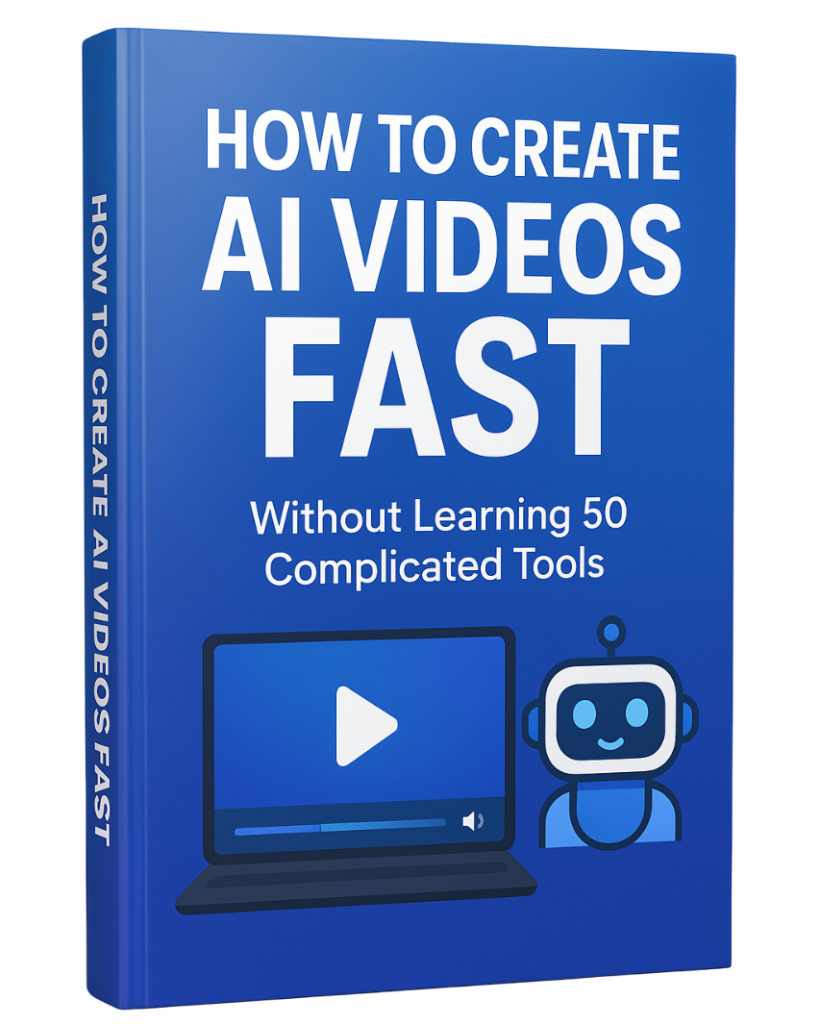
Learn How to Create AI Video Fast an Easy,
If you want a step-by-step guide to create AI videos fast — without learning 50 complicated tools — download the free PDF below and simplify your entire workflow.
Download the free guide:
How to Create AI Videos FAST Without Learning 50 Complicated Tools