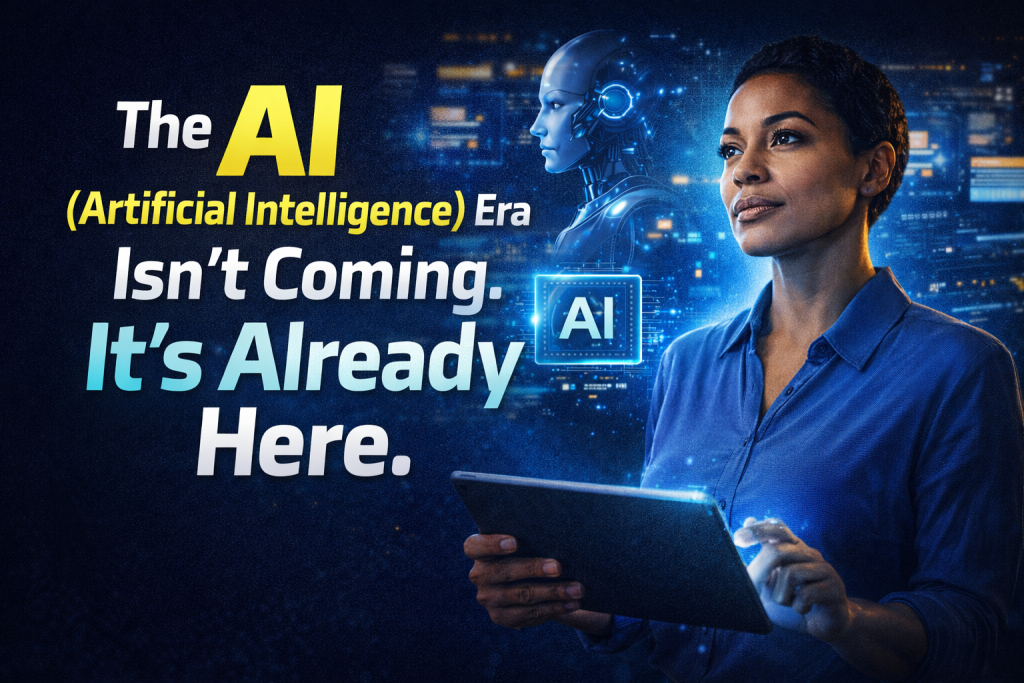
The AI (Artificial Intelligence) Era Isn’t Coming. It’s Already Here.
Did you know that over 60% of startups in 2025 are using AI tools to scale faster, design smarter, and automate more?
From solopreneurs to creative agencies, Artificial Intelligence is becoming the ultimate co-founder.
Here’s what you should know:
- AI isn’t just about ChatGPT. Tools like Runway, Midjourney, and Durable are revolutionizing content, design, and web building.
- Automating client responses, creating logos in seconds, and building landing pages overnight? That’s not sci-fi. That’s now.
- Ignoring AI in your business is like ignoring the internet in 1999.
Start small. Learn fast. Integrate smart.
This is the new creative frontier — and you don’t want to be watching from the sidelines.
The AI Era is now
Artificial Intelligence is often discussed as if it were a distant revolution waiting to arrive. Headlines talk about “what AI will do someday” or “how AI might change the world.” But the truth is far less speculative and far more concrete. The AI era is not approaching. It is already here, quietly embedded into how we work, communicate, buy, create, and make decisions.
What makes this moment different from past technological shifts is not just the power of AI, but its accessibility. Artificial Intelligence is no longer locked inside research labs or massive corporations. It lives in everyday tools, apps, platforms, and workflows. Many people interact with AI dozens of times a day without consciously realizing it.
Understanding this reality is essential, because those who recognize the present impact of AI can adapt, leverage it, and thrive. Those who continue to think of AI as “future tech” risk falling behind in real time.
Why the AI Era Feels Invisible to Many People
One of the reasons people underestimate how advanced AI already is lies in how seamlessly it integrates into daily life. Unlike previous technologies that arrived with dramatic visual changes, AI often operates in the background.
Recommendation engines on streaming platforms, personalized ads, smart assistants, fraud detection systems, navigation apps, and automated customer support are all driven by AI. These systems don’t announce themselves loudly. They simply work, quietly improving efficiency and convenience.
This invisibility creates a false sense that AI is still experimental or limited. In reality, AI has already crossed the threshold from novelty to infrastructure.

AI Has Already Transformed the Way We Work
In the workplace, AI is no longer a bonus skill. It is becoming a baseline expectation. Businesses across industries use AI to automate tasks, analyze data, and enhance productivity.
AI tools now handle:
- Data analysis and reporting
- Content creation and editing
- Customer support and communication
- Scheduling and workflow management
This does not mean humans are being replaced wholesale. Instead, roles are being reshaped. Professionals who know how to work with AI can produce more output, make better decisions, and focus on higher-level thinking.
The AI era is defined less by job loss and more by job evolution. The real risk is not AI replacing people, but people who ignore AI being replaced by those who use it.
AI Is Redefining Business Speed and Competition
One of the clearest signals that the AI era has arrived is the speed at which modern businesses operate. Decisions that once took weeks now take hours. Experiments that required large teams can now be run by individuals.
AI enables businesses to:
- Test ideas faster
- Personalize customer experiences at scale
- Predict trends before they become obvious
- Reduce operational costs dramatically
Small teams can now compete with much larger organizations because AI acts as a force multiplier. This shift has flattened traditional hierarchies and rewritten the rules of competition.
In this environment, agility matters more than size. Intelligence matters more than resources.
AI and Creativity Are No Longer Opposites
For years, creativity was considered a purely human domain. That assumption no longer holds. AI has become a powerful creative partner in writing, design, music, video, and visual storytelling.
AI tools generate:
- Articles, scripts, and marketing copy
- Images and illustrations
- Music and sound design
- Videos and animations
Rather than replacing creativity, AI expands it. Creators use AI to overcome creative blocks, explore variations, and bring ideas to life faster. The human role shifts toward direction, judgment, and originality.
The AI era has blurred the line between technical and creative work, making creativity more accessible while raising the bar for quality.
AI Is Already Embedded in Everyday Life
Beyond work and business, AI influences daily routines in subtle but significant ways. From health tracking to online shopping, AI systems shape choices and experiences.
Examples include:
- Fitness apps that adapt training plans
- Smart home systems that learn preferences
- E-commerce platforms that predict needs
- Navigation apps that optimize routes in real time
These systems continuously learn from behavior, improving over time. The result is a world that feels more personalized, responsive, and efficient.
The AI era is not defined by humanoid robots walking the streets. It is defined by intelligent systems quietly optimizing everyday decisions.
Education and Learning Have Entered the AI Age
Learning has undergone a fundamental shift thanks to AI. Personalized education, once a luxury, is now scalable.
AI-powered learning tools adapt content based on:
- Skill level
- Learning speed
- Knowledge gaps
- Personal goals
Students, professionals, and lifelong learners can access customized guidance at any time. This democratization of learning reduces barriers and accelerates skill acquisition.
In the AI era, learning is no longer linear or standardized. It is adaptive, on-demand, and deeply personalized.
AI Ethics and Responsibility Are No Longer Optional
The arrival of the AI era brings serious ethical responsibilities. As AI systems influence decisions at scale, issues like bias, transparency, and data privacy become critical.
Governments, companies, and institutions are actively developing frameworks to regulate AI use. Responsible organizations implement safeguards to ensure AI systems align with human values and societal norms.
Ignoring ethics is not just risky, it is short-sighted. Trust will be one of the most valuable currencies in the AI era.
Why Resistance to AI Is a Dangerous Strategy
Some individuals and organizations still view AI with skepticism or fear, hoping its impact will slow down or reverse. History suggests this is a losing strategy.
Technological shifts do not wait for consensus. They reward early adopters who experiment, adapt, and learn quickly. Resistance often leads to irrelevance, not protection.
The AI era rewards curiosity over fear and adaptability over denial.
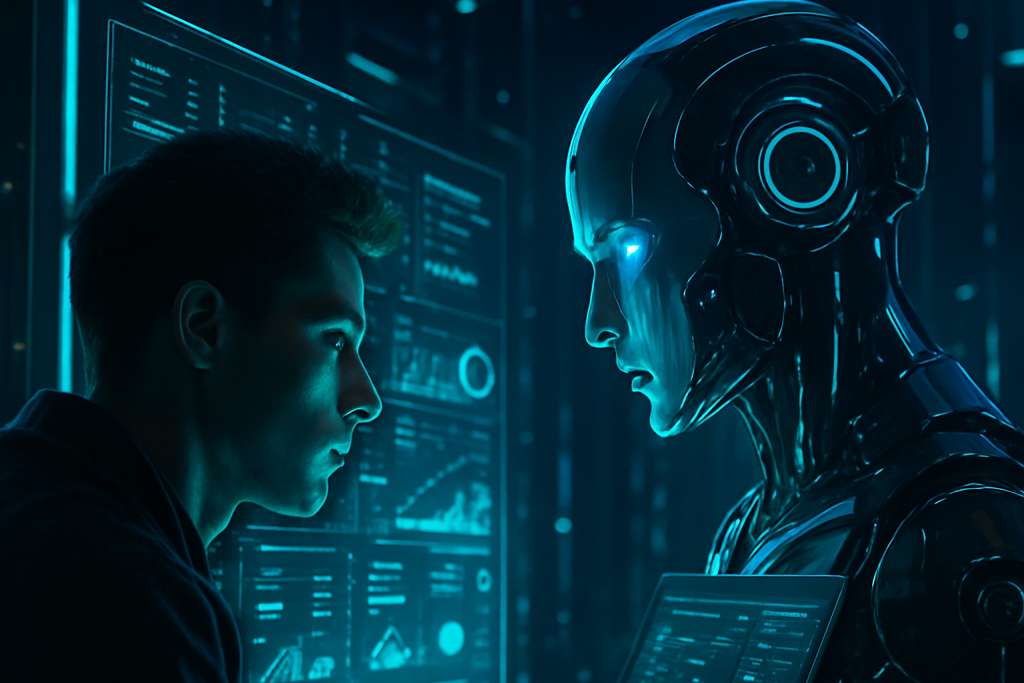
How Individuals Can Thrive in the AI Era
Thriving in the AI era does not require becoming a programmer or data scientist. It requires a mindset shift.
Key principles include:
- Learning how AI tools work at a practical level
- Using AI to augment, not replace, human skills
- Focusing on creativity, critical thinking, and judgment
- Staying adaptable as tools evolve
Those who treat AI as a collaborator rather than a threat position themselves for long-term success.
The AI Era Is a Present Reality, Not a Future Event
Perhaps the most important realization is this: waiting for the AI era to begin is like waiting for the internet to arrive after it already reshaped the world.
Artificial Intelligence is already embedded in the systems we depend on. The question is not whether it will change society, but how consciously we choose to engage with it.
Those who recognize that the AI era is already here can shape their future. Those who don’t may wake up one day wondering how everything changed so fast.
The future of AI is still being written, but the present is already unmistakably intelligent.
FAQs – The AI Era Isn’t Coming. It’s Already Here
1. What does it mean that the AI era is already here?
It means artificial intelligence is no longer experimental or futuristic—it is actively integrated into daily life. From search engines and recommendation systems to content creation, automation, and business analytics, AI is already shaping decisions, workflows, and consumer experiences at scale.
2. How is AI impacting everyday life right now?
AI powers tools people use daily, including:
- Smart assistants
- Navigation apps
- Social media algorithms
- Online shopping recommendations
- Customer service chatbots
Most users interact with AI multiple times per day without even realizing it.
3. Is AI replacing jobs or creating new ones?
Both. AI automates repetitive and predictable tasks, which can reduce demand in certain roles. At the same time, it creates new opportunities in AI management, prompt engineering, automation strategy, data analysis, and AI-assisted content production. The shift is more about adaptation than elimination.
4. Why do some people still think the AI era is “coming”?
Because many focus on futuristic concepts like artificial general intelligence or humanoid robots. However, practical AI—task-specific systems—is already deeply embedded in industries such as marketing, finance, healthcare, logistics, and media production.
5. What industries are being transformed the fastest?
Some of the fastest transformations are happening in:
- Digital marketing
- Content creation and media
- E-commerce
- Software development
- Customer support
These sectors benefit immediately from automation and scalable intelligence tools.
6. How should individuals prepare for the AI era?
Preparation involves:
- Learning how AI tools work
- Understanding automation workflows
- Developing strategic thinking and creativity
- Staying adaptable to new technologies
The goal is not to compete against AI, but to collaborate with it effectively.
7. What is the biggest misconception about the AI era?
The biggest misconception is that AI is only for tech experts. In reality, modern AI tools are accessible to entrepreneurs, freelancers, creators, and small business owners. The advantage belongs to those who adopt and integrate AI early—regardless of technical background.
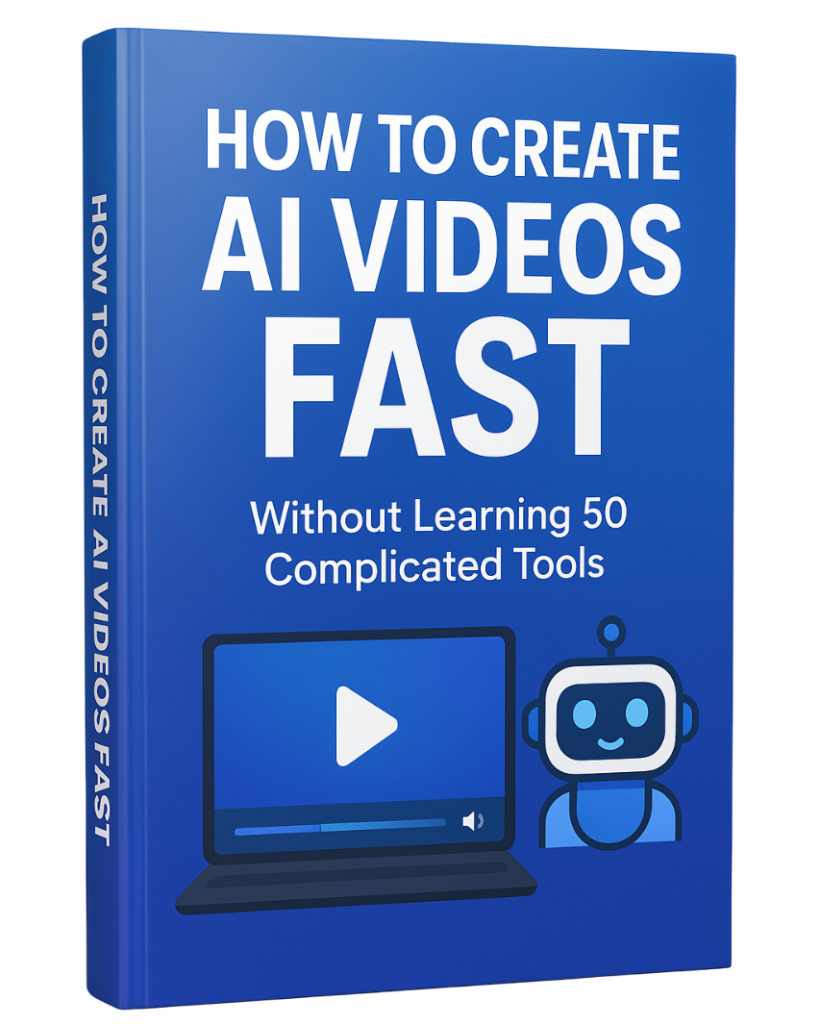
Learn How to Create AI Video Fast an Easy,
If you want a step-by-step guide to create AI videos fast — without learning 50 complicated tools — download the free PDF below and simplify your entire workflow.
Download the free guide:
How to Create AI Videos FAST Without Learning 50 Complicated Tools