AI news: Microsoft Copilot Comes to the U.S. House
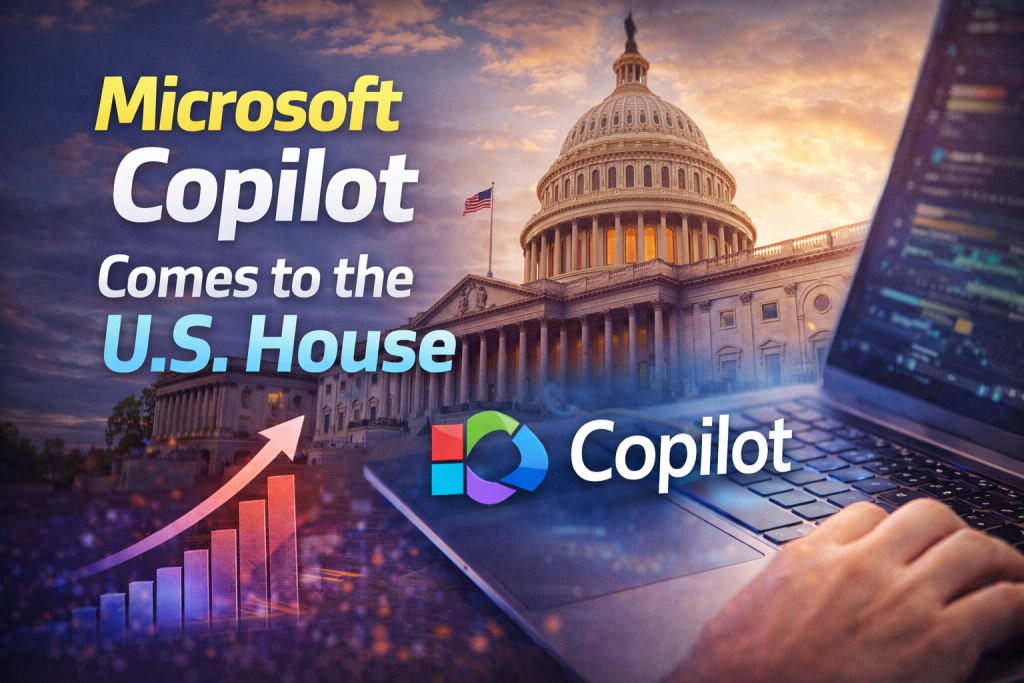
The arrival of Microsoft Copilot in the U.S. House of Representatives marks a pivotal moment in the relationship between artificial intelligence and government. What once sounded like a futuristic idea is now an operational reality inside one of the most influential legislative bodies in the world.
This move is not just about adopting a new productivity tool. It represents a broader shift in how governments are beginning to embrace AI to manage complexity, accelerate decision-making, and modernize outdated workflows. As the scale of information and legislative demands continues to grow, AI is becoming less of a luxury and more of an operational necessity.
Microsoft Copilot’s presence in the U.S. House sends a clear message: AI is no longer experimental in public institutions. It is becoming infrastructure.
What Is Microsoft Copilot
Microsoft Copilot is an AI-powered assistant integrated into Microsoft 365 applications such as Word, Excel, Outlook, PowerPoint, and Teams. Built on advanced large language models and deeply connected to an organization’s internal data, Copilot helps users draft documents, summarize information, analyze data, generate insights, and automate repetitive tasks.
Unlike standalone AI chatbots, Copilot operates inside the tools people already use daily. This contextual integration allows it to assist in real-world workflows rather than functioning as a separate experiment.
For an institution like the U.S. House, where documentation, communication, and analysis are constant, this integration is especially impactful.
Why the U.S. House Is Adopting AI Now
The legislative landscape in the United States has evolved into an environment of constant acceleration. Congress is no longer operating on slow policy cycles where bills move quietly through committees over months without intense public attention. Today, lawmakers and their staff are navigating a nonstop stream of draft legislation, amendments, committee reports, regulatory updates, oversight documents, policy briefings, and thousands of constituent messages arriving daily through email, social media, and official correspondence. The sheer volume of information is not just overwhelming — it is structurally incompatible with purely manual workflows.
Each new bill can span hundreds or even thousands of pages, often filled with technical language that references existing statutes, budget allocations, and regulatory frameworks. Staffers must cross-reference past legislation, identify conflicts, summarize implications, and prepare talking points — all while responding to media inquiries and constituent concerns in real time. The expectation for immediate analysis has increased dramatically, especially in an era where news cycles move by the hour and public reaction forms instantly online.
Traditional processes are struggling under four major pressures. First, legislative volume continues to rise, with more complex policy proposals covering emerging areas like artificial intelligence, cybersecurity, climate strategy, and digital commerce. Second, political and media cycles are faster than ever, meaning delays in analysis can translate into narrative disadvantages. Third, public scrutiny has intensified, with watchdog groups, journalists, and citizens demanding transparency and accuracy. And fourth, staffing constraints remain real. Congressional offices operate with limited personnel and fixed budgets, making it difficult to scale human review capacity in proportion to workload growth.
This is precisely where AI tools such as Microsoft Copilot enter the conversation. Rather than replacing staff members, these systems function as force multipliers. They can rapidly summarize long documents, highlight key sections, compare legislative drafts, extract relevant data points, and assist in drafting memos or responses. What previously required hours of manual reading can now be accelerated into minutes, allowing human experts to focus on interpretation, strategy, and decision-making instead of repetitive formatting and scanning tasks.
The move to adopt AI reflects a broader institutional recognition: effective governance in the digital age requires efficiency, speed, and precision. When legislative decisions influence national security, economic policy, healthcare systems, and technological regulation, the ability to process information accurately and quickly becomes a democratic necessity — not a luxury. Embracing AI tools signals that Congress understands the scale of modern complexity and is seeking pragmatic ways to enhance its operational capacity without expanding bureaucracy.
In short, the adoption of AI is less about technological experimentation and more about adapting governance to the realities of a high-velocity information era.

How Microsoft Copilot Will Be Used in the U.S. House
Microsoft Copilot is expected to support a wide range of day-to-day activities within congressional offices and committees.
Common use cases include:
- Drafting and summarizing legislative documents
- Analyzing large datasets and reports
- Preparing briefing notes and memos
- Managing emails and scheduling
- Summarizing meeting transcripts
- Supporting research and policy analysis
Instead of starting from scratch, staff can use Copilot to generate structured drafts and refine them with human expertise.
This dramatically reduces time spent on administrative tasks and allows staff to focus on higher-value work.
Microsoft Copilot Improving Legislative Productivity
One of the most immediate benefits of Copilot is productivity. Congressional staff often work under intense time pressure, especially during legislative sessions.
Copilot helps by:
- Reducing document preparation time
- Surfacing key insights quickly
- Minimizing repetitive manual work
- Enhancing collaboration across teams
By automating routine tasks, Copilot enables faster turnaround without sacrificing quality.
This matters in a legislative environment where delays can have real-world consequences.
AI as a Research Assistant, Not a Decision Maker
It is important to understand that Copilot does not replace human judgment. In the U.S. House, AI is positioned as a support tool, not a policymaker.
Copilot can:
- Summarize existing information
- Highlight patterns and trends
- Suggest drafts or outlines
But final decisions remain entirely in human hands.
This distinction is critical for maintaining democratic accountability while still benefiting from AI-driven efficiency.
Security, Privacy, and Compliance Concerns
One of the biggest barriers to AI adoption in government is security. Microsoft Copilot operates within Microsoft’s enterprise-grade security framework, which is designed to meet strict compliance standards.
Key considerations include:
- Data access controls
- Government-grade encryption
- Audit logs and monitoring
- Compliance with federal regulations
Copilot does not train on user data or expose sensitive information outside authorized environments. This makes it suitable for use in sensitive government contexts.
Security and trust are foundational to Copilot’s deployment in the U.S. House.
A Signal to Other Government Institutions
The U.S. House adopting Microsoft Copilot sets a precedent for other government bodies at local, state, and federal levels.
It sends a signal that:
- AI can be safely integrated into public institutions
- Modern tools can coexist with regulatory requirements
- Digital transformation is no longer optional
This move is likely to accelerate AI adoption across the public sector.
Government agencies watching this deployment will learn from its successes and challenges.
The Broader Impact on Public Sector Innovation
Public sector organizations are often criticized for being slow to innovate. The introduction of Copilot challenges that perception.
AI can help governments:
- Improve service delivery
- Reduce operational costs
- Enhance transparency
- Increase responsiveness
While AI will not solve political or structural issues, it can dramatically improve how work gets done.
The U.S. House adopting Copilot shows that innovation and governance are not mutually exclusive.
Concerns and Criticisms Around AI in Government
Despite its benefits, AI in government raises legitimate concerns.
Critics worry about:
- Over-reliance on automation
- Bias in AI-generated outputs
- Lack of transparency
- Potential misuse of technology
The integration of artificial intelligence into government operations is not happening without friction. While AI promises efficiency, scalability, and improved analytical capabilities, it also raises serious concerns that cannot be ignored — especially when public institutions and democratic processes are involved. Government decisions impact millions of lives, and any technology influencing those decisions must meet higher standards of accountability, transparency, and fairness than tools used in the private sector.
One of the primary concerns revolves around transparency. Many AI systems, particularly advanced language models, operate as complex “black boxes.” Even developers sometimes struggle to fully explain how specific outputs are generated. In a legislative environment where every interpretation, summary, or recommendation can shape public policy, critics question whether it is appropriate to rely on systems that lack fully traceable reasoning processes. If an AI tool summarizes a bill incorrectly or omits critical nuance, who is responsible? The software provider? The staffer who relied on it? The institution itself?
Data privacy is another major issue. Congressional offices handle sensitive information daily — including confidential policy drafts, internal communications, and constituent data. Introducing AI systems into this workflow requires strict safeguards to ensure that sensitive material is not exposed, stored improperly, or used to further train external models without consent. Even the perception of data vulnerability could erode public trust.
Bias is perhaps the most politically sensitive criticism. AI systems are trained on vast datasets that inevitably contain historical and cultural biases. If these biases influence how information is summarized, framed, or prioritized, they could subtly shape legislative analysis in unintended ways. In a polarized political climate, even minor distortions can become major controversies. The risk is not necessarily that AI will “choose sides,” but that hidden statistical patterns in training data may reflect unequal representations of viewpoints.
There is also concern about overreliance. Efficiency gains can create dependency. If staff begin trusting AI-generated summaries without rigorous review, errors may slip through. Governance requires judgment, contextual understanding, and ethical reasoning — qualities that cannot be fully automated. AI can assist, but it cannot replace human deliberation. The danger lies in gradually shifting from “AI as assistant” to “AI as authority.”
Finally, there are broader philosophical questions about democratic integrity. Citizens expect elected officials and their teams to personally engage with legislation. Even if AI accelerates document processing, critics argue that lawmakers must remain deeply involved in reviewing and understanding the content that shapes national policy. Technology should enhance human capacity, not dilute responsibility.
These concerns do not automatically invalidate AI adoption in government. Rather, they highlight the importance of implementing safeguards: clear usage policies, human oversight requirements, auditing mechanisms, and strict data protection standards. If deployed thoughtfully, AI can strengthen institutional capacity. If implemented carelessly, it risks undermining public confidence.
The debate is not about whether AI will enter government workflows — that shift is already underway. The real question is how responsibly it will be integrated, and whether transparency and accountability will evolve alongside technological capability.
These concerns highlight the importance of responsible AI governance, clear usage guidelines, and human oversight.
Microsoft Copilot and government institutions must continue to address these risks proactively.
Why Microsoft Is Leading This Shift
Microsoft has positioned itself as a key partner for enterprise and government AI adoption. Its focus on compliance, security, and integration makes it a natural choice for public institutions.
Key advantages include:
- Deep enterprise relationships
- Robust security infrastructure
- Long-standing government partnerships
- Scalable cloud and AI services
Copilot builds on Microsoft’s existing footprint rather than requiring institutions to reinvent their tech stack.
This reduces friction and accelerates adoption.
Microsoft Copilot: The Role of AI in the Future of Democracy
The integration of AI into legislative work raises important questions about the future of democracy.
Used responsibly, AI can:
- Enhance informed decision-making
- Improve legislative efficiency
- Increase transparency
- Support evidence-based policy
Used poorly, it could erode trust or amplify existing problems.
The U.S. House’s approach to Copilot will influence how AI is perceived in democratic institutions worldwide.

A Cultural Shift Inside Government Workflows
Beyond technology, Copilot introduces a cultural shift. Staff must learn how to collaborate with AI, verify outputs, and adapt workflows.
This requires:
- Training and education
- Clear usage policies
- Ethical guidelines
- Change management
Successful AI adoption is as much about people as it is about tools.
What This Means for Businesses and Creators
The adoption of Copilot by the U.S. House has ripple effects beyond government.
It legitimizes AI as a serious productivity tool and accelerates adoption across industries. Businesses, creators, and professionals are watching closely.
If AI is trusted in government, it signals readiness for broader enterprise use.
Microsoft Copilot in the U.S. House Is a Turning Point
Microsoft Copilot coming to the U.S. House represents more than a software deployment. It marks a turning point in how institutions approach artificial intelligence.
AI is no longer confined to startups, tech companies, or experimental labs. It is becoming embedded in the core operations of government.
This moment signals the beginning of a new era where AI supports governance, improves efficiency, and reshapes how public institutions function.
The future of government will not be AI-driven, but it will be AI-assisted. And that future has officially begun.

Learn How to Create AI Video Fast an Easy,
If you want a step-by-step guide to create AI videos fast — without learning 50 complicated tools — download the free PDF below and simplify your entire workflow.
Download the free guide:
How to Create AI Videos FAST Without Learning 50 Complicated Tools