AI Tools for Video Creation Introduction
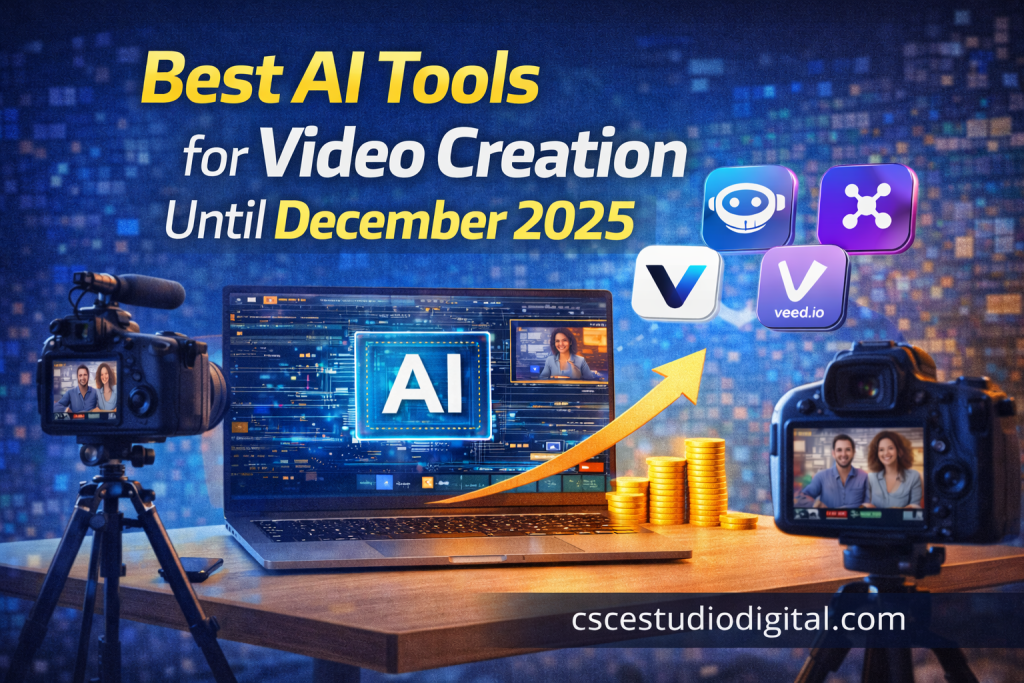
AI-powered video creation has moved from experimental technology to a core asset for creators, marketers, educators, and affiliate businesses. By the end of 2025, AI video tools are not just accelerating production, they are redefining how content is monetized across platforms like YouTube, TikTok, Instagram Reels, Pinterest, and landing pages. This guide covers the most powerful and reliable AI video tools to use up to December 2025, explaining what makes each platform valuable, who should use it, and how it fits into a long-term monetization strategy.
Why AI Video Tools Matter in 2025
Video remains the highest-converting content format online, but traditional production is slow, expensive, and skill-intensive. AI tools now remove those barriers. Creators can produce dozens of videos per day, brands can personalize content at scale, and affiliates can test offers faster than ever. Algorithms reward consistency and retention, and AI enables both. The competitive edge in 2025 is not video quality alone, but speed, iteration, and distribution efficiency.

Best AI Tools for Video Creation in 2025
Artificial intelligence has completely transformed the way videos are produced. What once required expensive equipment, professional editors, and days of production can now be done in minutes using AI video generators.
For creators, marketers, and affiliate publishers, this shift creates a massive opportunity. The right tools allow you to produce content faster, test more ideas, and scale distribution across platforms like YouTube, TikTok, Instagram Reels, and Pinterest.
However, not all AI video tools are designed for the same purpose. Some focus on cinematic generation, others on avatars, automation, editing, or content repurposing. Understanding where each platform excels helps creators build an efficient workflow rather than wasting time jumping between dozens of tools.
Below are some of the most powerful AI video platforms shaping the creator economy in 2025.
Google Veo 3
Google Veo 3 is widely considered one of the most advanced text-to-video models currently available. The system focuses on generating highly realistic video sequences from prompts, producing footage that often resembles professional cinematography rather than synthetic animation.
One of the most impressive aspects of Veo 3 is its ability to maintain narrative coherence across scenes. Many AI video generators struggle to keep visual consistency, but Veo produces smoother motion, more accurate physics, and scenes that feel visually grounded.
This makes it particularly powerful for creators working in storytelling formats, product ads, cinematic short films, and premium brand content.
Another major advantage is its effectiveness for vertical video platforms. Short-form content relies heavily on visual impact in the first seconds, and Veo’s realism helps capture attention quickly. For creators targeting YouTube Shorts, TikTok, or Instagram Reels, this visual quality can significantly improve viewer retention.
For monetization strategies, Veo 3 fits best in systems where visual authority matters. Creators often use it for:
• high-end promotional videos
• product demonstrations
• brand storytelling
• affiliate landing page visuals
• social media traffic funnels
Because of its cinematic output, Veo 3 is especially useful for creators building brand authority or premium digital products.
Runway
Runway remains one of the most versatile AI video platforms available. Unlike tools that focus purely on automatic generation, Runway combines AI creation with professional editing capabilities.
This hybrid approach is why many filmmakers, YouTubers, and creative agencies rely on it.
Runway includes features such as:
• AI video generation
• background removal
• motion tracking
• video inpainting
• scene expansion
• AI-assisted editing tools
Instead of replacing the editing process entirely, Runway accelerates it. Creators can generate elements with AI and then refine them manually to produce more polished results.
This workflow is particularly valuable for long-form content and projects where storytelling structure matters.
Runway performs extremely well in content formats such as:
• YouTube documentaries
• video sales letters (VSLs)
• educational video courses
• marketing campaigns
• cinematic social media content
Because it blends automation with creative control, Runway is often chosen by creators who want speed without sacrificing quality.
Pika Labs
Pika Labs has quickly become a favorite among creators focused on short-form content and experimental visuals. The platform emphasizes fast generation, stylized animation, and playful video effects rather than strict realism.
This makes it ideal for creators who prioritize volume and creative experimentation.
Short-form platforms reward novelty and frequent posting. Pika allows users to quickly test multiple visual concepts, hooks, and storytelling formats without spending hours editing.
Many creators use Pika Labs to produce:
• viral social media clips
• animated storytelling videos
• stylized brand visuals
• meme-style content
• trend-driven short videos
Affiliate marketers and content creators often rely on Pika when testing different video ideas across TikTok, Instagram, and YouTube Shorts. Because production is so fast, it becomes easier to identify which hooks or formats perform best.
Instead of focusing on perfection, Pika Labs encourages creative experimentation and high output.
Synthesia
Synthesia dominates the AI avatar video space and has become one of the most widely used platforms for professional talking-head videos.
The core concept is simple: users write a script, select an AI avatar, choose a voice and language, and the platform generates a polished presenter video without cameras, studios, or actors.
This makes Synthesia particularly useful for companies and educators who need scalable video production.
Common use cases include:
• corporate training videos
• software tutorials
• onboarding content
• product explainers
• multilingual marketing campaigns
Synthesia also supports multiple languages, making it easier for global brands to produce localized content without recording new footage.
For monetization strategies, Synthesia works well in structured information content. Creators often use it for evergreen YouTube videos, educational channels, and professional websites where clarity and authority drive conversions.
HeyGen
HeyGen has rapidly gained popularity as a more creator-friendly alternative in the AI avatar category. While it shares similarities with Synthesia, HeyGen places stronger emphasis on natural expressions, accurate lip-sync, and approachable presentation styles.
The result is avatar content that feels more authentic and less corporate.
This makes HeyGen particularly valuable for personal brands, coaches, consultants, and affiliate marketers who want face-driven content but prefer not to appear on camera themselves.
HeyGen works extremely well for:
• educational short videos
• personal brand content
• social media explainers
• digital product promotions
• affiliate marketing content
Because the avatars feel more conversational, HeyGen helps bridge the gap between professional presentation and creator-style authenticity.
For many marketers, it offers an efficient way to produce personality-driven content without needing recording equipment.
InVideo AI
InVideo AI focuses on speed and automation rather than cinematic video generation. Its main strength lies in transforming written content into ready-to-publish videos.
Users can provide a prompt, article, or script, and the platform automatically generates a structured video complete with visuals, captions, and music.
This makes it extremely attractive for bloggers, marketers, and content publishers who want to expand into video without starting from scratch.
InVideo AI is particularly effective for content repurposing strategies such as:
• turning blog posts into YouTube videos
• converting articles into video summaries
• creating Pinterest video pins
• generating quick educational clips
• scaling SEO-driven content systems
For websites already generating organic traffic through written content, InVideo AI becomes a powerful amplification tool.
Instead of writing entirely new scripts, creators can transform existing articles into videos and distribute them across multiple platforms.
Lumen5
Lumen5 has been around longer than many newer AI tools, but it remains a reliable platform for simple video creation from written content.
Unlike more advanced generators, Lumen5 focuses on ease of use and brand consistency rather than complex AI generation.
The platform allows users to convert blog posts, marketing copy, or social media text into lightweight videos using templates, stock footage, and automated scene generation.
Businesses often use Lumen5 for:
• social media marketing videos
• brand awareness campaigns
• content distribution strategies
• blog promotion
• short informational clips
While it may not deliver the cinematic realism of newer AI video models, its simplicity makes it useful for teams that prioritize speed and consistency.
For many organizations, Lumen5 works best as a complementary tool within a broader content marketing strategy.
Descript
Descript stands apart from most tools in this list because it focuses on editing rather than generation. Instead of creating videos from prompts, Descript simplifies the production workflow through AI-powered editing features.
One of its most powerful innovations is text-based editing. Users can edit video and audio simply by editing the transcript, which dramatically speeds up post-production.
Descript also includes tools for:
• automatic transcription
• voice cloning
• overdubbing
• podcast editing
• screen recording
• AI filler word removal
This makes it extremely popular among podcasters, educators, and YouTubers who produce dialogue-driven content.
For creators managing faceless channels or educational platforms, Descript significantly reduces editing time. Instead of spending hours cutting clips manually, creators can focus on publishing more content consistently.
In monetization terms, Descript doesn’t generate videos directly, but it improves efficiency. That efficiency allows creators to scale production and maintain a consistent publishing schedule, which is often the real key to growth.

How to Choose the Right AI Video Tool
Choosing the right AI video tool is not about picking the “most powerful” platform. It’s about selecting the tool that fits your content strategy and monetization goal. Many creators waste time experimenting with dozens of tools without understanding how those tools support their overall business model.
A better approach is to start with the outcome you want. Are you trying to generate viral traffic, build authority, sell products, or scale SEO content? Each of these goals requires a slightly different type of video production workflow.
For creators focused on short-form traffic and viral reach, tools that generate visually engaging clips quickly are the most valuable. Platforms such as Veo 3, Pika Labs, and Runway excel in this environment because they allow rapid experimentation with different ideas, visuals, and storytelling formats. These tools are particularly effective for platforms like TikTok, Instagram Reels, and YouTube Shorts where attention is captured within seconds.
If the goal is authority, trust, and higher conversion rates, avatar-based platforms often perform better. Tools like Synthesia and HeyGen allow creators to present information in a professional, structured format without needing cameras, lighting, or recording equipment. This makes them ideal for educational videos, product explainers, onboarding content, and evergreen marketing systems where clarity and credibility influence purchasing decisions.
For publishers, bloggers, and SEO-driven businesses, scalability is often more important than visual complexity. In those cases, tools such as InVideo AI and Descript provide an efficient way to transform written content into video assets. Articles can become YouTube videos, blog summaries can become social clips, and podcasts can quickly turn into video content without extensive editing.
One of the most important realizations successful creators have in 2025 is that a single tool rarely does everything well. Instead of relying on one platform, many creators build modular tool stacks where each tool handles a specific stage of production.
A typical stack might look like this:
• a text-to-video tool for visual generation
• an avatar tool for educational or authority content
• an editing platform for polishing and repurposing
• an automation platform for publishing and distribution
By assigning a clear role to each tool, creators avoid complexity while still benefiting from the strengths of multiple platforms. The result is a more efficient workflow that can scale over time.
Monetization Strategies Using AI Video
AI tools for video creation are not just about producing content faster. They open the door to multiple monetization strategies that were previously difficult or expensive to implement.
One of the most common revenue models is affiliate marketing. Creators produce informational or entertaining videos that introduce a problem, demonstrate a solution, and then direct viewers toward an affiliate offer. AI video generation allows this process to happen at a much larger scale, making it easier to test multiple niches, products, and hooks.
Another major revenue stream comes from advertising platforms. YouTube, in particular, remains one of the strongest ecosystems for creators generating consistent content. Long-form AI-assisted videos can build watch time and authority, eventually unlocking ad revenue once the channel reaches monetization thresholds.
Digital products represent another powerful opportunity. Many creators use AI video tools to produce educational content, tutorials, or mini-courses that can be sold directly to their audience. AI dramatically reduces production time, making it possible to launch digital products faster and update them regularly.
Lead generation is another frequently overlooked strategy. Instead of selling directly from a video, creators use videos to attract viewers and then capture email subscribers. These subscribers can later be nurtured through newsletters, automated funnels, and product launches. AI video allows creators to produce consistent content that feeds this audience-building process.
Brand partnerships and sponsorships also become more accessible once a creator has a consistent publishing system. Brands care less about whether content is AI-assisted and more about audience reach, engagement, and influence within a niche.
Different video formats support different parts of the revenue funnel. For example:
• short-form videos capture attention and generate traffic
• long-form videos build trust and authority
• AI avatar videos deliver clear explanations and sales messages
• repurposed content expands distribution across platforms
The creators who succeed with AI video rarely depend on a single revenue stream. Instead, they combine multiple monetization layers that reinforce each other over time.
Future Outlook Through December 2025
AI video technology is evolving at an extremely fast pace, and the next phase of development is already becoming clear. The focus is shifting away from simple novelty and toward practical production systems that integrate directly with marketing infrastructure.
One major trend is the rapid improvement in visual realism. Early AI video models often struggled with motion consistency, unnatural physics, or visual artifacts. Newer systems are producing smoother motion, more believable environments, and better object interactions. This makes AI video increasingly viable for professional marketing and storytelling applications.
Another important development is personalization. AI models are becoming better at generating content tailored to specific audiences, demographics, or brand styles. Instead of creating one generic video, creators will be able to generate multiple variations optimized for different platforms, audiences, or campaign goals.
Integration is also accelerating. AI video platforms are beginning to connect directly with advertising systems, analytics tools, and e-commerce platforms. This means creators will eventually be able to generate, publish, analyze, and optimize videos from a single workflow rather than using multiple disconnected tools.
Automation will also play a larger role. Content pipelines that automatically convert blog posts into videos, generate social clips from long-form content, and distribute those assets across platforms are becoming increasingly common. These systems transform video production from a manual task into a repeatable process.
By the end of 2025, AI video creation will likely be less about experimenting with new technology and more about operational advantage. The creators who build structured production systems today will be able to publish faster, test more ideas, and adapt to platform trends more quickly than competitors.
In attention-driven markets where visibility determines revenue, that operational advantage can become the difference between occasional success and long-term sustainability.

Emerging AI Video Tools to Watch
As the AI video ecosystem expands, new platforms continue entering the market with specialized capabilities. While major tools like Google Veo 3 and Runway dominate headlines, smaller and emerging platforms are quietly building innovative solutions for creators who prioritize speed, experimentation, and creative flexibility.
These newer tools often focus on specific niches of the AI video workflow. Some emphasize rapid prototyping, others aim for cinematic storytelling, and some prioritize creative experimentation. For creators and marketers who want an edge, keeping an eye on emerging platforms can provide early access to powerful production advantages.
Two platforms that have recently gained attention among creators and AI video enthusiasts are Nano Banana and Hailuo AI.
Nano Banana
Nano Banana is gaining attention as a lightweight, experimental AI video generation tool focused on speed, creative freedom, and rapid iteration. Rather than competing directly with high-end cinematic engines, the platform positions itself as a creative sandbox where ideas can be tested quickly and frequently.
The main strength of Nano Banana lies in how fast creators can move from concept to visual output. This makes it particularly attractive for social-first content strategies where volume and experimentation matter more than perfect realism. Creators producing faceless vertical videos, looping visual content, meme-style clips, or experimental storytelling formats can generate multiple variations in a short amount of time.
For content creators managing high-frequency publishing schedules, this speed becomes a strategic advantage. Instead of investing significant time refining a single concept, creators can test dozens of ideas, analyze audience reactions, and double down on the concepts that perform best.
Nano Banana also works well for early-stage concept development. A creator might use it to quickly visualize hooks, storytelling angles, or visual themes before investing additional effort in higher-production tools. In this way, the platform becomes a testing environment that feeds more advanced production pipelines.
Affiliate marketers, in particular, benefit from this type of rapid experimentation. Testing different product angles, emotional hooks, and visual storytelling styles can reveal what resonates most with audiences. Once winning concepts are identified, creators can scale production using more sophisticated tools while maintaining the creative direction validated through experimentation.
Although the platform is still evolving, Nano Banana represents an important shift in the AI video landscape. Not every tool needs to be cinematic. Some tools are valuable precisely because they make creative exploration faster and more accessible.
Hailuo (Hailuo AI)
Hailuo AI has emerged as a promising platform focused on realistic motion, character consistency, and emotionally expressive video output. While still developing its ecosystem, the platform is attracting attention from creators interested in narrative-driven content and cinematic storytelling.
One of Hailuo’s most notable strengths is its ability to produce visually cohesive scenes where characters, environments, and motion behave in a more believable way compared to many early AI video systems. This consistency makes it particularly useful for storytelling formats where visual continuity plays an important role.
Creators who produce cinematic short clips, narrative sequences, or visual storytelling videos often struggle with maintaining character identity and scene coherence across multiple shots. Hailuo is designed to address these challenges by improving how characters move, interact, and express emotion within generated scenes.
Because of these strengths, the platform is especially appealing for creators developing story-based marketing funnels. Narrative content has long been one of the most powerful ways to influence audiences, build emotional connections, and guide viewers toward purchasing decisions. When viewers feel emotionally engaged with a story, they are far more likely to remember the message and take action.
In marketing contexts, Hailuo can be used for brand storytelling videos, cinematic advertisements, visual product narratives, or emotionally driven promotional content. These types of videos often perform well in premium short-form environments where visual quality and storytelling depth influence viewer retention.
Another advantage is that creators can achieve cinematic-style visuals without relying on traditional video production equipment or advanced editing knowledge. This dramatically lowers the barrier to entry for storytellers who previously lacked the resources required to produce high-quality visual narratives.
As the platform continues evolving, Hailuo AI is positioning itself as a compelling option for creators who want visually rich storytelling tools without the steep learning curve of professional filmmaking software.
Conclusion
The best AI video tools through December 2025 are not simply production shortcuts. They are business multipliers that allow creators, marketers, and digital entrepreneurs to operate with greater speed, flexibility, and scale.
AI video platforms are transforming the way content is produced, distributed, and monetized across the internet. Tasks that once required large teams, expensive equipment, and extensive editing time can now be completed by individual creators using automated workflows and intelligent production systems.
For those focused on growing traffic, building authority, promoting affiliate products, or scaling digital brands, AI video tools have become a critical part of the modern content ecosystem. They allow creators to publish consistently, test ideas quickly, and expand their reach across multiple platforms without dramatically increasing workload.
Perhaps most importantly, the barrier to entry has never been lower. Creators who understand how to combine strategy with automation can compete in markets that were previously dominated by large media teams and established brands.
The opportunity is no longer something that lies in the future. It is already shaping the present landscape of online content. The creators who recognize this shift and build structured AI video workflows today will be the ones best positioned to capture attention, grow audiences, and generate revenue in the years ahead.
Author’s Note:I research and evaluate AI video tools from the perspective of a digital entrepreneur who builds and monetizes content sites across multiple niches. My focus is always practical: does this tool fit into a real production workflow, what does it actually cost at scale, and does it deliver value for creators building long-term online assets. This review reflects that analytical approach, combined with direct exploration of the platform.
AI Video Creation System
Learn How to Create AI Videos Fast an Easy,
If you want a step-by-step guide to create AI videos fast — without learning 50 complicated tools — download the free PDF below and simplify your entire workflow.
Download the free guide:
How to Create AI Videos FAST Without Learning 50 Complicated Tools