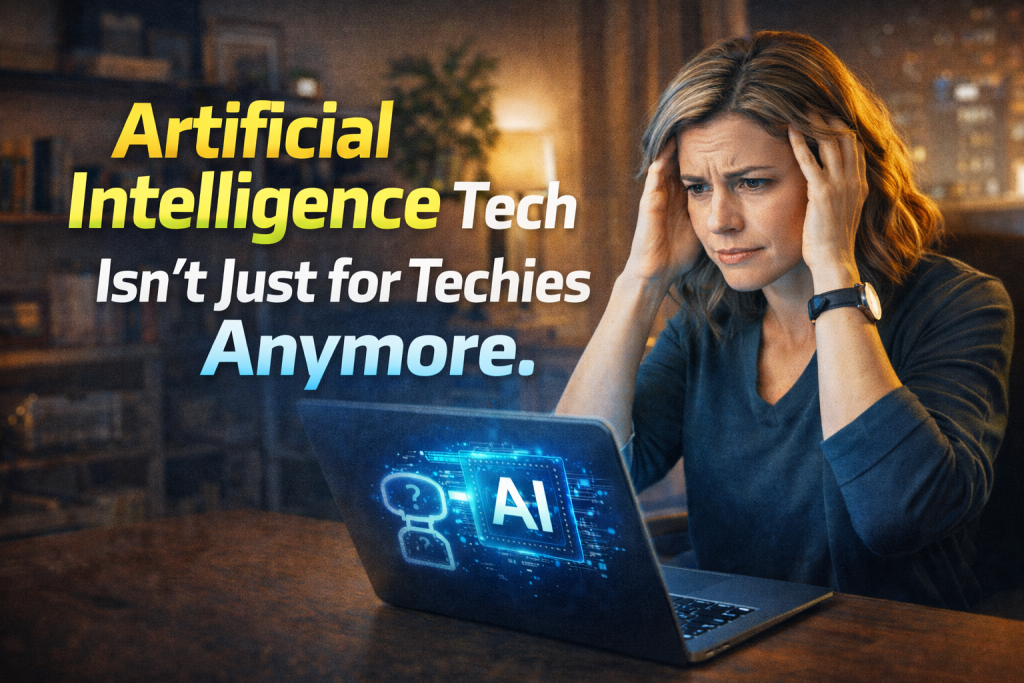
Artificial Intelligence tech Isn’t Just for Techies Anymore
You don’t need to code to benefit from Artificial Intelligence.
Solopreneurs, content creators, artists, even small shop owners — AI is now accessible, visual, and user-friendly.
For years, Artificial Intelligence tech carried an intimidating reputation. It was seen as complex, technical, and reserved exclusively for programmers, data scientists, and engineers working inside large tech companies. That perception shaped how many people viewed AI: powerful, yes, but distant and inaccessible.
That reality has changed completely.
Today, Artificial Intelligence is no longer just for techies. It has quietly evolved into a set of practical, user-friendly tools designed for everyday people. Entrepreneurs, marketers, designers, writers, educators, freelancers, and even small business owners now use AI daily, often without needing any technical background at all.
The AI revolution did not become mainstream by asking people to learn code. It became mainstream by adapting to how people already work.
How Artificial Intelligence tech Shifted From Technical to Practical
Early AI systems required specialized knowledge to operate. Models had to be trained manually, data needed careful preparation, and interfaces were built for experts. This limited adoption to a narrow audience.
Modern AI tools flipped that model.
Instead of forcing users to adapt to AI, AI adapted to users. Natural language interfaces, visual dashboards, and automation workflows removed complexity. Now, people interact with AI simply by typing, clicking, or speaking.
This shift from technical depth to practical usability is the reason AI adoption has exploded across non-technical industries.

AI Tools Are Designed for Real-World Jobs
Artificial Intelligence tech today solves everyday problems, not abstract technical challenges. Its value lies in speed, clarity, and efficiency.
AI tools now support tasks such as:
- Writing emails, articles, and marketing copy
- Designing visuals and presentations
- Editing videos and generating subtitles
- Analyzing customer behavior and trends
- Managing schedules and automating workflows
None of these require coding knowledge. They require understanding goals, context, and outcomes.
AI has become less about how it works internally and more about what it helps people achieve.
Why Non-Tech Professionals Are Embracing AI
The biggest driver behind AI adoption outside of tech is pressure. Modern work environments demand more output, faster turnaround times, and constant adaptation.
AI offers leverage.
- Marketers use AI to generate ideas, test messaging, and personalize campaigns.
- Designers use AI to speed up drafts and explore variations.
- Content creators use AI to script, edit, and publish at scale.
- Business owners use AI to automate repetitive tasks and decision-making.
In each case, AI does not replace expertise. It amplifies it.
Artificial Intelligence tech Is Becoming a Core Business Skill
Just as digital literacy became essential in the internet era, AI literacy is becoming essential now. This does not mean everyone needs to understand machine learning models. It means understanding how to use AI strategically.
Businesses increasingly expect teams to:
- Know which AI tools solve specific problems
- Use AI to improve efficiency and quality
- Evaluate AI outputs critically
- Integrate AI into existing workflows
AI is transitioning from a competitive advantage to a baseline capability.
The Rise of No-Code and Low-Code AI Platforms
One of the most important developments making AI accessible is the rise of no-code and low-code platforms. These tools allow users to build AI-powered workflows visually, without writing a single line of code.
With these platforms, users can:
- Automate customer responses
- Create content pipelines
- Analyze data visually
- Build simple AI-driven applications
This democratization removes the technical barrier entirely. The focus shifts from programming to problem-solving.
AI and Creativity: A New Partnership
Perhaps the biggest myth about AI is that it kills creativity. In reality, it often does the opposite.
AI helps creators:
- Overcome creative blocks
- Generate rough drafts quickly
- Explore multiple directions
- Focus on refinement and originality
Writers, designers, musicians, and video creators now treat AI as a creative assistant rather than a replacement. Human creativity guides the vision. AI accelerates execution.
This partnership is redefining creative industries, making high-quality output possible with fewer resources.

Small Businesses Benefit the Most from Accessible AI
Small businesses benefit the most from accessible AI because they operate with limited time, lean teams, and tighter budgets—exactly the conditions where efficiency creates exponential impact. Unlike large corporations that can afford entire departments for marketing, analytics, customer support, and content production, small businesses often rely on one person wearing multiple hats.
Accessible AI tools level the playing field by automating repetitive tasks, generating marketing assets in minutes, analyzing customer behavior without hiring data specialists, and streamlining communication through chatbots and smart email systems. What used to require outsourcing or expensive software is now available through intuitive, affordable platforms.
This means a small business owner can launch campaigns faster, test ideas quickly, personalize customer experiences, and make data-driven decisions without technical expertise. In many cases, AI doesn’t just improve productivity—it becomes a growth multiplier, allowing small businesses to compete with larger players by moving faster, adapting quicker, and operating smarter with fewer resources.
Large companies have always had access to advanced tools. What makes this moment unique is that small businesses now have similar capabilities.
AI allows small teams to:
- Compete with larger organizations
- Automate operations without hiring
- Offer personalized customer experiences
- Make data-driven decisions
This levels the playing field in a way rarely seen before. AI is not just a tool for growth. It is a tool for survival in competitive markets.
AI in Everyday Life Beyond Work
Artificial Intelligence is not limited to professional use. It increasingly shapes personal productivity and daily routines.
People use AI to:
- Plan schedules and manage tasks
- Learn new skills faster
- Improve health and fitness habits
- Organize finances and purchases
These tools blend into everyday life so smoothly that many users don’t even label them as AI. They simply see them as helpful software.
Why Fear Around AI Persists
Despite its accessibility, fear around AI remains common. Much of this fear comes from outdated narratives that frame AI as uncontrollable or job-destroying.
The reality is more nuanced.
AI replaces tasks, not people. Those who learn to use it become more valuable, not less. Fear often stems from unfamiliarity, not actual risk.
Education and exposure are the antidotes.
Learning AI Does Not Mean Becoming Technical
Learning AI does not mean becoming technical in the traditional sense of coding, engineering, or building complex algorithms from scratch. Today, understanding AI is more about knowing how to apply it strategically than mastering its underlying mathematics.
Modern AI platforms are designed for usability, offering intuitive dashboards, prompt-based interfaces, and automation workflows that require logical thinking rather than programming knowledge. For entrepreneurs, creators, and professionals, learning AI means understanding what problems it can solve, how to give clear instructions, how to evaluate outputs critically, and how to integrate tools into existing processes. It’s about developing digital leverage—using technology to multiply effort—not about becoming a software developer.
The real skill lies in asking better questions, refining inputs, spotting weak results, and combining human judgment with machine efficiency. In this new landscape, adaptability, creativity, and strategic thinking matter far more than technical depth, making AI accessible to anyone willing to experiment and learn by doing.
One of the most important mindset shifts is understanding that learning AI does not mean learning how to build AI systems. It means learning how to use them effectively.
Practical AI learning involves:
- Understanding strengths and limitations
- Knowing when to trust outputs and when to verify
- Using AI ethically and responsibly
- Integrating AI into daily habits
This learning curve is far smaller than many expect.
Artificial Intelligence tech Is Redefining Who Gets to Innovate
Innovation was once limited by technical skill and access to resources. AI has removed many of those constraints.
Today, innovation is driven by:
- Ideas
- Creativity
- Problem awareness
- Execution speed
AI gives non-tech professionals the power to turn ideas into reality faster than ever before.
The Future Belongs to AI-Literate Humans
Artificial Intelligence technology isn’t just for techies anymore, and that is precisely why it matters. The future will not belong to machines alone, nor to programmers alone. It will belong to people who know how to collaborate with intelligent systems.
AI is becoming a universal tool, much like the internet or smartphones once did. Those who embrace it early gain confidence, efficiency, and adaptability. Those who ignore it risk falling behind, not because they lack talent, but because they refused to evolve.
The AI era is not exclusive. It is inclusive by design. And for the first time, innovation is truly within reach of everyone.
Artificial Intelligence Tech: 7 FAQs
1. Why isn’t artificial intelligence tech just for techies anymore?
Artificial intelligence tech isn’t just for techies anymore because modern AI tools are designed with user-friendly interfaces, no-code features, and simple integrations. You no longer need programming skills to use AI for content creation, marketing, automation, or business optimization.
2. What types of people are using AI today?
AI is being used by:
- Entrepreneurs
- Freelancers
- Content creators
- Small business owners
- Marketers
- Educators
- E-commerce sellers
The barrier to entry has dropped dramatically, making AI accessible across industries.
3. Do I need coding skills to start using AI tools?
No. Many AI platforms operate with drag-and-drop systems, templates, and prompt-based interfaces. While technical knowledge can help you go deeper, it’s no longer required to benefit from artificial intelligence tech in practical ways.
4. How can beginners start using artificial intelligence tech?
Beginners can start by:
- Using AI writing assistants for content
- Trying AI video creation tools
- Automating repetitive tasks
- Using AI for idea generation and research
Starting small and applying AI to a specific problem is the fastest way to see results.
5. Is AI expensive to implement for non-technical users?
Many AI tools offer free versions or affordable monthly plans. For individuals and small businesses, the return on investment can be significant because AI reduces time spent on repetitive work and increases productivity.
6. What industries are benefiting the most from accessible AI?
Industries seeing major benefits include:
- Digital marketing
- Online education
- E-commerce
- Content production
- Consulting and coaching
Accessible AI tools allow professionals in these fields to scale output without hiring large teams.
7. What is the biggest mindset shift needed to use AI effectively?
The biggest shift is moving from fear to experimentation. Instead of viewing AI as a threat, successful users treat it as a tool that enhances creativity and efficiency. The advantage belongs to those willing to test, adapt, and integrate artificial intelligence tech into their workflow.
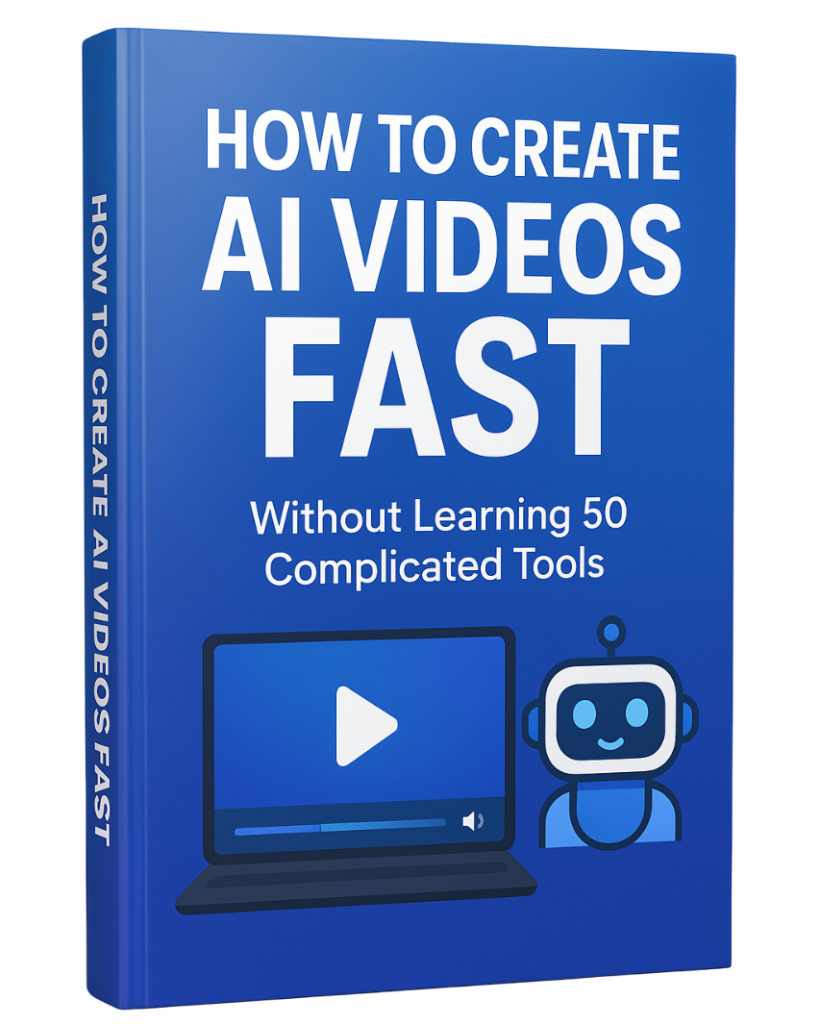
Learn How to Create AI Video Fast an Easy,
If you want a step-by-step guide to create AI videos fast — without learning 50 complicated tools — download the free PDF below and simplify your entire workflow.
Download the free guide:
How to Create AI Videos FAST Without Learning 50 Complicated Tools