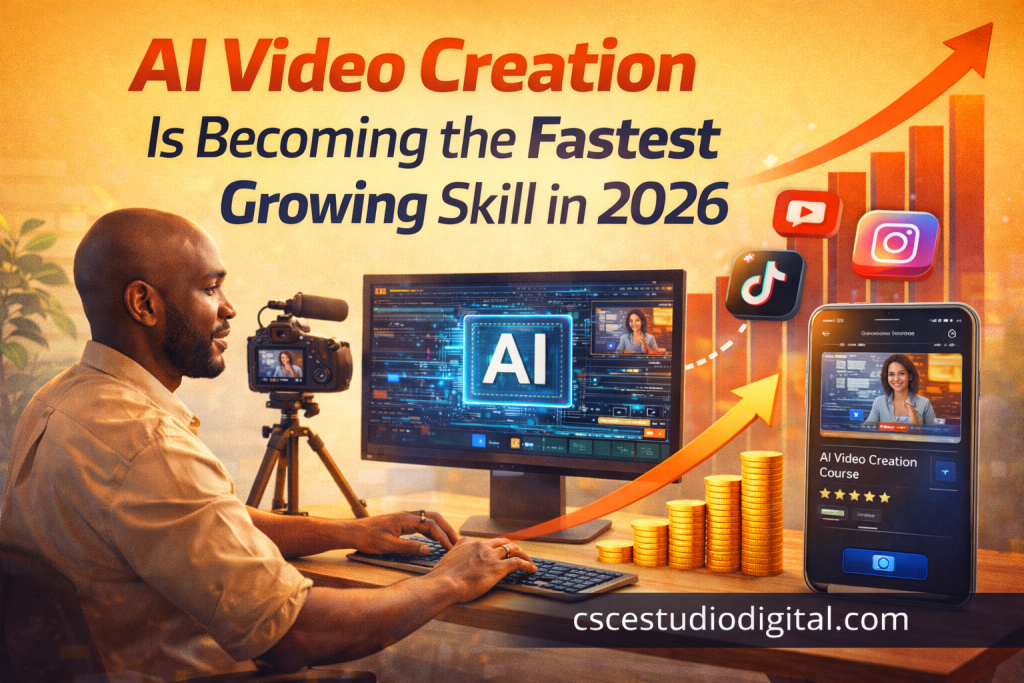
AI Video Creation Is Becoming the Fastest Growing Skill in 2026
A few years ago, video creation was considered a specialized talent. You needed expensive equipment, technical knowledge, and often a full team to produce professional-looking content. Today, everything has changed. In 2026, AI video creation is emerging as the fastest growing skill in the digital world.
This is not just another technology trend. It is a fundamental shift in how media is produced, shared, and monetized. Businesses, creators, educators, and entrepreneurs are all realizing the same thing: learning to create videos with AI is quickly becoming as important as knowing how to use email or social media.
The reason is simple. Video dominates the internet, and artificial intelligence has made video production accessible to almost everyone.
The Explosion of Video Demand
Every major online platform now prioritizes video content. YouTube, TikTok, Instagram, Facebook, LinkedIn, and even traditional websites are built around moving images. Consumers prefer watching over reading. Brands prefer explaining through visuals rather than long text.
This massive demand created a problem for years. Not enough people had the skills to produce high-quality videos at scale.
AI solved that problem almost overnight.
Now, instead of needing months of training, a person can learn the basics of AI video creation in a matter of days. That is why this skill is growing faster than graphic design, coding, or even traditional video editing.
AI Has Lowered the Barrier to Entry: The End of Technical Gatekeeping
In the previous decade, the distance between an “idea” and a “finished video” was measured in thousands of dollars and hundreds of hours. High-quality production was guarded by technical gatekeepers. To compete at a professional level, you were required to master a daunting list of manual skills:
- Learning Complex Editing Software: Professional tools like Premiere Pro or DaVinci Resolve had steep learning curves that took months to navigate effectively.
- Buying High-End Hardware: Cameras, lenses, and professional-grade microphones were essential investments that often exceeded $5,000 for a basic setup.
- Understanding Lighting and Sound Physics: You had to master “The Three-Point Lighting” setup and acoustic treatment just to ensure your content didn’t look or sound amateur.
- Hiring Expensive Talent: If you weren’t comfortable on camera, you had to budget for voice actors, presenters, or models, significantly increasing the cost per video.
- Managing “Dead Time”: Spending hours—or even days—waiting for videos to render and export, tying up your computer and halting your creative momentum.
AI tools have not just lowered these barriers; they have effectively demolished them.
In 2026, the “technical” part of video creation has been offloaded to intelligent software, allowing the creator to focus entirely on vision and strategy. Modern platforms can now execute the entire production chain:
- Write Scripts Automatically: Using advanced LLMs that understand audience retention patterns, psychological hooks, and niche-specific terminology.
- Generate Realistic Voiceovers: Producing neural speech that includes human nuances like emotion, breathing, and perfect regional accents in over 100 languages.
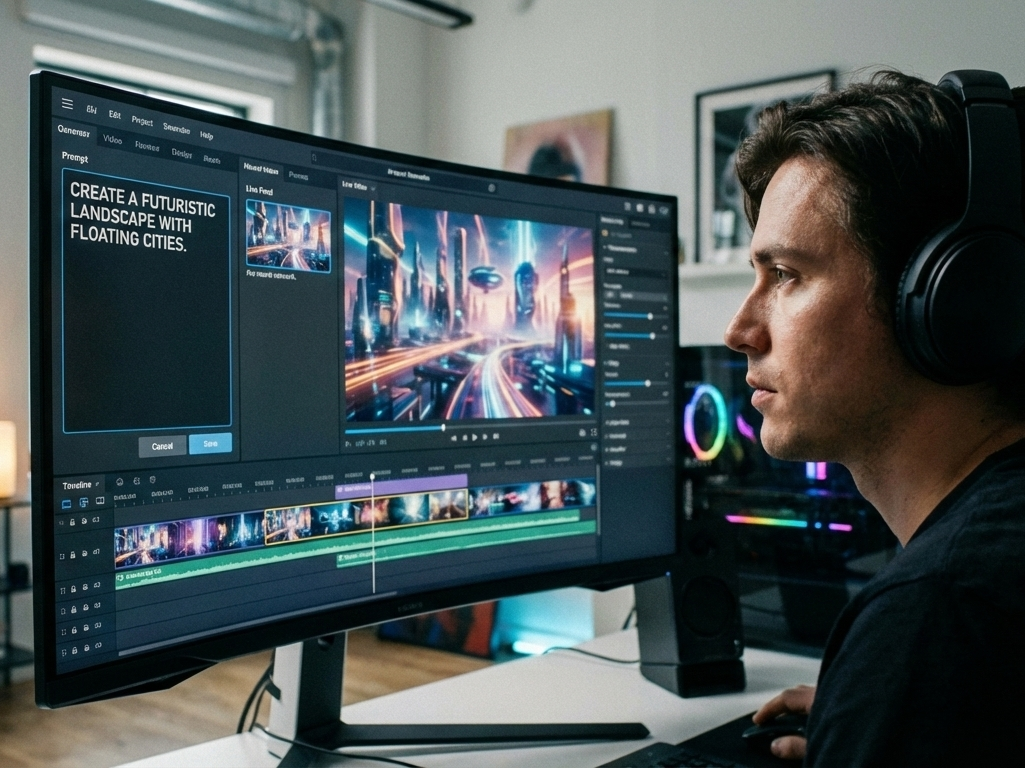
- Create Visuals from Text: Utilizing engines like Google Veo 3 to render 4K cinematic scenes, high-end animations, or realistic b-roll from a simple text description.
- Edit Footage Instantly: AI-driven NLEs (Non-Linear Editors) can now perform “Smart Cuts,” remove silences, and match visual pacing to the audio rhythm automatically.
- Add Music and Subtitles: Generating royalty-free, mood-accurate soundtracks and burned-in kinetic typography that is 99% accurate out of the box.
- Produce Complete Videos in Minutes: Shortening the production cycle from weeks to minutes, allowing for real-time content creation that reacts to global trends as they happen.
What used to require a team of specialized professionals—scriptwriters, cinematographers, and editors—can now be executed by a single beginner with a clear vision and the right software. This radical accessibility is the primary reason why AI video creation has transitioned from a niche hobby into a critical professional skill for 2026.

Businesses Are Desperate for AI Video Talent
Companies of all sizes are realizing that they need more video content than ever before. Social media marketing, product demonstrations, internal training, customer support, and advertising all rely heavily on video.
But most businesses cannot afford full production teams.
That is where AI video creators come in.
People who know how to use AI tools to quickly generate professional content are becoming extremely valuable in the job market. Small businesses, startups, and large corporations are actively looking for individuals who can produce videos efficiently using artificial intelligence.
In 2026, AI video creation is not just a hobby. It is a marketable, high-demand professional skill.
A Skill That Applies to Almost Every Industry
Unlike many technical abilities that are confined to a specific niche, AI video creation is a horizontal skill. It serves as a universal communication layer that is not limited to a single field. In 2026, the ability to turn text into high-fidelity video is the modern equivalent of knowing how to write—it is a foundational requirement for any sector that relies on digital attention.
It can be utilized across a vast spectrum of industries, including:
Marketing: Rapidly testing ad creatives for different demographics.
Education: Turning dense textbooks into engaging, visual learning modules.
E-commerce: Generating product showcases and 360-degree feature highlights.
Real Estate: Creating cinematic virtual tours of properties that don’t exist yet.
Healthcare: Explaining complex medical procedures to patients through clear, visual metaphors.
Entertainment: Producing high-quality trailers, music videos, and short films on a shoestring budget.
Coaching: Scaling a personal brand by delivering daily motivational or instructional content.
Social Media Management: Maintaining a 24/7 presence across multiple platforms with zero filming required.
Corporate Communication: Transforming boring internal memos into dynamic video updates.
Any industry that needs to communicate ideas visually can benefit from AI-generated videos. This versatility ensures that as a creator, you are never “trapped” in one niche; your skill set is inherently future-proof.
Creators Can Now Compete With Big Brands
One of the most exciting aspects of AI video technology is how it radically levels the playing field. For decades, “High Production Value” was a barrier to entry guarded by massive budgets and large creative agencies. In 2026, that barrier has effectively collapsed.
A single person with a laptop and a suite of AI tools can now produce content that matches the visual polish and narrative depth of videos created by global brands. This democratization of production means independent creators can:
- Build YouTube Channels: Compete with major media networks for subscribers and ad revenue.
- Grow TikTok Audiences: Reach millions by producing high-volume, trend-setting vertical content.
- Launch Online Courses: Create professional educational suites that rival established universities.
- Promote Affiliate Products: Build trust through high-quality reviews and demonstrations without a studio.
- Create Digital Businesses: Operate as a one-person media conglomerate.
Knowing how to create AI videos gives individuals the same “creative firepower” that used to be the exclusive domain of Fortune 500 companies. In the current economy, the size of your budget matters much less than the quality of your systems.
The Learning Curve Is Surprisingly Small
Another reason this skill is expanding at such an explosive rate is the unprecedented ease of entry. Traditional video editing, motion graphics, and cinematography used to take months or even years to master at a professional level. AI video platforms, however, are engineered for high-level abstraction and simplicity.
Most modern tools utilize intuitive drag-and-drop interfaces, intelligent templates, and automated workflows that handle the technical heavy lifting. This means a complete beginner can move from “Idea” to “Finished Asset” in a single afternoon by following a straightforward process:
- Type a Script: Use an LLM to generate a retention-optimized narrative.
- Choose a Template: Select a visual style that aligns with the target audience.
- Select a Voice: Apply a neural voiceover that carries the perfect emotional tone.
- Generate Visuals: Let engines like Google Veo 3 render cinematic scenes instantly.
- Export a Finished Video: Distribute a high-resolution file to all major platforms.
This remarkably short learning curve makes AI video creation one of the most accessible and high-leverage digital skills available today. It is no longer about learning the software; it’s about learning how to direct the intelligence within the software.
The Perfect Skill for Side Hustles
More people than ever are searching for flexible ways to earn income online. Rising living costs, remote work culture, and digital platforms have reshaped how side hustles operate. AI video creation fits perfectly into this new environment.
It offers low startup costs, scalable production, and global distribution.
With this skill you can:
- Start faceless YouTube channels
Build niche-based channels without appearing on camera. AI handles scripting, visuals, and voiceovers, allowing you to focus on content strategy and monetization. - Create social media content for clients
Small businesses, coaches, and brands constantly need short-form video. AI tools allow you to deliver high-volume content quickly without a studio setup. - Sell video services on freelance platforms
Platforms like Fiverr and Upwork are full of demand for short-form content, explainer videos, ad creatives, and YouTube automation services. AI increases your delivery speed and profit margins. - Build automated content pages
Combine AI videos with niche websites, affiliate blogs, or monetized media pages. Video increases engagement and conversion rates across digital properties. - Launch educational projects
Create mini-courses, visual lessons, or digital training materials without hiring production teams. AI makes professional-looking visuals accessible to solo creators.
Because AI dramatically reduces production time, income generation becomes less dependent on hours worked. Instead of trading time for money, creators can build repeatable systems that scale output.
That is why many entrepreneurs in 2026 are not just experimenting with AI — they are deliberately mastering it. They recognize that speed plus strategy creates leverage.
And leverage builds income faster than effort alone.
AI Video Creation Encourages Creativity
A common fear is that AI replaces creativity. The reality is more nuanced — and more optimistic.
AI removes friction. It handles technical tasks such as:
- Basic editing
- Visual generation
- Scene transitions
- Formatting for multiple platforms
This frees creators to focus on higher-value thinking:
- Story development
- Hook experimentation
- Audience psychology
- Narrative pacing
- Brand positioning
Instead of spending three hours adjusting transitions, creators can spend those three hours refining the message. Instead of being limited by budget, they can test bold visual concepts, abstract ideas, futuristic scenes, or stylized storytelling that would otherwise be impossible to film.
AI becomes a creative accelerator.
It allows faster iteration. Faster iteration leads to better ideas. Better ideas lead to stronger content. The creators thriving in 2026 aren’t less creative — they are more experimental. They test formats quickly, analyze results, and refine concepts in real time.
AI doesn’t eliminate imagination. It expands what imagination can execute. That shift is attracting millions of people to learn AI video skills — not because they want shortcuts, but because they want creative freedom without technical bottlenecks.
A Core Part of the Future Workforce
In the early 2000s, basic computer literacy became essential. Then social media literacy. Then mobile-first thinking. Now, AI literacy is becoming the new baseline.
In 2026, many job descriptions already include requirements such as:
- Experience with AI tools
- Ability to create digital content
- Understanding of automated media production
- Knowledge of AI video platforms
Marketing roles, education roles, startup teams, media companies, and even corporate departments increasingly expect employees to understand AI-assisted workflows.
Why?
-Because AI reduces operational costs.
-It increases output capacity.
-It shortens production cycles.
Organizations want people who can operate inside this new reality.
Learning AI video creation is no longer optional for individuals who want to remain competitive in modern digital environments. It is becoming a core digital competency — similar to knowing how to use spreadsheets or presentation software.
Those who understand AI systems can:
- Produce more value in less time
- Lead content initiatives
- Optimize workflows
- Adapt quickly as tools evolve
The workforce is not just changing technologically. It is changing structurally.
People who combine creativity, strategy, and AI fluency will dominate emerging opportunities. Those who ignore it risk becoming slower and less adaptable in a speed-driven economy. In 2026 and beyond, AI video creation is not just a skill.
It’s an advantage.
The Tools Keep Improving Every Month: The Speed of Innovation
One of the most compelling reasons to master this skill right now is the sheer velocity of the underlying technology. We are currently in a “compounding” phase of development where improvements are not linear, but exponential. Unlike traditional software that remains static for years, AI video tools are evolving in real-time.
Every few months, the landscape shifts with:
- Higher Fidelity Video Quality: We have moved from distorted “dream-like” textures to crisp, high-bitrate 4K cinematic footage that is indistinguishable from reality.
- Hyper-Realistic Neural Voices: AI voices now incorporate human-like nuances such as breathing, varying emotional inflection, and perfect local accents, making “voice cloning” a standard tool.
- Near-Instant Cloud Rendering: What used to take hours of local computer processing now happens in seconds on remote servers, allowing for real-time iteration.
- Smarter Semantic Editing: Modern AI understands concepts, not just pixels. You can now tell an editor to “make this scene more dramatic” or “remove the background person,” and it executes the command perfectly.
- Infinite Creative Possibilities: Features like “Style Transfer” and “Image-to-Video” allow you to turn a simple sketch or a prompt into a fully realized cinematic world.
By entering the field now, you aren’t just learning a tool; you are boarding a high-speed train. Those who develop “Prompt Fluency” today will be the senior architects of tomorrow as these tools become increasingly powerful.
Why 2026 Is the Turning Point: The Great Content Migration
While previous years were defined by novelty and experimentation, 2026 is the year AI video becomes the industry standard. We have moved past the “uncanny valley” and entered an era of total utility. This year marks a permanent shift in how media is produced for four specific reasons:
Platform Maturity: Tools like Google Veo 3 and Runway Gen-4 have moved out of “beta.” They are now robust, professional-grade platforms designed for high-volume commercial use.
The Quality Ceiling has Shattered: AI-generated content is no longer “good for AI”—it is simply good. It is now winning awards, powering national ad campaigns, and dominating the YouTube algorithm.
The Collapse of Production Costs: The cost to produce a minute of high-end video has dropped by over 90%, making it accessible to every small business and independent creator on earth.
Record-Breaking Demand: With the rise of “Infinite Scroll” platforms, the world’s hunger for video content is at an all-time high. Every brand is now a media company, and they all need a system to feed the beast.
These factors have combined to create a “perfect storm.” AI video creation is no longer a futuristic hobby; it is one of the most critical and fastest-growing professional abilities of the decade.
How to Start Learning Today: Your Practical Roadmap
The barrier to entry has never been lower, but the rewards for those who start today are massive. You don’t need a degree in computer science or a $5,000 camera. You simply need a structured approach to mastery.
The Roadmap to Expertise:
Step 1: Commit to One Ecosystem:
Don’t get distracted by “tool hopping.” Choose a professional platform (like Google Veo 3) and learn its specific nuances, strengths, and limitations.
Step 2: Start with “Micro-Content”:
Don’t try to make a feature film on day one. Practice by creating 15-second YouTube Shorts or Instagram Reels. These small wins build momentum.
Step 3: Master the “Prompt-Script” Connection:
Experiment with how different script structures affect the final visual output. Learn how to “direct” the AI through your text.
Step 4: Build a Public Portfolio:
Publish your content online immediately. Whether it’s a faceless YouTube channel or a TikTok page, real-world feedback is the fastest way to learn.
Step 5: Adopt an Iterative Mindset:
Use analytics to see what works. If viewers drop off at 5 seconds, change your hook. If a voice sounds too robotic, try a different neural model.
Step 6: Layer Advanced Techniques:
As you grow comfortable, start experimenting with “In-painting,” “Motion Brushes,” and “Multi-modal generation” to add professional polish.
Remember: Consistency matters more than perfection.
In the AI world, the person who publishes 100 “good” videos will always beat the person who spends six months trying to make one “perfect” video. Daily practice is the engine that turns a beginner into a high-paid expert.
Long-Term Opportunities: Future-Proofing Your Career
Mastering AI video creation in 2026 is not just about learning a new tool; it is about positioning yourself at the forefront of the “Innovation Economy.” By the end of this decade, the distinction between a “video creator” and an “AI systems architect” will have virtually disappeared.
Mastering this skill opens doors to high-leverage opportunities across the global workforce:
- Full-Time “AI Media Director” Careers: Companies are moving beyond “pilots” and are now hiring full-time specialists to lead AI-driven content departments.
- Scaleable Freelance Income: Transition from “trading hours for dollars” to “trading systems for results.” AI allows you to handle 10x the client load of a traditional editor.
- Next-Gen Entrepreneurship: Launch entirely new business models, such as automated news networks, niche-specific educational platforms, or localized ad agencies.
- Autonomous Content Creation: Build “digital real estate”—YouTube channels and social media empires that operate with 90% automation, generating passive income through ads and sponsorships.
- Strategic Digital Marketing Roles: Lead high-impact campaigns using Video Commerce and hyper-personalized ads, which are seeing conversion rates up to 40% higher than static content.
As video continues to account for over 65% of all global mobile internet traffic, the ability to produce it systematically is becoming the most valuable asset in the digital job market.
Final Thoughts: The Digital Competency of the Decade
AI video creation is not a temporary trend or a “cool gadget”—it is becoming a core digital competency for the modern professional.
Just as proficiency in spreadsheets became essential in the 90s, and social media literacy became mandatory in the 2010s, knowing how to architect video with AI is the non-negotiable skill of the 2020s. In 2026, we have reached the “Agentic Leap,” where the tools no longer just assist us—they execute our creative vision at scale.
The landscape of 2026 is clear:
- The Tools are Mature: Google Veo 3 and other platforms provide broadcast-quality results instantly.
- The Demand is Insatiable: Every industry, from Healthcare to Real Estate, is hungry for high-retention video.
- The Competitive Advantage is Massive: Those who build systems now are the “Digital Landlords” who will own the attention of the next decade.
Whether you want to grow a global business, build a personal brand, or secure a high-paying strategic role, learning AI video creation is the smartest investment of your time.
The only real question is simple: Will you learn this skill today and lead the market, or wait and be forced to catch up tomorrow?
AI Video Creation the Fastest Growing Skill in 2026 Podcast
This video provides a deep dive into how AI is fundamentally reshaping the global job market through 2030, reinforcing why system-based digital skills are essential.
EXTRA: AI Video Creation: 7 AI tools to create videos for free
Pika
AI video generator from text or images.
Great for short cinematic clips, animations, and transitions.
Free plan includes limited credits and watermarks.
Runway (Gen-2)
Text-to-video and image-to-video AI.
Very powerful for creative and experimental videos.
Free tier allows short generations with limitations.
Luma AI (Dream Machine)
High-quality text-to-video generation with realistic motion.
Excellent consistency and camera movement.
Free plan gives limited generations per day.
Kaiber
AI video generation from text, images, or music.
Popular for music videos and artistic visuals.
Free credits on signup, watermark included.
PixVerse AI
Text-to-video and image-to-video AI.
Good for social media clips and short-form content.
Free daily credits available.
LeiaPix (now Immersity AI)
Turns images into animated 3D-style videos.
Perfect for simple motion effects and depth animation.
Free version available with limits.
CapCut AI Video Tools
AI-powered video generation, scripts, avatars, and effects.
Not pure text-to-video, but extremely useful for fast AI videos.
Free plan is generous and beginner-friendly.
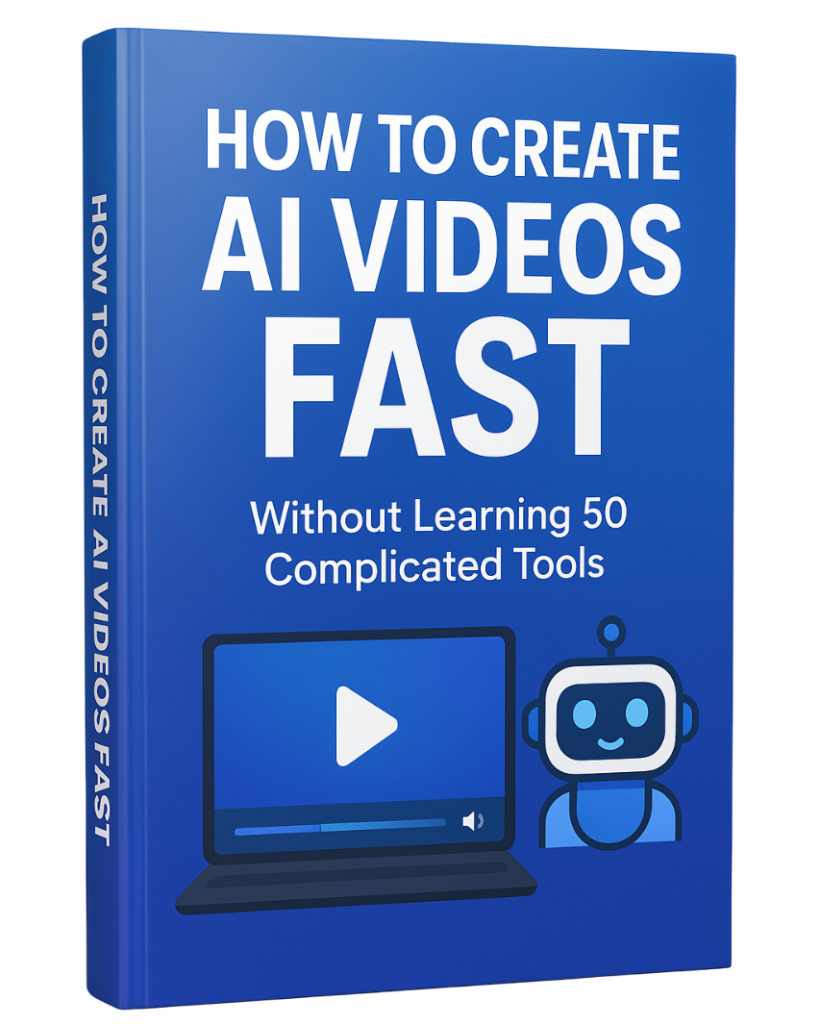
AI Video Creation System
Learn How to Create AI Videos Fast an Easy,
If you want a step-by-step guide to create AI videos fast — without learning 50 complicated tools — download the free PDF below and simplify your entire workflow.
Download the free guide:
How to Create AI Videos FAST Without Learning 50 Complicated Tools