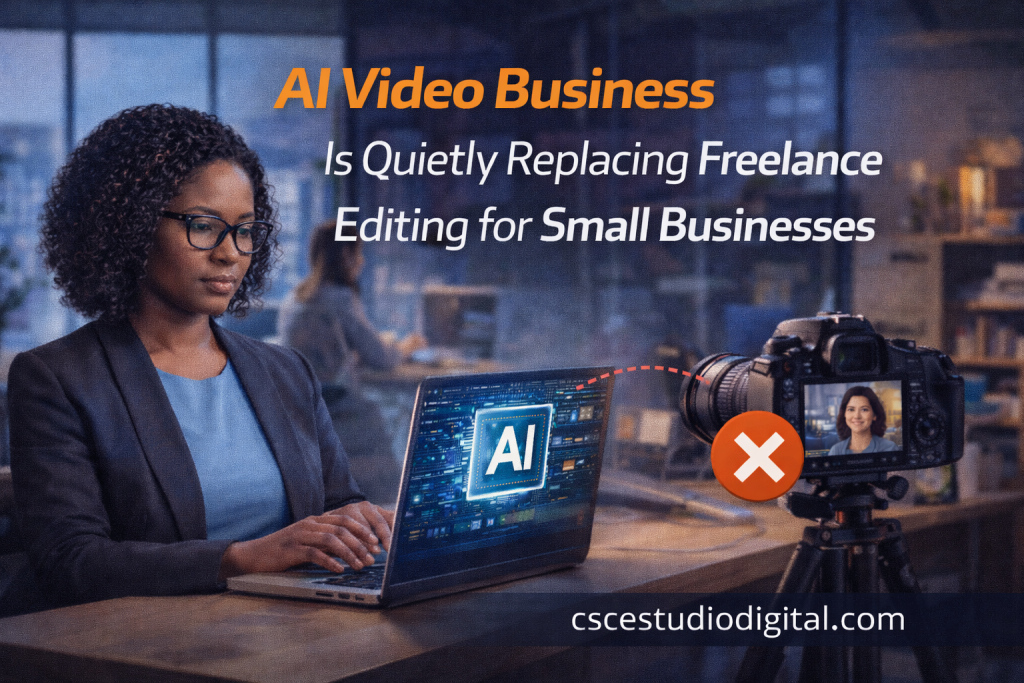
AI Video Business Is Quietly Replacing Freelance Editing for Small Businesses
The freelance video editing market is shifting faster than most professionals expected. For years, small businesses depended on freelancers or boutique agencies to handle promotional videos, social media clips, product showcases, and branded content. That system worked — but it was slow, expensive, and often unsustainable for companies operating with limited budgets.
What is changing is not the demand for video. If anything, demand has increased. Every brand now competes for attention across multiple platforms where video dominates reach and engagement. The difference is in how that video is being produced.
Artificial intelligence is quietly absorbing tasks that once required full editing teams.
In 2026, an AI-driven video business can replicate much of what previously required freelance editors, motion designers, and revision cycles. The production bottleneck has been dramatically reduced. Content that once took days to finalize can now be generated, adjusted, and exported within hours.
This shift is not eliminating opportunity. It is redistributing it.
Entrepreneurs who understand how to operate AI video tools — and who position themselves as solution providers rather than traditional editors — are stepping into a new kind of service model. Tools like advanced text-to-video systems allow them to deliver speed, scalability, and cost efficiency that small businesses increasingly prefer.
This transformation matters because it redefines value. The competitive edge is no longer manual editing skill alone. It is workflow design, automation, and strategic implementation. Those who recognize this early are building lean, highly profitable service businesses around AI-powered production.
The Traditional Freelance Editing Model Is Breaking
For more than a decade, creating a basic business video followed a predictable process. A business owner would identify the need for content, then begin the search for a freelance editor. After initial discussions and scope clarification, the owner would record raw footage or provide assets, followed by multiple rounds of file exchanges and revisions.
The typical workflow required:
- Finding and vetting a freelance editor
- Explaining expectations and creative direction
- Recording or collecting raw footage
- Exchanging large files across platforms
- Waiting days — sometimes weeks — for revisions
- Paying hourly or per-project rates that added up quickly
This system created friction at every stage. Communication gaps slowed projects. Revision cycles increased costs. Turnaround times limited how frequently businesses could publish new content.
As a result, many small businesses produced video sporadically. Some avoided it altogether because the process felt overwhelming. Others restricted production to major launches or seasonal campaigns due to budget constraints.
The core issue was not lack of interest. It was lack of efficiency.
AI has disrupted this model by compressing production timelines and eliminating multiple dependency points. The traditional editing workflow is not disappearing overnight, but it is no longer the only viable option — and for many small businesses, it is no longer the most attractive one.
Why Small Businesses Are Switching to AI Video
Artificial intelligence has removed many of the pain points embedded in the old freelance editing structure. Modern AI video tools allow businesses to generate promotional content without filming new footage, create advertisements in minutes, and test multiple creative angles without committing to large budgets.
With current AI capabilities, businesses can:
- Generate videos without organizing complex shoots
- Produce ad variations rapidly for testing
- Scale content output without increasing staff
- Reduce reliance on expensive freelancers
- Update messaging instantly when offers change
From a business owner’s perspective, the economic logic is straightforward. If AI can produce comparable results at a fraction of the cost and in significantly less time, the incentive to switch becomes strong.
This is not a distant forecast. It is already unfolding across industries. Small brands are experimenting with AI-generated ads. Local service providers are automating social media content. E-commerce stores are testing product videos without booking studio sessions.
The transition is gradual but undeniable.
As more businesses prioritize speed, flexibility, and cost control, AI video solutions are becoming an operational standard rather than an experimental add-on. The opportunity now lies with those who understand how to harness this shift and deliver structured, results-driven AI video services in a rapidly evolving market.

The Rise of the AI Video Business Model
A new service structure is emerging in the digital content space. Traditional freelance editing, built around hourly billing and project-based delivery, is gradually being replaced by AI-powered production models. This shift is not about eliminating creative services. It is about redesigning how those services are delivered.
Instead of manually editing every frame, forward-thinking creators are building AI-driven video businesses. They are no longer positioning themselves as editors for hire. They operate as content systems providers, offering ongoing production powered by automation and structured workflows.
The model is straightforward but powerful:
- Use AI tools to generate professional-quality videos
- Package video creation as a monthly service for small businesses
- Deliver content quickly and consistently
- Charge subscription-based pricing instead of one-time fees
This structure changes the economics completely. Rather than negotiating each individual project, the service becomes ongoing. Businesses pay for consistent output and predictable delivery, not just isolated edits.
Because AI reduces production time dramatically, capacity increases without proportional effort. What once required dozens of editing hours can now be executed in a fraction of the time, allowing service providers to focus on client acquisition, messaging, and strategic improvements.
The result is a model that scales more efficiently than traditional freelancing. Revenue becomes more stable. Workflows become repeatable. Growth becomes intentional rather than reactive.
Why This Model Is Superior
An AI video business offers structural advantages that freelance editing rarely provides. The biggest difference lies in leverage. Instead of trading time directly for money, you design a production system that operates with automation at its core.
Key advantages include:
- No need to exchange hours for every dollar earned
- Reduced complexity in revision cycles
- Faster turnaround times for clients
- Lower production costs per video
- Ability to serve multiple clients simultaneously
- Predictable recurring monthly income
Traditional freelancing depends heavily on availability. If you stop working, revenue stops. In contrast, a subscription-based AI video model builds recurring income streams tied to ongoing service access rather than isolated deliverables.
Clients are not simply paying for edits. They are paying for access to a streamlined content engine. That distinction changes your positioning in the market. You move from being a technician completing tasks to a partner providing scalable visibility.
This is a different level of business design. It prioritizes systems over labor, predictability over sporadic payments, and scalability over burnout. For entrepreneurs willing to adapt, the AI video business model represents not just a new service — but a more sustainable way to operate in the evolving digital economy.
How Google Veo 3 Powers This Revolution
One of the core technologies accelerating this transformation is Google Veo 3. Advanced text-to-video systems like this are redefining what is possible for solo operators and small teams. What previously required cameras, lighting setups, actors, and editing software can now begin with a structured prompt.
Google Veo 3 allows users to generate high-quality video content without relying on traditional editing workflows. Instead of stitching together clips manually, creators can build scenes, adjust styles, and refine outputs through intelligent generation and iteration. The technical barrier is dramatically lower, but the creative control remains substantial.
With tools at this level, users can:
- Generate realistic scenes with dynamic motion
- Create promotional and brand-focused videos
- Produce vertical content optimized for social platforms
- Build professional-style advertising creatives
- Design product showcases without physical shoots
All of this can be done without touching a camera or opening a complex editing timeline.
The implication is significant. A single operator can now manage what used to require a small production team. Ideation, generation, refinement, and delivery can happen within one streamlined workflow. Just a few years ago, that level of independence would have been unrealistic for most entrepreneurs.
The power is not only in automation. It is in compression. Production cycles shrink. Experimentation speeds up. Service capacity expands.
What Small Businesses Actually Need
Despite the excitement around cinematic AI capabilities, most small businesses are not searching for blockbuster production. They are looking for clarity, consistency, and content that communicates value effectively. The majority do not need elaborate storytelling or expensive visual effects.
They need practical assets that support growth.
Typical content demands include:
- Social media posts for visibility
- Short promotional clips for campaigns
- Product demonstrations to increase conversions
- Service explanations to clarify offers
- Local advertising videos to attract nearby customers
These formats prioritize frequency and clarity over cinematic complexity. They require speed and adaptability more than artistic experimentation.
This is exactly where AI video tools excel.
Freelancers traditionally filled this production gap, offering editing services for recurring content needs. However, as AI systems become more capable, businesses are recognizing that much of this output can be generated faster and at lower cost through automated workflows.
The demand for video remains strong. What is changing is the method of delivery. AI is not eliminating the need for content. It is redefining how that content is created, scaled, and maintained in a competitive digital environment.
Services You Can Offer With an AI Video Business: Beyond Traditional Editing
Si tu objetivo es sustituir el modelo de freelance tradicional por un modelo basado en IA, no debes vender “edición de video”; debes vender soluciones de visibilidad y conversión. En 2026, las empresas no buscan a alguien que sepa usar Premiere Pro, buscan sistemas que llenen sus redes sociales de contenido de alta calidad sin fricción.
1. Social Media Content Packages (The “Retention” Subscription)
Este es el servicio más rentable debido a su recurrencia. Puedes ofrecer paquetes mensuales que garanticen una presencia omnicanal absoluta.
- The “60-Asset” Bundle: Entrega 20 Reels, 20 TikToks y 20 YouTube Shorts optimizados para cada algoritmo.
- Brand Customization: Gracias a la IA, puedes entrenar modelos para que utilicen siempre la paleta de colores, fuentes y el tono de voz (Voice Cloning) específico de la marca del cliente.
- Engagement Loops: No solo entregas el video, sino que utilizas IA para generar los captions y las descripciones optimizadas para SEO en cada plataforma.
2. Local Business Promotions (The “High-End” Look for Small Budgets)
La mayoría de los negocios locales (restaurantes, gimnasios, agentes inmobiliarios, dentistas) saben que necesitan video, pero se sienten intimidados por los precios de las agencias tradicionales.
- Cinematic Tours: Utiliza Google Veo 3 para generar escenas cinemáticas que simulan tomas con drones o grúas de las instalaciones del cliente.
- Social Proof Ads: Crea videos promocionales que parecen producciones de alto presupuesto para campañas de Facebook e Instagram Ads locales, aumentando drásticamente su tasa de clics (CTR).
3. E-Commerce Product Videos (The “Conversion” Engine)
Los vendedores de Amazon, Shopify y Etsy necesitan video para reducir las devoluciones y aumentar las ventas, pero producir videos para 100 productos diferentes es logísticamente imposible de forma manual.
- Product Highlights: Genera videos de 15 segundos que resaltan los beneficios clave del producto usando modelos generados por IA.
- Feature Demonstrations: Crea animaciones que explican el funcionamiento técnico de un producto sin necesidad de un estudio de grabación física.
- Testimonial-Style Videos: Genera avatares hiperrealistas que actúan como “clientes satisfechos”, ideales para anuncios de retargeting.
4. Explainer and Educational Videos (The “Authority” Builder)
Las empresas de servicios (SaaS, consultoras, agencias de seguros) necesitan educar a su cliente antes de venderle.
The “Why Us” Video: Crea narrativas visuales que expliquen la propuesta de valor única de la empresa, utilizando visuales generativos que serían imposibles de grabar en la vida real.
Micro-Learning Modules: Convierte manuales aburridos en videos educativos dinámicos de 1 minuto.
Why Freelancers Cannot Compete With AI: The Efficiency Gap
The market reality in 2026 is harsh: traditional freelance editors are fighting against a technological tide that cannot be stopped. A model based on human effort simply cannot compete with a model based on systems.
The Traditional Model Trap
Conventional freelancers are constrained by both biological and technical limitations:
- Manual Editing: Every cut, transition, and color adjustment requires direct human intervention. If the editor gets tired or burnt out, production stops.
- Hourly Pricing: Their business model actually punishes efficiency. If they work faster, they earn less, creating a fundamental conflict of interest with the client.
- Complex Workflows: They rely on heavy file transfers, slow rendering times, and endless manual revisions.
- Limited Capacity: A human editor has a clear production ceiling. It is physically impossible for them to produce 100 high-quality videos in a single week without collapsing.
The AI Video Business Model
An AI-based video business shatters these traditional barriers through technological leverage:
Scalability: A single individual can oversee the simultaneous generation of hundreds of videos. “Rendering” is nearly instantaneous, and the AI handles the tedious labor.
Value-Based Pricing: You charge for impact and volume rather than your time. If the AI completes the task in 10 minutes, your profit margin is massive.
Infinite Creativity: You are no longer limited by what you can capture with a physical camera. You can generate any scenario, in any location on earth, in any time period.
The Final Verdict
The transition is not a question of talent; it is a question of leverage. A traditional editor is a craftsman; an AI video business owner is an industrial architect.
In 2026, the market does not reward the one who works the hardest, but the one who best utilizes technology to solve the client’s problem.
Building Your Own AI Video Business Step by Step
If you want to enter this space, the path is simpler than you think.
Step 1 – Choose a Clear Market
Do not try to serve everyone.
Pick a specific audience such as:
- Local restaurants
- Real estate agents
- Coaches and consultants
- Online stores
- Personal trainers
Specialization makes selling much easier.
Step 2 – Build a Simple Service Offer
Create clear packages like:
- Basic plan: 10 videos per month
- Standard plan: 20 videos per month
- Premium plan: 40 videos per month
Keep it simple and easy to understand.
Step 3 – Set Up Your AI Workflow
Your production system should include:
- Google Veo 3 for video generation
- AI voiceover tools
- Caption automation
- Basic editing templates
Once this system is built, delivering videos becomes incredibly fast.
Step 4 – Create Sample Content
Before finding clients, build examples for:
- Different industries
- Various styles
- Multiple formats
These samples become your sales portfolio.
Step 5 – Offer Monthly Subscriptions
Small businesses love predictable pricing.
Instead of charging per video, sell:
- Monthly content packages
- Unlimited revisions
- Fast delivery
- Done-for-you service
This creates stable recurring income.
Pricing an AI Video Service
One of the strongest advantages of an AI-powered video business is pricing flexibility. Because production costs remain low and turnaround times are fast, margins can be significantly higher than traditional freelance editing. You are not billing strictly for hours worked. You are pricing access to a structured content system.
This allows you to create tiered subscription models that feel clear and predictable for clients while remaining profitable for you.
A simple example structure could look like this:
- Starter package: $199 per month
- Growth package: $399 per month
- Business package: $699 per month
The math becomes compelling quickly. With just 10 clients at $399 per month, revenue approaches $4,000 monthly. At 25 clients, you are operating a strong full-time income with a workload that remains manageable due to automation and streamlined workflows.
This subscription approach is fundamentally different from chasing one-off freelance gigs. Instead of constantly searching for the next project, you build recurring revenue. Stability replaces unpredictability. Scale replaces burnout.
How to Find Your First Clients
Acquiring clients for an AI video service is often easier than expected because the demand already exists. Most small businesses understand that video is essential for visibility and growth. Their challenge is cost, complexity, and time — not awareness.
The first step is positioning yourself as a practical solution.
Effective starting strategies include:
- Reaching out to local businesses through social media
- Offering a free sample video to demonstrate capability
- Showing before-and-after content examples
- Participating in small business Facebook groups
- Contacting companies with weak or outdated online presence
The key is clarity in communication. Business owners are not looking for technical explanations about AI. They want results: more engagement, better presentation, and consistent content.
When you demonstrate how your service solves a real visibility problem at an affordable monthly rate, conversations become much easier. You are not convincing them that video matters. You are showing them a more efficient way to get it.
Why This Is a Long-Term Opportunity
This shift toward AI-powered video services is not a temporary spike in interest. Video marketing continues to grow in importance across platforms, and that trend shows no signs of slowing. At the same time, artificial intelligence tools are advancing rapidly.
Several forces are aligning:
- AI tools are improving in realism and usability
- Production costs are decreasing
- Demand for consistent content is expanding
When technology improves while demand increases and costs fall, markets grow. That combination creates durable opportunity.
Freelance editing will not disappear entirely. High-end cinematic projects, brand films, and complex productions will still require specialized expertise. However, for everyday content needs — social posts, ads, promotional clips, service explainers — AI-driven production is positioned to dominate due to speed and affordability.
This places AI video services in a strong long-term position within the small business ecosystem.
Common Mistakes to Avoid
While the opportunity is substantial, success depends on disciplined execution. Many newcomers overcomplicate the model or replicate outdated agency structures.
Common mistakes include:
- Trying to copy traditional creative agencies
- Charging too little and undercutting sustainability
- Offering too many services at once
- Overcomplicating pricing packages
- Operating without a defined workflow system
The strength of this model lies in simplicity. Clear packages, streamlined delivery, and repeatable processes allow you to scale without increasing stress. Complexity reduces margins and slows growth.
Focus on building a clean, scalable system. Refine it. Then expand strategically. That discipline is what turns an AI video service from a side hustle into a sustainable digital business.
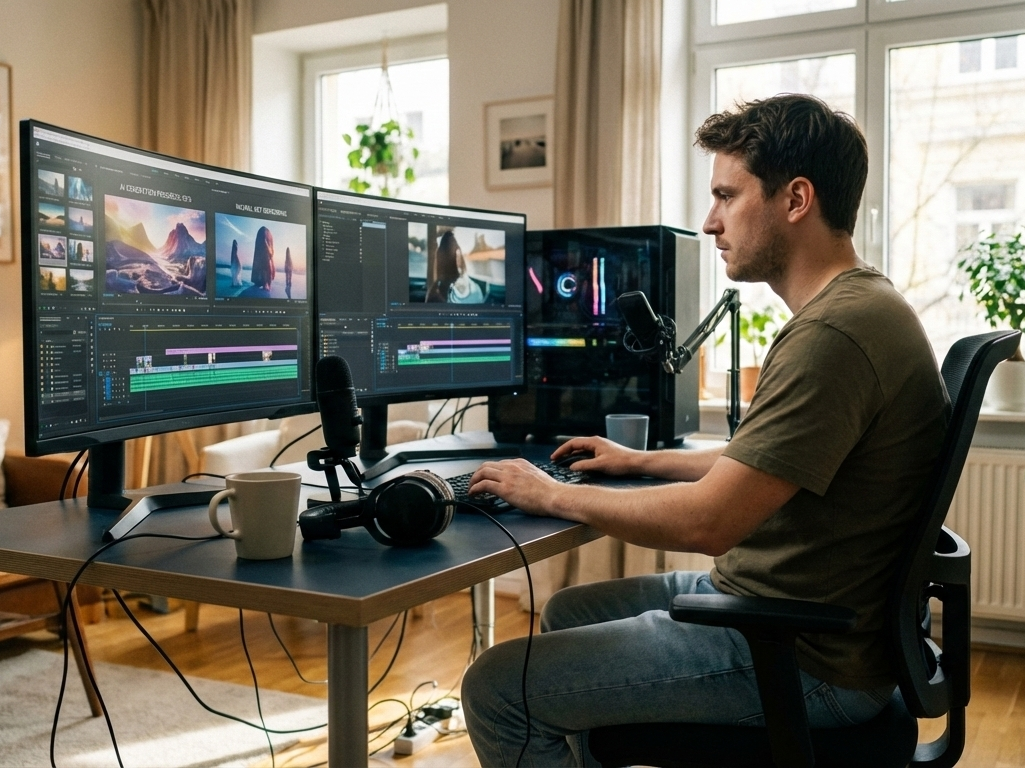
The Future of Video Services
The structure of video services is undergoing a quiet but decisive transformation. As artificial intelligence becomes more accessible and reliable, small businesses are beginning to reconsider how they approach content production. The shift is not emotional. It is economic and operational.
In the near future, many small businesses will no longer default to hiring freelance editors for routine content. Instead, they will subscribe to AI-powered content services that provide consistent output at predictable monthly costs. The decision will be driven by efficiency, not trend.
We have seen this pattern before in other industries.
- Website builders reduced reliance on custom web designers for basic sites
- Email marketing platforms replaced manually coded newsletters
- Social media schedulers reduced the need for dedicated posting assistants
Each of these tools did not eliminate experts entirely. They redefined the baseline. High-end, complex work still exists, but everyday needs shifted toward automated, scalable systems.
AI video services are following the same trajectory. Routine promotional content, social media clips, product showcases, and local advertising will increasingly be handled by AI-driven subscription models rather than project-based editing.
The entrepreneurs who recognize this early and position themselves accordingly will capture market share while competition is still forming. Early adaptation creates leverage.
How to Start This Weekend
One of the most attractive aspects of this opportunity is speed of entry. You do not need a large team, expensive equipment, or months of preparation. With focused execution, you can begin building the foundation almost immediately.
A simple starting plan could include:
- Learning the core features of Google Veo 3
- Creating 10 polished sample videos in different niches
- Designing three clear and simple service packages
- Contacting 50 small businesses with a direct offer
- Offering a limited free trial to demonstrate value
This level of action is enough to secure early conversations and potentially land your first paying clients. The goal at this stage is not perfection. It is proof of demand and validation of your offer.
Momentum compounds quickly in service-based models. Once a few businesses begin paying monthly, referrals and testimonials make outreach easier. The hardest step is the first wave of execution.
The opportunity does not require waiting for the future. It rewards those willing to start before the market feels crowded.
Final Thoughts
The traditional freelance editing model for everyday small business content is losing ground quickly. Not because video demand is shrinking, but because the production method is evolving. What once required manual editing hours is now increasingly handled by AI-driven workflows that deliver faster and more affordable results.
AI is not a distant disruption on the horizon. It is already reshaping how content services are delivered.
For many professionals, this may feel like competition. In reality, it is leverage. The opportunity is not in defending outdated service models. It is in redesigning them. Instead of competing for one-off, low-margin freelance projects, you can position yourself around a modern AI video business built for scale and predictability.
A well-structured AI-powered service can:
- Scale without proportional increases in workload
- Reduce production time dramatically
- Generate recurring subscription-based income
- Provide consistent value to real businesses
Tools like Google Veo 3 lower the barrier to entry. They allow a single operator to manage production capacity that previously required a small team. The advantage does not come from the tool alone, but from how strategically it is integrated into a repeatable system.
The creators who recognize this shift early will build stable, scalable service businesses while others continue competing in shrinking freelance marketplaces. Markets evolve. Technology advances. Business models adjust.
The market is ready.
The technology is ready.
What determines the outcome now is execution.
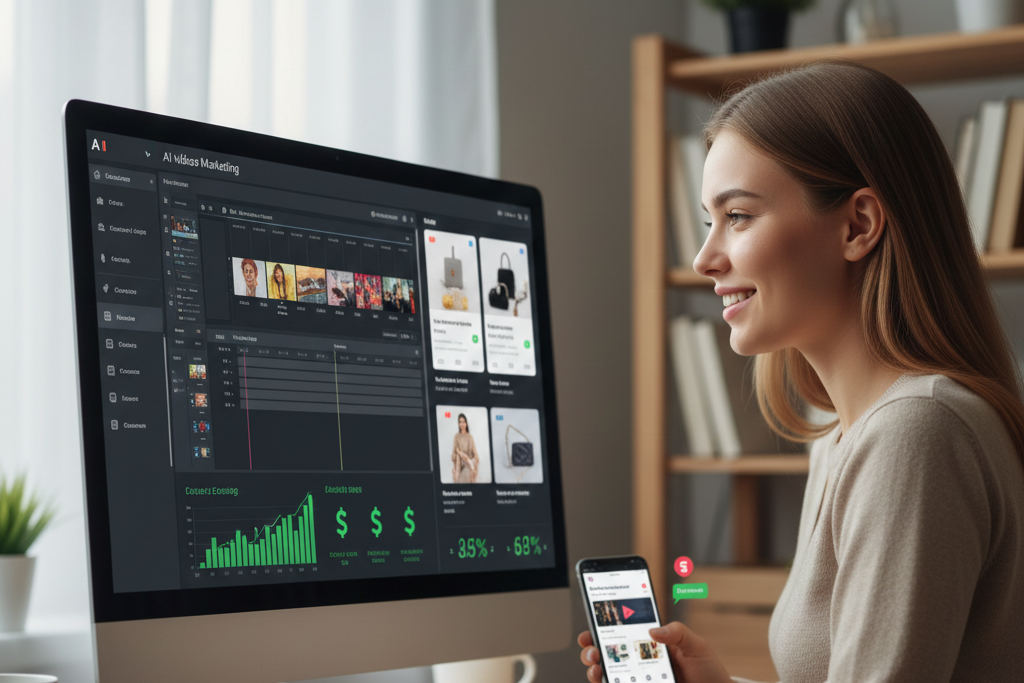
Here are 7 Work from Home AI video business Ideas
AI Social Media Shorts Package
Create short-form videos (Reels, Shorts, TikTok) from long videos or raw clips.
Use AI to auto-cut, add captions, emojis optional, hooks, and branding.
Target: local businesses, coaches, gyms, restaurants.
Recurring monthly service = estabilidad.
AI Promo Videos for Local Businesses
Text-to-video or image-to-video promos using AI.
Perfect for restaurants, real estate agents, salons, clinics.
Fast delivery, low production cost, high perceived value.
AI Video Ads for Facebook & Instagram
Create multiple ad variations using AI (different hooks, texts, visuals).
Small businesses love this because they can test ads without spending on production.
Upsell: monthly ad refresh.
AI Explainer Videos
Short explainer videos using AI avatars, voiceover, and animations.
Ideal for services, landing pages, and WhatsApp campaigns.
Small businesses care about clarity, not Hollywood quality.
AI Product Videos for E-commerce & Local Shops
Turn product photos into short AI-generated videos.
Perfect for Shopify stores, local shops, and Instagram catalogs.
Fast, scalable, easy to template.
AI Google Business Profile Videos
Create short videos optimized for Google Business profiles.
Most businesses don’t do this and it helps local SEO and trust.
Low competition, high opportunity.
AI Video Repurposing Service
Turn one piece of content into 5–10 videos using AI.
You sell efficiency, not editing.
This is gold for busy business owners.
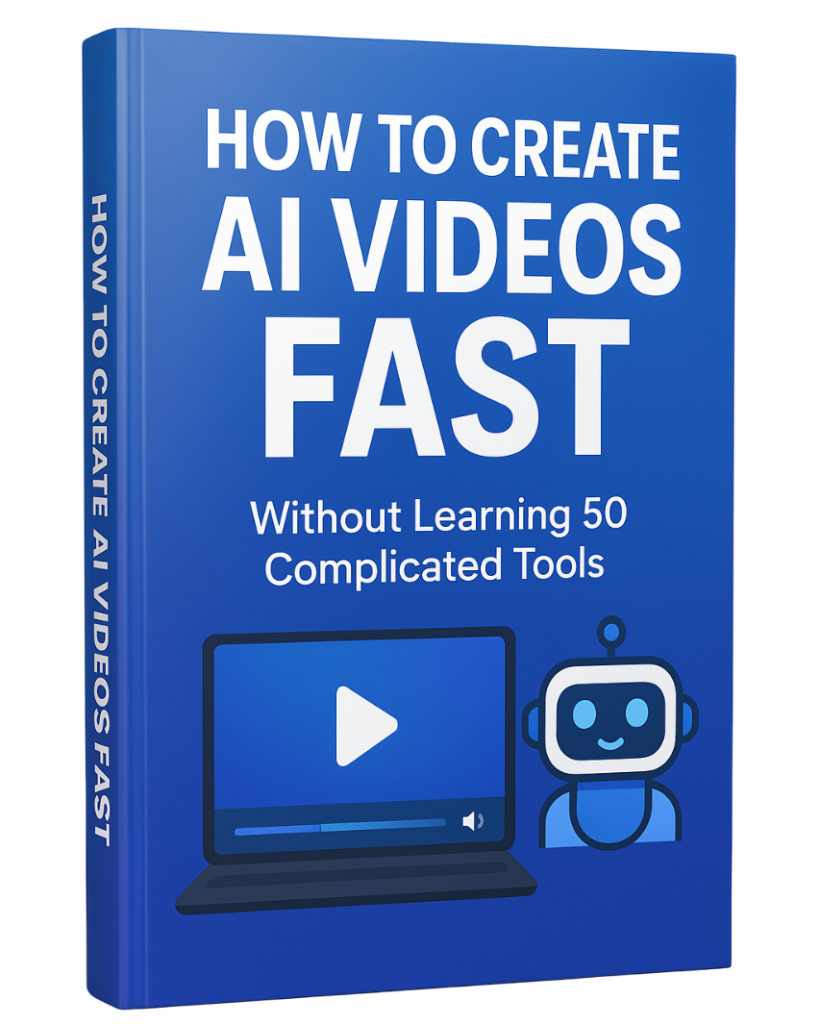
AI video business Creation System
Learn How to Create AI Videos like a Pro
If you want a step-by-step guide to create AI videos fast — without learning 50 complicated tools — download the free PDF below and simplify your entire workflow.
Download the free guide:
How to Create AI Videos FAST Without Learning 50 Complicated Tools