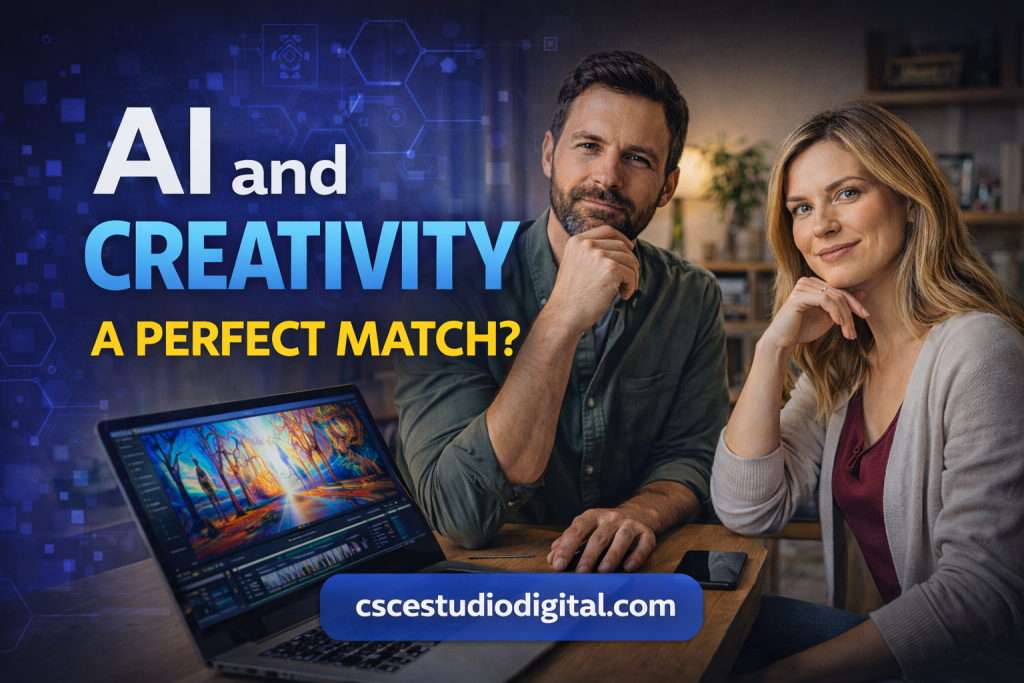
AI and Creativity – A Perfect Match?
For decades, creativity was considered one of the last exclusively human abilities. Art, music, storytelling, design, and innovation were believed to come from emotion, intuition, and lived experience—things machines could never truly replicate. Then artificial intelligence entered the creative arena, and everything changed.
Today, AI writes stories, generates art, edits videos, composes music, designs logos, and even assists in filmmaking. This has sparked an ongoing debate: is AI replacing creativity, or is it becoming its most powerful ally? The answer is more nuanced than a simple yes or no. AI and creativity are not enemies. In fact, when used correctly, they form a partnership that is redefining how creative work is produced, scaled, and monetized.
Understanding Creativity in the Age of AI
Creativity is often misunderstood as a spontaneous spark of genius. In reality, it is a process. It involves ideation, experimentation, iteration, refinement, and execution. AI does not eliminate this process; it accelerates and augments it.
Artificial intelligence excels at analyzing patterns, learning from massive datasets, and generating variations at scale. Human creators excel at context, emotion, judgment, and meaning. When these strengths combine, creative output becomes faster, more flexible, and often more ambitious.
Instead of asking whether AI can be creative, the more useful question is how AI can support human creativity without replacing the human voice behind it.
How AI Enhances Creative Work

AI is not a replacement for imagination. It is a tool that expands creative capacity.
In writing, AI helps overcome blank-page paralysis. Writers can generate outlines, brainstorm ideas, rewrite paragraphs, improve clarity, or adapt tone for different audiences. The creative direction still comes from the human, but AI reduces friction and speeds up execution.
In visual design, AI tools generate concepts, color palettes, layouts, and mockups in seconds. Designers no longer start from scratch every time. Instead, they refine, curate, and elevate AI-generated foundations.
In video production, AI automates time-consuming tasks such as editing, captioning, scene selection, voiceovers, and format adaptation. This allows creators to focus on storytelling, strategy, and audience engagement rather than technical bottlenecks.
In music and audio, AI assists with composition, sound design, mastering, and experimentation across genres. Musicians can test ideas quickly and push creative boundaries without expensive studio setups.
In all these areas, AI acts as a creative amplifier rather than a creative replacement.

AI Does Not Kill Originality, Laziness Does
One of the biggest fears around AI is that it will flood the internet with generic, soulless content. That fear is not entirely wrong, but AI is not the root cause. The real problem is misuse.
When creators rely on AI without direction, editing, or intention, the result is mediocre content. When creators treat AI as a collaborator rather than a shortcut, originality increases.
AI outputs are only as strong as the prompts, constraints, and creative vision behind them. A skilled creator can use the same AI tool as a beginner and produce dramatically different results. The difference lies in taste, experience, and decision-making.
Creativity has always depended on tools. Cameras did not kill painting. Digital editing did not kill filmmaking. AI will not kill creativity either. It simply raises the bar.
The Shift from Creator to Creative Director
One of the most important changes AI introduces is a shift in creative roles. Creators are increasingly becoming creative directors.
Instead of manually executing every step, creators now define vision, style, narrative, and goals, while AI handles repetitive or technical tasks. This shift allows individuals to produce work that previously required entire teams.
A solo creator can now run a content operation that includes writing, video production, social media, design, and distribution. This democratization of creativity lowers barriers and opens opportunities for people who previously lacked resources.
The creative advantage no longer belongs to those with the biggest budgets, but to those who understand how to orchestrate tools intelligently.
AI as a Catalyst for New Creative Formats
AI is not only speeding up existing workflows. It is enabling entirely new forms of creativity.
Interactive storytelling powered by AI allows narratives to adapt based on user choices. Personalized content can be generated at scale, tailoring messages to individual preferences without manual effort.
Virtual influencers, AI-generated avatars, and synthetic voices are changing branding and marketing. These formats would be impractical or impossible without AI-driven systems.
In education and entertainment, AI enables immersive experiences, simulations, and adaptive learning environments that respond in real time.
These innovations are not about replacing artists or storytellers. They are about expanding what is possible.
The Ethical Side of AI and Creativity
No discussion about AI and creativity is complete without addressing ethics. Questions around authorship, originality, copyright, and data usage are legitimate concerns.
Responsible use of AI requires transparency, attribution where appropriate, and respect for intellectual property. Creators must understand how tools are trained and how outputs are generated.
Ethical creativity also involves maintaining a human voice. AI should assist expression, not erase identity. The most successful creators use AI to enhance their perspective, not replace it.
Platforms, policymakers, and creators all share responsibility in shaping standards that protect creativity while allowing innovation to thrive.
Why Human Creativity Still Matters
AI can generate content, but it does not experience meaning. It does not feel joy, frustration, fear, or curiosity. It does not understand cultural nuance in the same way humans do. These elements remain essential to powerful creative work.
Human creativity provides intention, context, and emotional resonance. AI provides speed, scale, and variation. Together, they form a balanced ecosystem.
Audiences connect with stories, values, and authenticity. AI helps deliver those stories more efficiently, but the emotional core still comes from people.
Creators who embrace this balance gain a significant advantage. They produce more, test faster, adapt quicker, and reach wider audiences without burning out.
The Future of Creativity Is Hybrid
The future is not human versus machine. It is human plus machine.
Creative professionals who resist AI risk falling behind, not because AI is better, but because others will use it more effectively. At the same time, those who rely entirely on AI without developing creative judgment will struggle to stand out.
The winning strategy is hybrid creativity. Learn the tools. Master the prompts. Develop taste. Refine vision. Use AI as a multiplier, not a crutch.
In this new landscape, creativity becomes less about manual effort and more about strategic thinking. Ideas matter more than execution speed. Perspective matters more than production volume.
Conclusion
AI and creativity are not opposites. They are complementary forces shaping a new creative era. Artificial intelligence removes friction, accelerates workflows, and unlocks new formats, while human creativity provides meaning, originality, and emotional depth.
The real question is not whether AI can be creative, but whether creators are willing to evolve. Those who adapt will not lose their creative voice. They will amplify it.
AI is not here to replace creativity. It is here to challenge it, expand it, and push it further than ever before.
FAQs – AI and Creativity: A Perfect Match?
1. Can AI truly be considered creative?
AI does not experience creativity the way humans do. It analyzes patterns, data, and existing content to generate new combinations. While it can produce original-looking outputs, the intent, emotional depth, and contextual understanding still come from humans.
2. Does AI replace human creativity?
No. AI enhances and accelerates creative processes, but it does not replace human imagination, intuition, or lived experience. The strongest results usually come from collaboration between AI tools and human direction.
3. How can AI improve the creative workflow?
AI can:
- Generate ideas quickly
- Create drafts or variations
- Automate repetitive tasks
- Suggest improvements
- Speed up editing processes
This allows creators to focus more on strategy, storytelling, and refinement.
4. What are the risks of relying too much on AI for creativity?
Overreliance on AI can lead to:
- Generic or repetitive content
- Lack of originality
- Weak brand identity
- Reduced critical thinking
Human review and creative judgment remain essential.
5. In which creative fields is AI most impactful?
AI is widely used in:
- Graphic design
- Video production
- Music composition
- Writing and copywriting
- Marketing and advertising
Its impact is especially strong in areas where speed and iteration matter.
6. Does using AI reduce authenticity?
Not necessarily. Authenticity depends on how AI is used. When AI supports a clear human voice and vision, it can enhance authenticity. Problems arise when content is fully automated without personal input or refinement.
7. What is the future of AI and creativity?
The future points toward collaboration, not competition. AI will continue to become more sophisticated, but human creativity will remain the guiding force. The most successful creators will be those who learn how to combine technological efficiency with emotional intelligence and strategic thinking
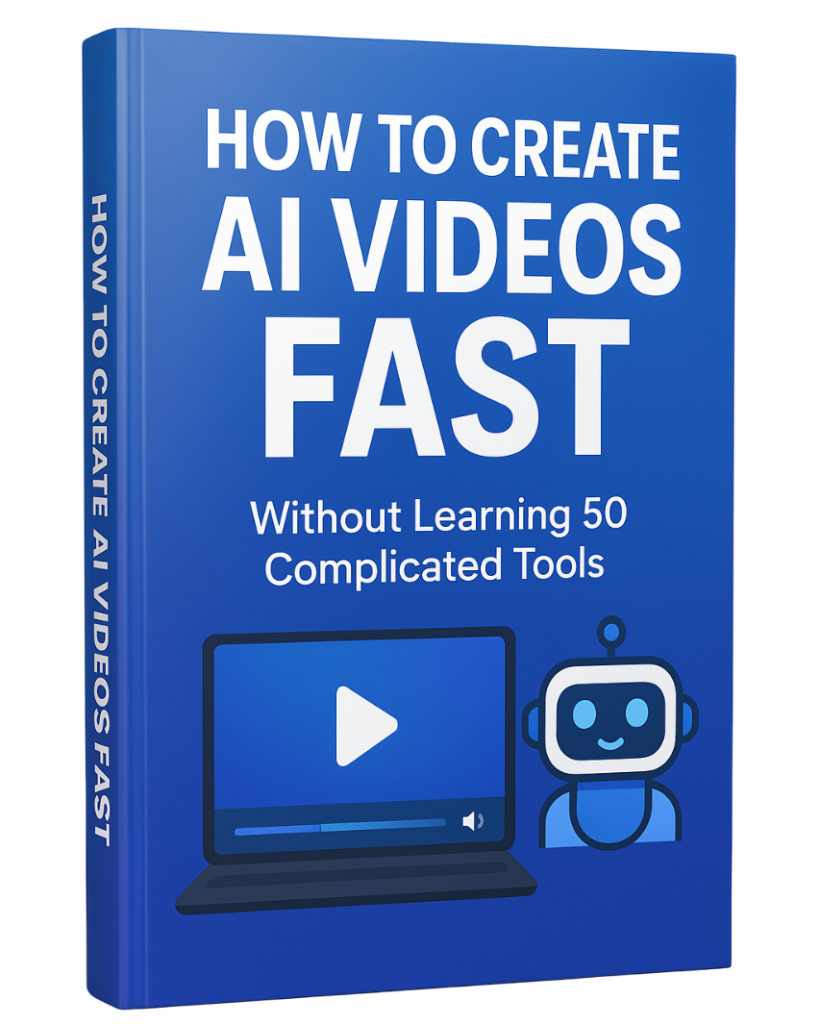
Learn How to Create AI Video Fast an Easy,
If you want a step-by-step guide to create AI videos fast — without learning 50 complicated tools — download the free PDF below and simplify your entire workflow.
Download the free guide:
How to Create AI Videos FAST Without Learning 50 Complicated Tools